
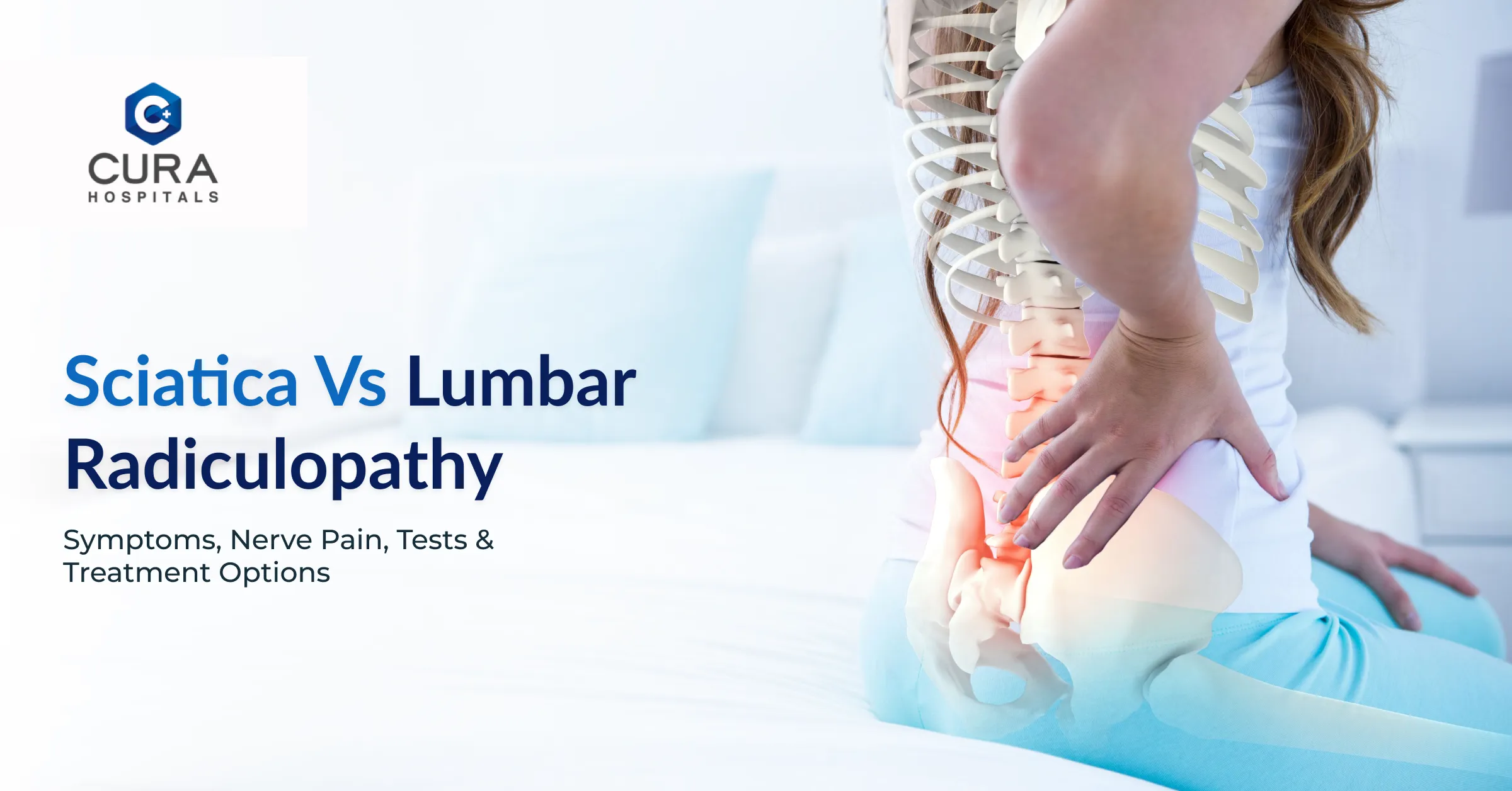
Sciatica vs Lumbar Radiculopathy: Symptoms, Nerve Pain, Tests & Treatment Options
 Cura Hospitals

If you have ever had a sharp, shooting pain travel from your lower back down through your leg, you have probably already heard the word ‘sciatica’ thrown around, maybe by a friend, maybe by Dr Google. But your doctor might use a different term altogether: lumbar radiculopathy. The two terms get used so interchangeably that most people assume they mean exactly the same thing. They are closely related, but understanding the difference can actually help you make sense of your own symptoms and have a more informed conversation with your doctor.
What is Sciatica?
Sciatica refers to pain that travels along the path of the sciatic nerve, the longest and widest nerve in the body. This nerve runs from the lower back, through the buttock, and down the back of each leg. When something irritates or compresses this nerve, typically at its root near the spine, it produces a very specific kind of pain pattern.
Sciatica symptoms classically show up as a burning or shooting pain that starts in the lower back or buttock and travels down one leg, sometimes all the way to the foot. Sciatica pain is usually felt on one side of the body and can range from a mild ache to a pain sharp enough to make sitting or standing genuinely difficult.
It is worth noting that sciatica itself is not a diagnosis in the medical sense. It is a description of a symptom pattern, a set of complaints that point toward irritation of the sciatic nerve, rather than a name for what is actually causing that irritation.
What is Lumbar Radiculopathy?
Lumbar radiculopathy, on the other hand, is the actual medical diagnosis behind that symptom pattern in most cases. It refers to compression, inflammation, or irritation of a nerve root as it exits the lumbar spine, the lower portion of your back made up of five vertebrae.
Lumbar radiculopathy symptoms occur when a structural issue, commonly a herniated or bulging disc, bone spur, or spinal narrowing, presses on one of the nerve roots that eventually joins together to form the sciatic nerve. Depending on which specific nerve root is affected, the pain, numbness, or weakness can show up in slightly different parts of the leg or foot.
In simple terms, lumbar radiculopathy is the underlying mechanism, while sciatica is often the resulting symptom.
Are They the Same?
This is where the sciatica vs lumbar radiculopathy question really comes down to terminology rather than two entirely separate conditions. In most cases, sciatica is a symptom of lumbar radiculopathy. The nerve root irritation in your lower back is the cause, and the radiating leg pain is the effect that gets labelled sciatica.
However, they are not always perfectly interchangeable. Lumbar radiculopathy can sometimes cause symptoms that do not follow the classic sciatic nerve pathway, depending on which nerve root is involved. And technically, pain along the sciatic nerve distribution can occasionally arise from causes outside the spine, such as piriformis muscle irritation, even though this is less common than true radiculopathy.
So while the two terms overlap heavily in everyday use, your doctor’s choice of words usually reflects whether they are describing your symptom pattern (sciatica) or the underlying spinal cause (lumbar radiculopathy).
Symptoms: Pain, Numbness, Tingling, Weakness
Whether your doctor calls it sciatica or lumbar radiculopathy, the symptoms generally fall into a few recognisable categories:
- Back pain radiating to leg: Pain that starts in the lower back and travels down through the buttock and leg, often following a fairly specific path depending on the nerve root involved
- Numbness in thigh, calf, or foot: A loss of normal sensation, sometimes described as a patch of skin that feels different to touch compared to the rest of the leg
- Tingling or a pins-and-needles sensation: Often felt in the leg or foot, particularly after sitting for long periods or first thing in the morning
- Weakness: Difficulty lifting the foot, weakness when trying to stand on your toes, or a feeling that the leg might give way
- Worsening with specific positions: Symptoms that intensify with prolonged sitting, bending forward, coughing, or sneezing, and that may ease somewhat with lying down
The exact combination and severity of these symptoms vary quite a bit from person to person, which is part of why a proper clinical evaluation matters rather than self-diagnosing based on symptoms alone.
Nerve-Compression Signs
A pinched nerve in the lower back tends to leave behind a few telltale clinical signs that doctors look for during an examination:
- Straight leg raise test: Lifting the affected leg while lying flat reproduces the radiating pain
- Reflex changes: A reduced or absent ankle or knee reflex on the affected side
- Muscle strength testing: Checking specific muscle groups, since different nerve roots control different movements. For example, weakness in lifting the big toe upward often points toward irritation of one lumbar nerve root, while weakness in pushing the foot downward may point toward another
- Sensory testing: Lightly touching different parts of the leg and foot to map out areas of numbness, which helps pinpoint which nerve root is involved
Together, these signs help differentiate true nerve compression from other causes of leg pain, like muscle strain or joint issues.
Red Flags Needing Urgent Care
Most cases of sciatica or lumbar radiculopathy are manageable with conservative treatment, but certain symptoms should never be ignored and need prompt medical attention:
- Loss of bladder or bowel control, or new difficulty starting or controlling urination
- Numbness in the groin or inner thighs, sometimes called saddle anaesthesia
- Rapidly worsening leg weakness, especially if it affects both legs
- Severe, unrelenting pain that does not improve with rest or change in position
- Fever along with back pain, which could suggest an infection rather than a mechanical cause
- A history of trauma, such as a fall or accident, followed by new back or leg symptoms
These red flags can point toward a more serious condition called cauda equina syndrome, a rare but urgent complication that requires immediate evaluation and often emergency treatment to prevent lasting nerve damage.
Diagnosis: Exam, X-ray, MRI, Nerve Tests
Diagnosing sciatica or lumbar radiculopathy usually starts with a detailed clinical examination, including the nerve-compression tests described earlier, along with a thorough history of when the pain started, what makes it better or worse, and whether there are any red flag symptoms.
Imaging is often the next step. An X-ray can rule out obvious structural issues like fractures or significant alignment problems, though it does not show soft tissue like discs or nerves directly. An MRI is generally the most useful imaging test for diagnosing lumbar radiculopathy, since it provides detailed images of the discs, nerve roots, and spinal canal, helping pinpoint exactly where compression is occurring.
In some cases, particularly when the diagnosis is unclear or symptoms persist despite treatment, doctors may recommend nerve conduction studies or electromyography (EMG). These tests measure how well electrical signals travel along the nerves and can help confirm nerve root involvement, especially when distinguishing it from other causes of leg pain.
Treatment Options
Treatment for sciatica and lumbar radiculopathy typically follows a step-up approach, starting conservative and escalating only if needed:
- Rest and activity modification: Avoiding positions and activities that worsen symptoms, while staying as active as comfortably possible, since complete bed rest is generally not recommended
- Physiotherapy: Targeted exercises to strengthen core and back muscles, improve flexibility, and take pressure off the affected nerve root
- Medications: Anti-inflammatory medications, muscle relaxants, or nerve pain medications, depending on the specific symptoms and severity
- Epidural steroid injections: For more persistent pain, a targeted injection near the affected nerve root can help reduce inflammation and provide relief
- Surgery: Reserved for cases with significant nerve compression, progressive weakness, or red flag symptoms, or when conservative treatment has not provided adequate relief over a reasonable period
The right treatment path depends heavily on the severity of symptoms, how long they have been present, and what is found on examination and imaging, which is why a personalised evaluation matters more than following a generic recovery plan.
Consult Cura’s Team of Experts
You do not need to wait until the pain becomes unbearable before seeking specialist care. Reach out to Cura’s spine and orthopaedics team if:
- Your back pain has been radiating down one or both legs for more than a week or two
- You are experiencing numbness, tingling, or weakness along with your back pain
- Over-the-counter pain relief and rest are not providing meaningful improvement
- You notice any of the red flag symptoms described above, in which case you should seek immediate care
- You have had recurrent episodes of similar pain in the past and want a thorough evaluation to understand the underlying cause
At Cura Multispeciality Hospitals, our spine and orthopaedic specialists combine clinical expertise with advanced imaging and diagnostic capabilities to accurately identify the cause of your nerve pain and guide you through the most appropriate, least invasive treatment path possible.
Media Center Health Concerns?
Our specialists at Cura Hospitals are here to help with screening, diagnosis, risk assessment, and personalized treatment plans tailored to your health needs.
Schedule A ConsultationFrequently Asked Questions
Lumbar radiculopathy is the underlying medical condition, where a nerve root in the lower spine is compressed or irritated. Sciatica is the symptom that often results from it, the radiating pain that travels down the leg along the sciatic nerve. In short, lumbar radiculopathy is usually the cause, and sciatica is usually the effect.
Treatment usually starts conservatively with rest, activity modification, and physiotherapy, along with anti-inflammatory or nerve pain medications if needed. If symptoms persist, epidural steroid injections may help reduce inflammation around the affected nerve root. Surgery is generally reserved for cases with significant nerve compression, progressive weakness, or red flag symptoms that don’t respond to conservative care.
Early signs often include a dull ache or sharp pain in the lower back that starts radiating into the buttock and leg, sometimes along with mild tingling or a pins-and-needles sensation. These symptoms often worsen with sitting, bending forward, coughing, or sneezing.
Many cases improve within four to six weeks with conservative treatment like physiotherapy and activity changes. Some cases take a few months to fully resolve, but for persistent symptoms beyond this period, they usually need further evaluation to rule out more significant nerve compression.
Is sciatica 100% curable?
Most cases of sciatica respond well to conservative treatment and resolve fully or significantly improve over time. However, outcomes depend on the underlying cause, severity of nerve compression, and how early treatment begins, so a small number of cases with significant structural issues may need more targeted intervention, including surgery, for lasting relief.
Related Blogs
Kidney Stone Size Guide: Can It Pass Naturally, or Does It Need RIRS, URS, or PCNL?

Leg Pain, Swelling or a Non-Healing Wound: Vascular Surgeon, Orthopaedic Doctor or Diabetologist?