Fatty Liver Grades Explained – Grade 1, Grade 2 & Grade 3 Fatty Liver


Key Takeaways
Fatty liver grades (1, 2 and 3) describe how much fat shows on an ultrasound: mild, moderate and severe.
Grade is not the same as stage. Stages describe scarring, and scarring is the stronger predictor of liver-related risk (Dulai et al., 2017).
Grade 1 fatty liver is the mildest and is very common. It can often improve with lifestyle changes, but it is still a signal to look at weight, blood sugar and cholesterol.
Grade 3 fatty liver means a lot of fat, but that alone does not mean cirrhosis. Doctors check for scarring with a FIB-4 score and a FibroScan.
Fatty liver stages run from fat alone, to inflammation (MASH), to scarring, to cirrhosis.
Ultrasound grading is a judgment made by the person reading the scan, so the same liver can be graded slightly differently by different readers.
If your report says “grade 1 fatty liver” or “grade 3 fatty liver disease”, you may wonder how serious that is. The word grade sounds like the grading of a cancer, but here it means something much simpler: how much fat the ultrasound can see in your liver. It does not tell you how much damage there is.
This guide explains what each grade means, how grades differ from stages, how doctors check for scarring and what you can do next.
Questions about an ultrasound or FibroScan report?
What Are Fatty Liver Grades?
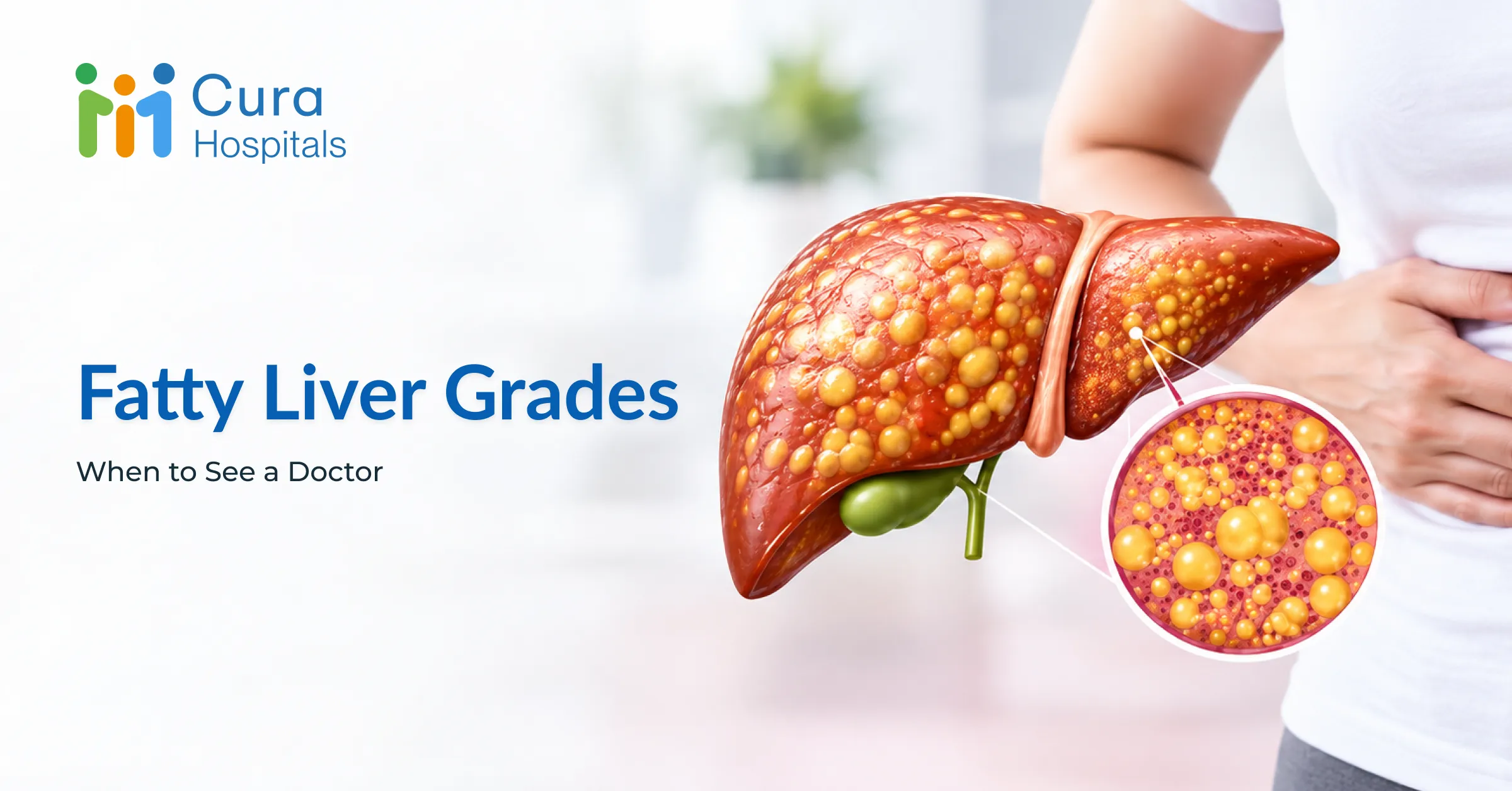
Fatty liver grades come from the ultrasound report. Fat makes the liver look brighter on the scan and makes it harder for the sound waves to pass through. The radiologist compares the liver with the kidney, checks how clearly the blood vessel walls and the diaphragm can be seen and then calls the fat mild, moderate or severe. These are written as grade 1, grade 2 and grade 3.
Fatty Liver Grades on Ultrasound
| Grade | Name | What the ultrasound shows | Plain meaning |
| Grade 1 | Mild | The liver is slightly brighter than the kidney. Blood vessel walls and the diaphragm are still clear. | A small to moderate amount of fat |
| Grade 2 | Moderate | The liver is brighter. Vessel walls are less clear and the diaphragm is only partly seen. | More fat |
| Grade 3 | Severe | The liver is very bright. Vessel walls and the diaphragm cannot be seen, and deeper parts of the liver are hard to see. | A large amount of fat |
These descriptions follow the commonly used ultrasound criteria (Ferraioli and Monteiro, 2019). Studies show that more severe ultrasound findings go with more features of metabolic syndrome and more belly fat (Hamaguchi et al., 2007), so a higher grade is a useful sign that the body is struggling with sugar and fat.
What Grade 1 Fatty Liver Means
Grade 1 fatty liver is the mildest grade and the most common one on routine scans. Most people with it have no symptoms. For many, it can improve with lifestyle changes. Grade 1 fatty liver is still worth acting on, because it is a sign that weight, blood sugar, cholesterol or blood pressure may need attention, and because a small number of people with mild fat already have some scarring.
- Ask your doctor about a blood sugar test, a lipid profile and liver enzymes.
- Ask whether an FIB-4 score is needed to check the risk of scarring.
- Start with food, activity and weight, even if you have no fatty liver symptoms.
- Repeat the ultrasound when your doctor advises, usually after some months to a year.
What Grade 2 Fatty Liver Means
Grade 2 means a moderate amount of fat. The approach is similar to grade 1, with a bit more urgency. The doctor will usually look more closely at blood sugar, cholesterol, triglycerides and blood pressure, check the scarring risk and talk about a clear weight and activity target. Grade 2 can improve with the same steps as grade 1.
What Grade 3 Fatty Liver Means
Grade 3 is severe fatty change, which means a large amount of fat. It does not mean cirrhosis, and it does not mean the liver is failing. Many people with grade 3 fatty liver have no scarring at all. But a large amount of fat often goes with diabetes, high triglycerides and a large waist, so doctors take it seriously.
- A FIB-4 score and usually a FibroScan are used to check for scarring.
- A gastroenterologist or hepatologist may follow you, especially if the scarring risk is raised.
- Blood sugar, blood pressure and cholesterol need good control, because heart disease is a major risk in fatty liver (Rinella et al., 2023b).
- Weight loss and food changes still help, even at this grade.
Fatty Liver Stages
While grade describes fat, stage describes what the fat has done to the liver. The stages of fatty liver usually run in this order, though many people stay at the first one for life.
| Stage | What happens | Can it improve? |
| Fat only (steatosis, MASL) | Fat builds up without much inflammation | Often, with weight loss and lifestyle change |
| Inflammation (steatohepatitis, MASH) | Fat is joined by inflammation and injury to liver cells | It can improve with weight loss and good control of other conditions |
| Fibrosis (scarring, F1 to F3) | Scar tissue slowly builds up in the liver | It can sometimes improve, and progress can often be slowed |
| Cirrhosis (F4) | The liver is badly scarred and stiff | Advanced scarring is unlikely to reverse fully, but monitoring and treatment can reduce the risk of complications |
The terms MASL and MASH come from the 2023 consensus on new fatty liver names (Rinella et al., 2023a). Scarring matters most. In a large analysis, the risk of death from liver disease rose steeply with each stage of fibrosis (Dulai et al., 2017). In a year-long lifestyle programme for people with liver inflammation, about one in five saw their scarring regress, and greater weight loss gave better results (Vilar-Gomez et al., 2015).
Why Grade and Stage Are Not the Same
A person can have grade 3 fat and no scarring, and another person can have grade 1 fat and some scarring. Ultrasound shows fat well but cannot reliably show early scarring, which is why doctors use extra tests for that. In short, grade tells you how much fat there is, and stage tells you how much harm it has done.
| Doctor’s Insight “Patients often fix on the grade written in the report. The grade tells us about fat. What we really want to know is whether there is scarring, and that needs a separate check. Even in a higher grade, a clear plan on food, activity and sugar control makes a real difference.” DR. ABRAR MOHAMMED M.B.B.S, M.S, Orthopaedics Registered Medical Practitioner | KMC Registration No: 116389 |
How Doctors Check for Scarring
- FIB-4 score. A simple calculation from age, AST, ALT and platelet count. Guidance recommends it as the first step for people with fatty liver (Rinella et al., 2023b).
- FibroScan (liver stiffness measurement). A painless scan that measures how stiff the liver is. Stiffer livers have more scarring.
- Blood tests such as the ELF test, in some centres.
- MRI or a liver biopsy may be needed when the other results are unclear or the risk is high.
Can Fatty Liver Grades Improve?
Yes, they often can. Weight loss of about 7 to 10%, a Mediterranean-style diet, regular activity and avoiding alcohol are the core steps (Tacke et al., 2024). In some people the ultrasound goes back to normal. In others, the grade drops, for example from grade 3 to grade 2, or the liver simply holds less fat. Results differ from person to person, and no one can promise a particular outcome.
What to Do Next if Your Report Shows Fatty Liver
- Do not panic. Fatty liver is common, and the grade alone does not tell you how much harm there is.
- Ask for tests of blood sugar, cholesterol and triglycerides, and liver enzymes.
- Ask about a FIB-4 score and, if needed, a FibroScan.
- Begin with a fatty liver diet and activity.
- Avoid alcohol, or discuss it with your doctor.
- See a doctor. A general physician is a good first step, and a gastroenterologist if the scarring risk is raised.
Fatty Liver Care at Cura Hospitals
The gastroenterology department at Cura Hospitals provides liver disease management, including fatty liver disease, with regular monitoring and personalised care plans. The hospitals are in Kammanahalli and on Kanakapura Road, Bengaluru.
For appointments or general enquiries, reach out to the hospital.
Contact details
Cura Hospitals, Kammanahalli: #1, Bethel St, HRBR Layout 2nd Block, Kalyan Nagar, Kammanahalli, Bengaluru, Karnataka 560043
Cura Hospitals, Kanakapura Road: No.18, Kanakapura Rd, Venkatareddy Layout, Doddakallasandra, Uttarahalli Hobli, Bengaluru, Karnataka 560062
Phone: +91 87480 30303 | Email: info@curahospitals.com | 24/7 emergency: +91 84312 41403
This article is for general health education and is not a substitute for personal medical advice. Please speak to your treating doctor about your own report and treatment plan.
References
Dulai, P.S., Singh, S., Patel, J., Soni, M., Prokop, L.J., Younossi, Z., Sebastiani, G., Ekstedt, M., Hagstrom, H., Nasr, P., Stal, P., Wong, V.W.S., Kechagias, S., Hultcrantz, R. and Loomba, R. (2017) ‘Increased risk of mortality by fibrosis stage in nonalcoholic fatty liver disease: systematic review and meta-analysis’, Hepatology, 65(5), pp. 1557-1565.
Ferraioli, G. and Monteiro, L.B.S. (2019) ‘Ultrasound-based techniques for the diagnosis of liver steatosis’, World Journal of Gastroenterology, 25(40), pp. 6053-6062.
Hamaguchi, M., Kojima, T., Itoh, Y. et al. (2007) ‘The severity of ultrasonographic findings in nonalcoholic fatty liver disease reflects the metabolic syndrome and visceral fat accumulation’, American Journal of Gastroenterology, 102(12), pp. 2708-2715. doi:10.1111/j.1572-0241.2007.01526.x.
Rinella, M.E., Lazarus, J.V., Ratziu, V. et al. (2023a) ‘A multisociety Delphi consensus statement on new fatty liver disease nomenclature’, Hepatology, 78(6), pp. 1966-1986.
Rinella, M.E., Neuschwander-Tetri, B.A., Siddiqui, M.S. et al. (2023b) ‘AASLD practice guidance on the clinical assessment and management of nonalcoholic fatty liver disease’, Hepatology, 77(5), pp. 1797-1835.
Tacke, F., Horn, P., Wai-Sun Wong, V. et al. (2024) ‘EASL-EASD-EASO clinical practice guidelines on the management of metabolic dysfunction-associated steatotic liver disease (MASLD)’, Journal of Hepatology, 81(3), pp. 492-542. doi:10.1016/j.jhep.2024.04.031.
Vilar-Gomez, E., Martinez-Perez, Y., Calzadilla-Bertot, L. et al. (2015) ‘Weight loss through lifestyle modification significantly reduces features of nonalcoholic steatohepatitis’, Gastroenterology, 149(2), pp. 367-378.
Media Center Health Concerns?
Our specialists at Cura Hospitals are here to help with screening, diagnosis, risk assessment, and personalized treatment plans tailored to your health needs.
Schedule A ConsultationFrequently Asked Questions
Grade 1 fatty liver is mild fat in the liver, seen as a slightly bright liver on ultrasound. It usually causes no symptoms and is very common.
Usually it is not dangerous by itself, and it can often improve with lifestyle changes. It is still worth acting on, because it points to weight, sugar or cholesterol problems, and a few people with it have some scarring. Your doctor can check this with a FIB-4 score.
In many people it can improve or clear with weight loss, a better diet, regular activity and avoiding alcohol. Results vary, and your doctor will advise on follow-up scans.
Grade 3 is severe fatty change, meaning a large amount of fat in the liver. It does not mean cirrhosis. Doctors check for scarring with a FIB-4 score and a FibroScan.
It can. Weight loss, food changes, exercise, avoiding alcohol and good control of diabetes, cholesterol and blood pressure all help. Some people see their grade fall on a later scan, though results differ.
The stages run from fat alone, to inflammation (MASH), to scarring (fibrosis) and then cirrhosis. Many people stay at the first stage for life.
Not usually for the liver itself. The main steps are lifestyle changes and treating conditions such as diabetes, high cholesterol or high blood pressure. Medicines for the liver are used in selected people with inflammation and scarring, as decided by a liver specialist.