Piles, Fissure or Fistula? How to Tell the Difference and Choose the Right Treatment
 Cura Hospitals

At a Glance: Piles, anal fissure, and anal fistula can all cause pain, bleeding, or discomfort near the anus, but they’re different conditions with different treatments.
Piles: swollen blood vessels, usually painless bleeding and a lump, and often respond to fibre, fluids, and topical care
Anal fissure: a small tear causing sharp pain during and after passing stool that often heals with stool softeners and sitz baths
Anal fistula: an abnormal tract, usually after an abscess, causing ongoing discharge that needs surgery to close
Red flags: heavy or dark bleeding, fever, spreading redness, a growing hard lump, or unintentional weight loss
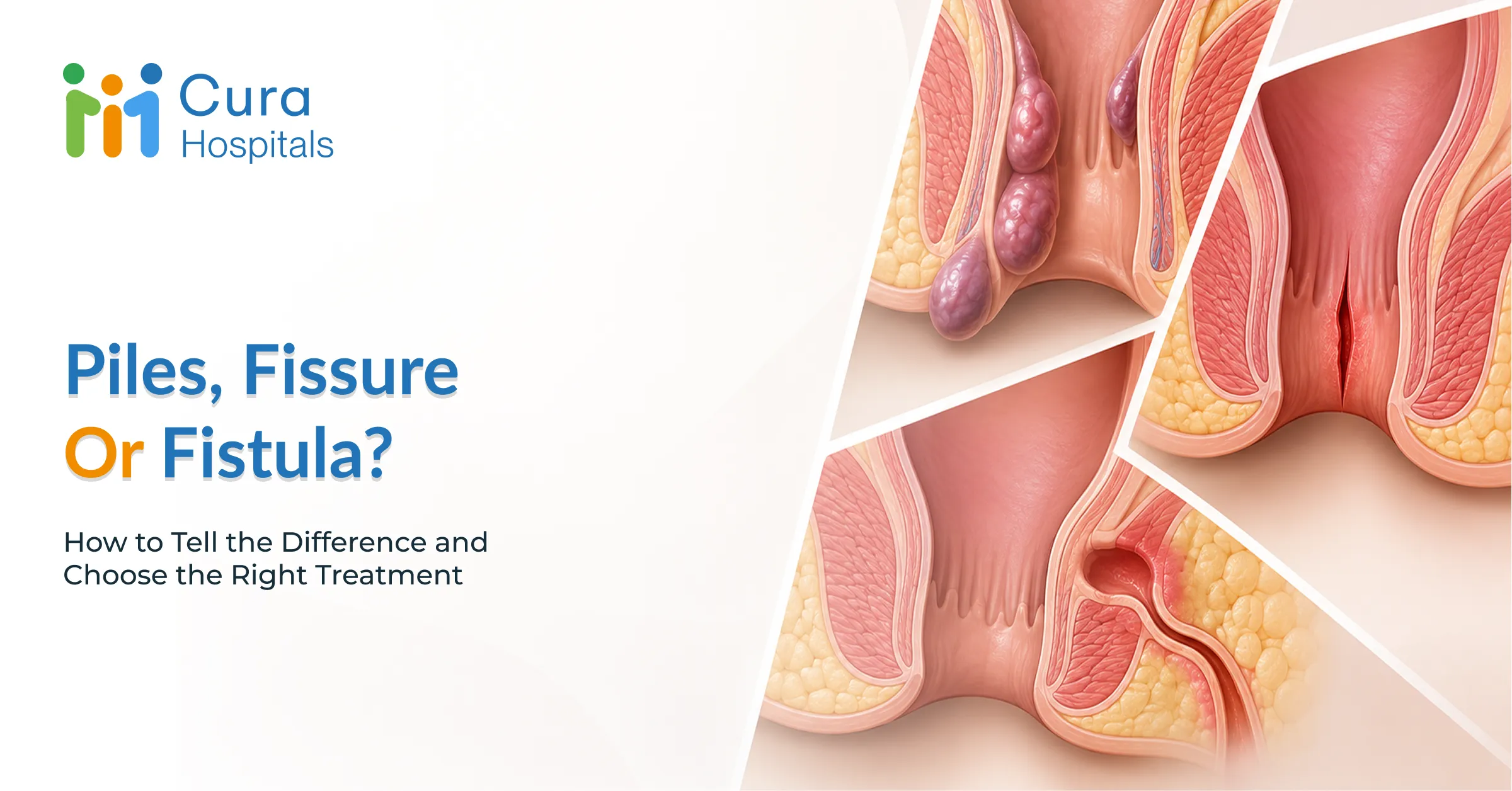
Piles, anal fissure, and anal fistula are three different conditions that may all cause pain, bleeding, or discomfort around the anus, but they are not the same problem and they are not treated the same way. Piles are swollen blood vessels, a fissure is a small tear in the lining, and a fistula is an abnormal pathway that usually forms after an infection. Understanding the difference is extremely important since all three conditions have different treatment approaches.
These are some of the most common conditions a general surgeon sees, and there is nothing unusual about needing help with them. This article walks through how piles, fissures, and fistulas typically feel, which symptoms need urgent attention, and what treatment usually looks like once you have a clear diagnosis.
Difference Between Piles, Anal Fissure and Anal Fistula
Piles, anal fissures and anal fistulas can cause similar symptoms, but their typical patterns of pain, bleeding, swelling and discharge often differ. A clinical examination can help determine which condition is causing your symptoms.
| Feature | Piles (Haemorrhoids) | Anal Fissure | Anal Fistula |
| Pain pattern | Often mild, or a dull ache with a lump | Sharp, tearing pain during and after passing stool | Persistent, throbbing ache, sometimes worse when sitting |
| Bleeding | Bright red blood, usually painless | Bright red blood, usually with sharp pain | Uncommon, but discharge may be blood tinged |
| Discharge | Mucus in some cases | Rare | Pus or foul smelling fluid, often staining underwear |
| Lump or swelling | Common, may be felt or seen at the anus | Uncommon | Small opening or swelling near the anus |
| Itching | Common | Occasional | Common, from ongoing discharge |
| Usual cause | Straining, prolonged sitting, pregnancy, constipation | Passing hard stools, chronic constipation | A previous anal abscess that did not fully heal |
If your symptoms do not fit neatly into one category, that is not unusual. These conditions can have overlapping symptoms, and a clinical examination is the most reliable way to determine the cause.
What are Piles?
Piles are swollen veins in or around the anus, and they typically cause painless bleeding, itching, and a sense of fullness or a lump, rather than sharp pain with every bowel movement. Bleeding is usually bright red and shows up on toilet paper or in the toilet bowl.
Internal piles sit higher up and often cause little pain since that area has fewer pain-sensing nerves, though a piece may prolapse, meaning it pushes out during a bowel movement and sometimes needs to be gently pushed back in.
Watch: Dr. Adithi explains piles (haemorrhoids), symptoms, stages and treatment options.
External piles sit lower, near the anal opening, and can become genuinely painful if a clot forms inside them, a condition called a thrombosed haemorrhoid, which usually causes sudden, firm swelling. Piles remain one of the most common reasons people search for anorectal treatment, and a large share of cases respond well to simple, non-surgical care once properly diagnosed.
What is Anal Fissure?
An anal fissure is a small tear in the lining of the anal canal, and it typically causes sharp, tearing pain during a bowel movement that can linger for minutes or hours afterward, often described as passing glass. This pain pattern is one of the features that separates a fissure from piles.
Fissures are usually caused by passing hard or large stools, and they are common after childbirth or during periods of chronic constipation.
A telltale sign is a small skin tag near the tear, sometimes called a sentinel tag, along with visible spasm of the surrounding muscle. Bleeding does happen, but it is usually a smaller amount than with piles, often just a few streaks on the stool.
Fissures are, in fact, one of the more common causes of anal pain overall, even more so than piles in some clinical settings, largely because the pain is sharp enough that people notice it right away (Villalba et al., 2007).
What is Anal Fistula?
An anal fistula is an abnormal pathway that forms between the inside of the anal canal and the skin near the anus, and it typically causes persistent discharge, recurrent swelling, and a dull ongoing pain rather than the sharp pain of a fissure. Many fistulas develop after an anal abscess has drained, either on its own or through a procedure, leaving behind a small connecting tract that does not close by itself.
The most recognisable sign is a small opening near the anus that leaks pus, blood-tinged fluid, or a foul-smelling discharge, sometimes staining underwear throughout the day. Some people also notice the area becoming swollen and painful again periodically, as the tract flares up before draining once more. Unlike piles or a simple fissure, a fistula essentially never heals on its own once fully formed, and clinical guidelines consistently point to surgery as the main path to lasting treatment (Lu et al., 2025).
Red Flags
Certain symptoms call for a same-day or urgent medical review. Anal symptoms can occasionally point to something more serious than piles, a fissure, or a fistula.
See a doctor promptly if you notice:
- Bleeding that is heavy, dark, or mixed into the stool rather than sitting on the surface of it
- A change in bowel habit that lasts more than a few weeks, alongside anal symptoms
- Fever, chills, or spreading redness around the anus, which can signal a developing abscess
- A lump that keeps growing, feels hard, or does not improve after a couple of weeks of home care
- Unintentional weight loss alongside any of the symptoms above
None of these automatically mean something serious. But self-treating through them, rather than getting examined, is where people sometimes lose time they did not need to lose.
If you have persistent bleeding, anal pain, swelling, fever, or changes in bowel habits, seek a timely medical evaluation to identify the cause and start appropriate treatment.
Examination and Tests
Diagnosing piles, a fissure, or a fistula usually starts with a visual examination and a gentle digital rectal exam, and this alone is often enough for a surgeon to tell the three apart. Further tests are only added when the picture is unclear or when surgery is being planned.
For straightforward cases, a look at the area combined with a brief, gentle internal exam usually confirms the diagnosis. If a fistula is suspected, imaging such as an MRI may be used beforehand to map the exact path of the tract, since fistulas can branch in ways that are not obvious from the outside, and getting this mapping right meaningfully affects how the surgery is planned (Lu et al., 2025). You can learn more about diagnostics and imaging available for medical evaluation.
An anoscopy, a short, well tolerated procedure using a small scope, may also be used to view piles or a fissure more closely when needed. All of these examinations are quick and our general surgery team will explain each step before doing it.
Conservative and Surgical Options
Treatment for piles and fissures usually starts with simple, non-surgical measures, while a true fistula almost always needs a surgical procedure to close the tract permanently. The right option depends heavily on which of the three conditions you actually have, and how advanced it is.
Piles Treatment
- Dietary fibre
- Adequate fluids
- Topical treatments
- Simple lifestyle changes
- Rubber band ligation for larger or recurring piles
- Surgery for more advanced cases
Anal Fissure Treatment
- Stool softeners
- Warm sitz baths
- Topical medication to relax the sphincter muscle
- Minor surgical procedure for chronic, non-healing fissures
Anal Fistula Treatment
- Fistulotomy for straightforward fistula tracts
- Sphincter-preserving techniques for complex fistulas
- Surgical treatment selected to protect bowel control while closing the fistula tract permanently
It is also worth knowing that living with ongoing anal pain or discharge is not as easy as it seems to be. Research following thousands of patients with fissures and fistulas found meaningfully higher rates of depression in this group compared to people without these conditions, which is one more reason getting a proper diagnosis and starting treatment sooner tends to help on more than one front (Krieg et al., 2024).
Book a Consultation
The only way to know whether you are dealing with piles, a fissure, or a fistula, or some combination of the three, is a proper examination by a general surgeon. Guessing from symptoms alone, or from a table like the one above, can only take you so far.
Cura’s general surgery team, including Dr. Vinayaka N S, sees these conditions regularly and treats every consultation with the discretion it deserves.
“A lot of patients wait far longer than they need to before coming in, simply because these conditions feel embarrassing to talk about. But piles, fissures, and fistulas are some of the most common things we see in general surgery. There’s nothing unusual about needing help, and getting a proper diagnosis early almost always makes treatment simpler.”
— Dr. Vinayaka N S, General Surgery,
Cura Hospitals
If you are looking for an experienced general surgeon in Bangalore for persistent anal pain, bleeding, or discharge, our team, based at an accredited surgical facility, can confirm your diagnosis and walk you through the most appropriate treatment path.
Book a confidential General Surgery consultation for persistent pain, bleeding, swelling or discharge, contact us to schedule a review.
If you have ongoing anal pain, bleeding, swelling, or discharge, consult a general surgeon for an accurate diagnosis and the right treatment approach.
References
Gardner, I.H., Siddharthan, R.V. and Tsikitis, V.L. (2020) ‘Benign anorectal disease: hemorrhoids, fissures, and fistulas‘, Annals of Gastroenterology, 33(1), pp. 9–18.
Krieg, A. et al. (2024) ‘Depression in patients with anorectal fistulas and anal fissures: a propensity score-matched cohort study‘, Quality of Life Research.
Lu, M.Y. et al. (2025) ‘Diagnosis and treatment for anal fistula: a systematic review of clinical practice guidelines and consensus statements‘, Frontiers in Surgery.
Villalba, H., Villalba, S. and Abbas, M.A. (2007) ‘Anal fissure: a common cause of anal pain’, The Permanente Journal, 11(4), pp. 62–65.
Uncategorized Health Concerns?
Our specialists at Cura Hospitals are here to help with screening, diagnosis, risk assessment, and personalized treatment plans tailored to your health needs.
Schedule A ConsultationFrequently Asked Questions
Piles usually cause painless bleeding and a lump, a fissure causes sharp pain during and after passing stool, and a fistula causes ongoing discharge and recurring swelling near the anus. Symptoms can overlap, so a clinical examination remains the most reliable way to know for sure.
Yes, most acute fissures heal within a few weeks with stool softeners, warm sitz baths, and topical medication. Chronic fissures that do not heal with these measures may need a minor surgical procedure to relax the sphincter muscle.
Almost always, yes. A fistula is a tunnel that has already formed, and it very rarely closes on its own. Treatment ranges from a straightforward procedure for simple tracts to more specialised, sphincter-preserving surgery for complex ones.
Piles treatment often starts with fibre, fluids, and topical care, moving to office-based procedures or surgery only if needed. Fistula treatment is almost always surgical from the start, since the underlying tunnel needs to be closed rather than simply managed.
If symptoms last more than two to three weeks despite home care, or if you notice heavy bleeding, fever, a rapidly growing lump, or persistent discharge, it is time for a proper examination rather than continued self-treatment.