Ovarian Cyst Treatment: Monitoring or Laparoscopic Surgery?
 Cura Hospitals

At a Glance: Most ovarian cysts are harmless, hormone-related, and go away on their own within a few months. Whether a cyst needs monitoring or treatment depends on its size, ultrasound appearance, and symptoms.
Functional cysts: linked to the normal menstrual cycle; usually resolve on their own within a couple of cycles
Complex cysts: have features like solid areas or irregular walls on ultrasound; need closer evaluation, not automatic surgery
Monitoring: appropriate for small, simple, symptom-free cysts, with a scheduled follow-up scan
Emergency signs: sudden severe one-sided pain, especially with nausea, vomiting, or fainting.
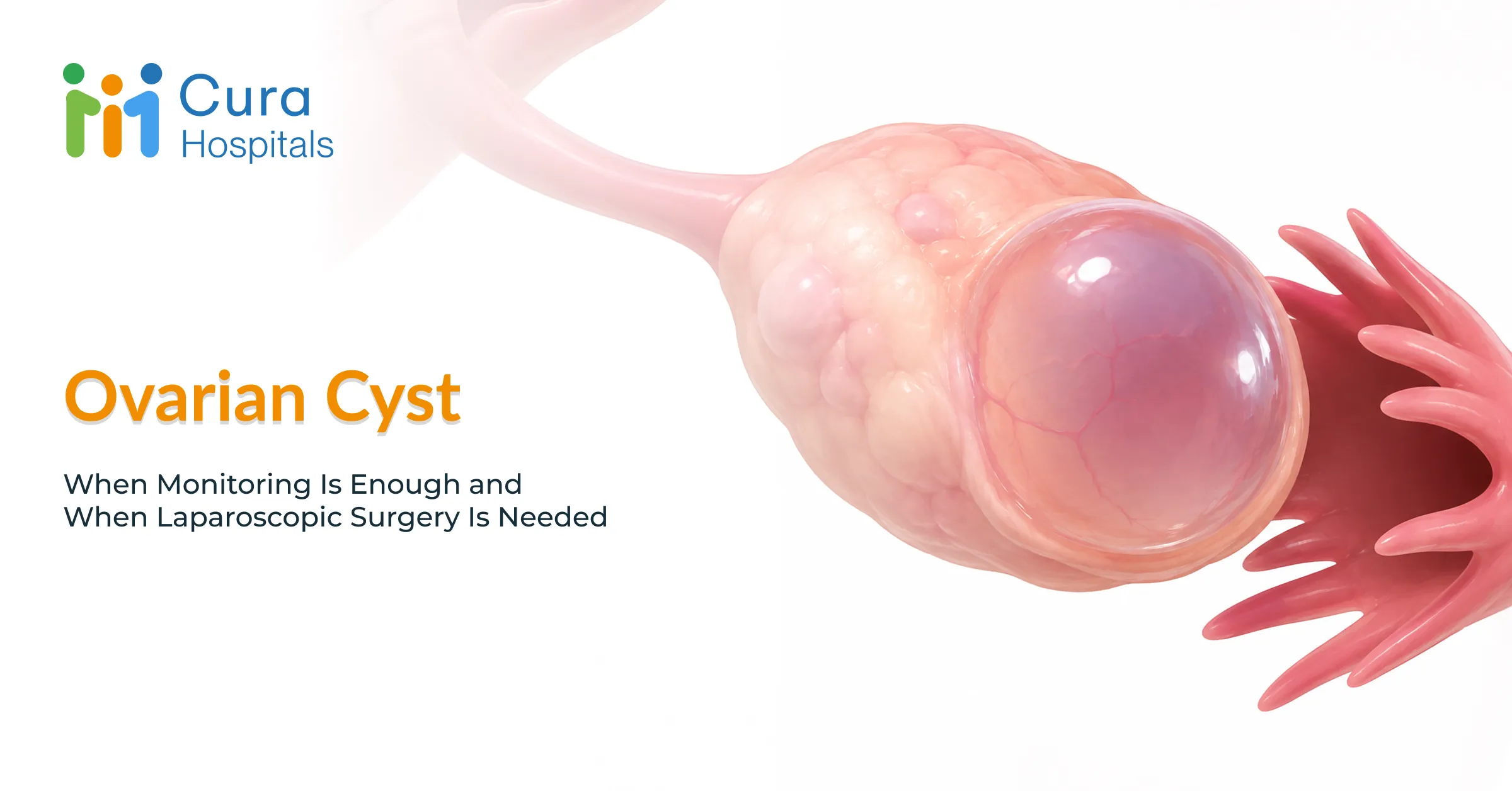
An ovarian cyst is a fluid-filled sac that forms on or inside an ovary, and most are harmless, hormone-related, and go away on their own within a few months. Ovarian cysts are extremely common, and many women develop one at some point without ever knowing it, since most cause no symptoms and are found only incidentally, during a scan done for another reason.
Whether a particular cyst needs simple monitoring or active ovarian cyst treatment depends mainly on three factors: its size, its appearance on ultrasound, and the symptoms it is causing. This guide covers what an ovarian cyst is, the difference between a functional and a complex cyst, when monitoring is typically recommended, when surgery is considered, and the warning signs that call for immediate medical attention.
What Is an Ovarian Cyst?
An ovarian cyst is simply a closed sac of fluid that develops within or on the surface of an ovary, and the vast majority form as a normal part of the monthly ovulation cycle rather than as a sign of disease. Most cause no symptoms at all and are picked up incidentally on a routine pelvic ultrasound done for an entirely different reason.
The ovaries release an egg from a small fluid-filled structure called a follicle every month, and if that follicle doesn’t release its egg properly or doesn’t dissolve after ovulation the way it’s meant to, it can keep filling with fluid and turn into a cyst.
This is why cysts are so common during the reproductive years. Women dealing with related hormonal conditions such as polycystic ovary syndrome (PCOS) tend to develop multiple small cysts as part of that underlying condition, which is managed a little differently from a single, isolated cyst.
Functional Versus Complex Cysts
Ovarian cysts are commonly classified as functional or complex cysts based on how they appear on an ultrasound and how they develop. Functional cysts are usually related to the normal menstrual cycle and often disappear on their own, while complex cysts may contain solid areas, internal divisions, or irregular walls that require closer medical evaluation.
The type and appearance of the cyst are important when deciding whether it needs monitoring or treatment. The assessment is usually made by the radiologist along with your gynaecologist, rather than based on the cyst’s size alone.
| Type | What It Means | Common Examples / Features |
| Functional cysts | Usually harmless cysts caused by normal hormonal changes during the menstrual cycle. Most resolve on their own within a couple of menstrual cycles. | Follicular cyst: Forms when a follicle does not rupture to release an egg. Corpus luteum cyst: Forms after ovulation when the follicle closes and fills with fluid. These are generally simple, thin-walled, fluid-filled cysts and are common in premenopausal women. |
| Complex cysts | Cysts with features on ultrasound that need closer evaluation, such as solid areas, internal septations, or irregular walls. | Dermoid cyst: Also called a mature cystic teratoma and may contain tissue such as hair, skin, or fat. Cystadenoma: Develops from the outer surface of the ovary. Endometrioma: Also known as a “chocolate cyst” and associated with endometriosis. Some complex cysts may also have features that require urgent gynaecological review. |
Not every complex ovarian cyst is cancerous, but a complex cyst should be properly evaluated before deciding whether it needs observation or removal. Your gynaecologist can assess the ultrasound findings along with your age, symptoms, medical history, and other relevant factors to recommend the appropriate next step.
If you have been diagnosed with a complex ovarian cyst, get a specialist evaluation to understand whether monitoring or treatment is right for you.
Symptoms and Ultrasound Features
Ovarian cyst symptoms can range from no symptoms at all to pelvic pain, bloating, pressure, or changes in the menstrual cycle. Ultrasound helps doctors assess the cyst’s size, structure, fluid content, internal walls, solid areas, and blood flow to understand whether it is more likely to need monitoring or further treatment.
Common Symptoms of Ovarian Cysts
Many ovarian cysts are found incidentally during an ultrasound done for another reason. When symptoms are present, they may include:
- Pelvic pain or a dull ache, particularly on one side
- Bloating or abdominal discomfort
- A feeling of pressure or fullness in the lower abdomen
- Irregular or changed menstrual periods
- Pain during sexual intercourse
- Discomfort or pain with sudden movements, particularly when the cyst is larger
What Doctors Look for on Ultrasound
During an ultrasound, the doctor may assess:
- Cyst size: Larger cysts may be more likely to cause pressure or discomfort.
- Internal structure: A cyst may be unilocular, meaning it has one fluid-filled space, or it may have internal walls or divisions.
- Fluid appearance: A simple cyst usually appears fluid filled with a thin, smooth wall.
- Solid components: The presence of solid areas may require closer evaluation.
- Blood flow: Doppler ultrasound can help assess blood flow within or around the cyst.
A simple, unilocular, fluid-filled cyst with a thin, smooth wall and no internal blood flow on Doppler is generally a more reassuring ultrasound appearance. Depending on the patient’s age, symptoms, and other findings, this may support monitoring rather than immediate surgery.
Cysts that are larger, cause pressure on the bladder or bowel, or produce significant pain may require a more detailed discussion with a gynaecologist about active treatment.
When Monitoring May Be Recommended
Monitoring, also called watchful waiting, is often recommended for small, simple ovarian cysts that do not cause symptoms, particularly in women of reproductive age. Instead of removing the cyst immediately, the doctor plans a follow-up pelvic ultrasound after a specific period to check whether it has changed, reduced in size, or disappeared.
A review of published evidence in postmenopausal women found that most simple ovarian cysts either become smaller or remain unchanged over time. The likelihood of these simple cysts being cancerous was also found to be extremely low, around one in ten thousand (Liu et al., 2023).
Research on unilocular cysts smaller than 10 centimetres reported similarly low rates of malignancy (Modesitt et al., 2003).
In practice, monitoring may involve a repeat ultrasound within several weeks to a few months. In some cases, a CA 125 blood test may also be recommended when the doctor considers additional evaluation appropriate.
Monitoring May Be Considered When:
- The cyst is small in size
- It has simple ultrasound features
- There are no solid or irregular areas
- The cyst is not causing significant pain or other symptoms
- There are no personal or strong family history factors that increase the baseline risk of ovarian cancer
Monitoring does not mean ignoring the cyst. It is a planned medical follow-up, with the timing and type of repeat testing decided by your gynaecologist based on your age, symptoms, ultrasound findings, and overall risk.
‘Many women feel anxious the moment they hear the word “cyst”, and understandably so. But most ovarian cysts, especially the simple, fluid-filled ones, settle on their own within a cycle or two. When we recommend monitoring, it’s because the ultrasound findings genuinely support waiting.”
— Dr. Divya Chandrashekar, Gynaecology and Obstetrics,
Cura Hospitals
When Is Ovarian Cyst Surgery Recommended?
Ovarian cyst surgery may be considered when a cyst is large, continues to grow, does not resolve with monitoring, causes ongoing or worsening pain, or has complex features that cannot be confidently considered benign. Age is also important, as an ovarian cyst with uncertain features generally needs more careful evaluation in a postmenopausal woman than a typical functional cyst in a younger woman.
Other situations where ovarian cyst removal may be discussed include:
- A cyst that may affect fertility plans
- An endometriosis-related cyst causing significant or persistent pain. You can learn more about endometriosis treatment and available care options.
- A dermoid cyst, which usually does not disappear on its own like a functional cyst
- A cyst that continues to cause symptoms despite appropriate monitoring
- A cyst with ultrasound features that require further evaluation or cannot be confidently classified as benign
- A personal preference for removal after your doctor has explained the risks and benefits of continued monitoring
The decision is not based on cyst size alone. Cura’s gynaecology team will consider your ultrasound findings, symptoms, age, medical history, fertility plans, and individual risk factors before recommending ovarian cyst surgery or continued observation.
If surgery is recommended, your doctor can also explain the available surgical approaches and what to expect during recovery.
Emergency Signs of Torsion or Rupture
Ovarian torsion and a ruptured ovarian cyst are medical emergencies that require same-day hospital assessment. Torsion occurs when the ovary twists and its blood supply is reduced or cut off, while a ruptured cyst can cause bleeding into the pelvis. Sudden symptoms should not be ignored or managed by simply waiting at home.
Cysts larger than about 5 centimetres have a higher risk of torsion, although torsion can occur with cysts of different sizes. Therefore, cyst size alone should not be used to dismiss sudden symptoms (Bridwell, Koyfman and Long, 2022).
Seek Emergency Medical Care If You Experience:
- Sudden, severe pain on one side of the pelvis or lower abdomen, particularly when it starts sharply
- Pelvic pain with nausea or vomiting, which can occur with ovarian torsion
- Pain after sudden movement, exercise, or intercourse, which may occur when the ovary twists
- Fainting or dizziness with significant pain, which may indicate internal bleeding from a ruptured cyst
If you experience any of these symptoms, do not wait for them to settle on their own. Seek immediate care at a hospital with round-the-clock gynaecology and surgical services, such as an accredited surgical facility. Emergency laparoscopy may be required to untwist the ovary or control bleeding, depending on the cause.
Laparoscopy and Recovery
Laparoscopic ovarian cystectomy is commonly preferred for benign ovarian cysts because it uses small keyhole incisions and aims to remove the cyst while preserving healthy ovarian tissue. Open surgery, or laparotomy, may be considered for very large cysts, certain complex masses, or cases where cancer is suspected and a wider surgical approach is required.
A review of randomised trials comparing laparoscopic and open surgery for benign ovarian tumours found that laparoscopic surgery was associated with fewer complications, less postoperative pain, and a shorter hospital stay, although the procedure itself could sometimes take longer (Medeiros et al., 2009).
For women who wish to preserve their fertility, laparoscopic cystectomy may be preferred when clinically appropriate because the aim is to preserve as much healthy ovarian tissue as possible. However, the surgical approach depends on the type and appearance of the cyst and the individual patient’s circumstances.
Recovery After Laparoscopic Ovarian Cyst Surgery
Recovery is generally faster after laparoscopic surgery than after open surgery. Depending on the procedure and individual recovery, patients may typically:
- Return to light daily activities within one to two weeks
- Resume normal exercise and heavier lifting after around four to six weeks, once cleared by the surgeon
- Experience mild shoulder tip pain during the first day or two, caused by the gas used during laparoscopy
- Gradually return to their usual routine according to their surgeon’s advice
Your surgeon will provide a recovery timeline based on the type of cyst removed, the surgical findings, the procedure performed, and your overall health.
Talk to a Gynaecologist Before Deciding
The only reliable way to know whether your ovarian cyst is safe to monitor or needs surgery is a proper clinical assessment alongside your ultrasound report, since cyst type, size, and your own symptoms and age all factor into the decision differently for each woman.
At Cura, our gynaecology and obstetrics team reviews your ultrasound findings in detail, explains in plain terms whether monitoring is genuinely appropriate for your cyst, and walks you through what laparoscopic ovarian cyst surgery would involve if that’s the right next step.
If you’re looking for dependable ovarian cyst surgery in Bangalore, whether you’re closer to our centres or coming in from areas like Attibele, our team also works with most major insurance and TPA partners, so cost concerns don’t have to get in the way of the right decision for your health.
Cura’s gynaecology team provides minimally invasive laparoscopic surgery for ovarian cysts when surgery is clinically appropriate, with surgical support available at our Bengaluru hospitals.
Book a gynaecology consultation and bring your ultrasound report for a personalised assessment of whether your ovarian cyst needs monitoring or laparoscopic surgery.
If you have an ovarian cyst and are unsure whether it needs monitoring or surgery, consult a gynaecologist for a detailed evaluation of your ultrasound and personalised treatment options.
References
Modesitt, S.C., Pavlik, E.J., Ueland, F.R., DePriest, P.D., Kryscio, R.J. and van Nagell, J.R. (2003) ‘Risk of malignancy in unilocular ovarian cystic tumours less than 10 centimetres in diameter‘, Obstetrics & Gynecology, 102(3), pp. 594–599.
Liu, Y.N., Tan, X., Xiong, W., Dong, X., Liu, J., Wang, Z.L. and Chen, H.X. (2023) ‘Natural history and malignant potential of simple ovarian cysts in postmenopausal women: a systematic review and meta-analysis‘, Menopause, 30(5), pp. 559–565.
Medeiros, L.R., Rosa, D.D., Bozzetti, M.C., Fachel, J.M.G., Furness, S., Garry, R., Rosa, M.I. and Stein, A.T. (2009) ‘Laparoscopy versus laparotomy for benign ovarian tumour‘, Cochrane Database of Systematic Reviews, Issue 2, Art. No. CD004751.
Bridwell, R.E., Koyfman, A. and Long, B. (2022) ‘High risk and low prevalence diseases: Ovarian torsion‘, American Journal of Emergency Medicine, 56, pp. 145–150.
Uncategorized Health Concerns?
Our specialists at Cura Hospitals are here to help with screening, diagnosis, risk assessment, and personalized treatment plans tailored to your health needs.
Schedule A ConsultationFrequently Asked Questions
An ovarian cyst usually needs surgery when it is large, keeps growing on repeat ultrasounds, doesn’t resolve after a period of monitoring, causes persistent pain, or shows complex features that raise concern on imaging. Sudden severe pain, especially with nausea, vomiting, or fainting, needs emergency assessment for possible torsion or rupture, not a wait-and-watch approach.
No. Monitoring is generally appropriate only for small, simple, fluid-filled cysts that aren’t causing significant symptoms, usually in women of reproductive age, and it’s done with a scheduled follow-up scan rather than being left indefinitely. It isn’t considered appropriate for complex cysts with solid or irregular features, or for any cyst causing sudden severe pain.
A functional cyst is a simple, fluid-filled sac linked to the normal ovulation cycle, and it usually disappears on its own within a couple of menstrual cycles. A complex cyst has additional features on ultrasound, such as solid areas, septations, or irregular walls, and needs closer evaluation by a gynaecologist to guide whether monitoring or ovarian cyst treatment is appropriate.
Very urgent. Torsion cuts off blood supply to the ovary and can threaten the ovary within hours if not treated. Sudden, severe, one-sided pelvic pain, especially with nausea or vomiting, needs an emergency room visit straightaway rather than a routine gynaecology appointment.
Most women resume light daily activities within one to two weeks, with heavier exercise and lifting usually avoided for around four to six weeks, depending on the extent of surgery and individual healing. Your surgeon will give you a timeline specific to your procedure.