Root Canal or Extraction: How Dentists Decide Which Option Can Save the Tooth
 Cura Hospitals

At a Glance: Whether a tooth needs root canal treatment or extraction comes down to one question: how much healthy tooth and bone is left to work with.
Root canal: saves the natural tooth when the infection has reached the nerve but the outer structure and bone are still intact
Extraction: usually recommended when a tooth is broken below the gum, cracked at the root, or too loose from bone loss
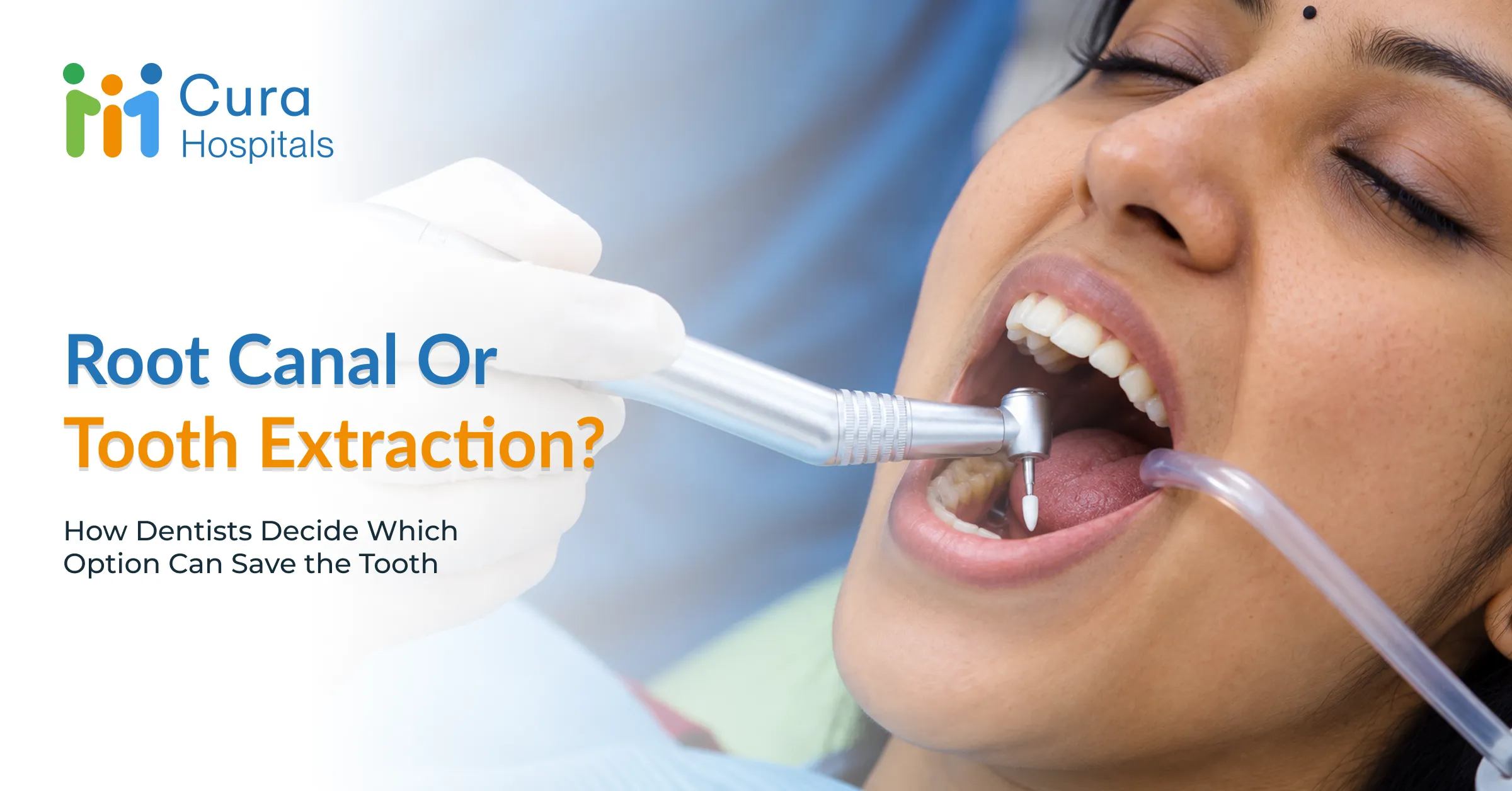
Decision tools: X-ray, nerve response test, gum pocket depth, and tooth mobility check
After extraction: replacement (implant, bridge, or denture) matters since leaving the gap empty lets teeth shift and jawbone shrink
Root canal treatment cleans out the infected part of a tooth and keeps the tooth in place. Extraction removes the tooth completely. The choice between root canal and extraction depends mainly on one question: “How much healthy tooth and bone is left to work with?”
Being told a tooth needs root canal treatment or extraction can feel like a decision you have to make in a hurry, and that’s not a comfortable feeling. It helps to understand what each option actually involves and why your dentist is choosing one over the other before you decide anything. This guide covers a quick comparison of both when a tooth can usually be saved and when it’s better to remove it, the tests your dentist uses to decide, and what recovery looks like either way.
Root Canal or Extraction
Root canal treatment keeps your natural tooth. Extraction removes it and, in most cases, needs a replacement afterward. Here’s how the two compare at a glance.
| Root Canal Treatment | Extraction | |
| What happens to the tooth | Infected tissue is removed, and the tooth is cleaned, sealed, and usually capped with a crown. | The tooth is taken out completely. |
| Number of visits | Usually 1–2, sometimes more for complicated cases | Usually 1 visit |
| Discomfort | Mild soreness for a few days | Mild to moderate soreness for a few days |
| What you’ll need afterward | A crown, in most cases, to protect the tooth | A replacement needs an implant, bridge, or denture to fill the gap |
| Effect over time | Your natural tooth and bite stay as they are. | Nearby teeth can shift, and the jawbone can shrink if the gap is left empty. |
| Best for | Teeth with enough structure and bone left to repair | Teeth that are broken below the gum, badly decayed, or loose from bone loss |
When a Tooth Can Be Saved
A tooth can usually be saved with root canal treatment if the infection has reached the nerve inside but hasn’t destroyed the outer structure, the root, or the bone around it. This is the main thing your dentist checks.
Teeth with deep decay, a leaking old filling, or a crack that lets bacteria reach the nerve are often still saveable, as long as there’s enough tooth left above the gum line to hold a crown once treatment is done.
A tooth is also more likely to be saved if there’s no crack running down the root, no major bone loss around it, and you’re able to come back for the follow-up visit to get it crowned.
Saving the natural tooth through root-canal treatment is usually the preferred route wherever it’s realistically possible, since a natural tooth still feels and functions like your own tooth and keeps the jawbone beneath it active in a way no artificial replacement fully copies.
When Extraction May Be Recommended
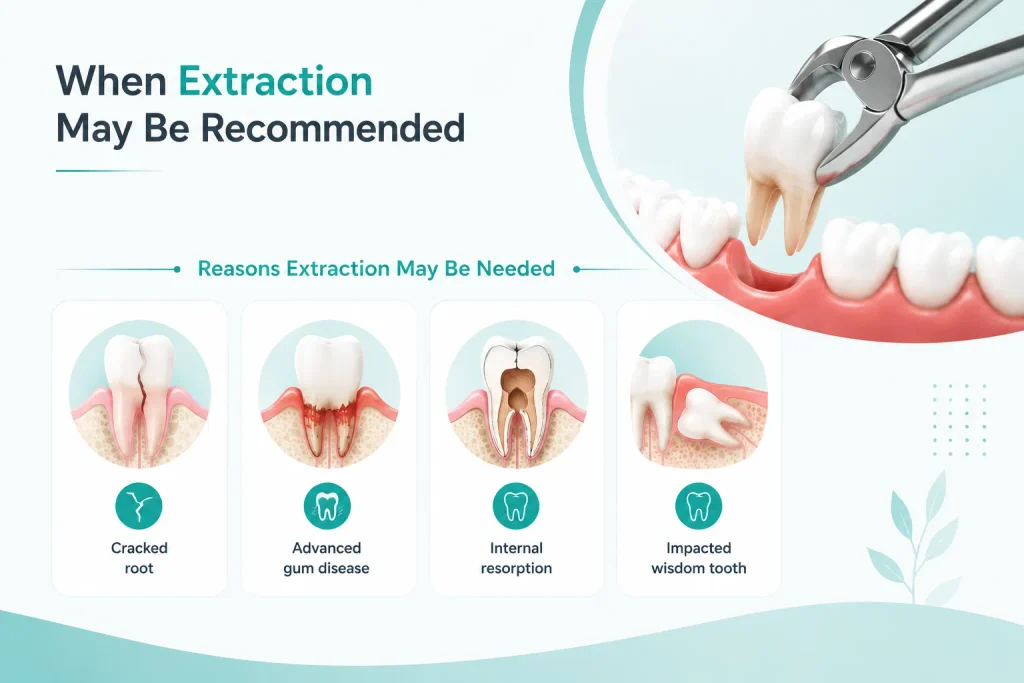
Extraction is usually the better option when a tooth is broken below the gum line, has lost too much structure to hold a crown, or sits in bone that’s been badly weakened by gum disease. Trying to save a tooth like this with root canal treatment would mean going through the procedure without a real chance of the tooth lasting.
Reasons Tooth Extraction May Be Needed
- A crack running down the root (this can’t be fixed with root canal treatment)
- Advanced gum disease that has left the tooth too loose to function
- Internal resorption that has significantly weakened the tooth
- An impacted wisdom tooth causing repeated infection with no realistic way to restore it
Your age, overall dental health, and whether the tooth is worth restoring all factor into this call, which is why it’s a case-by-case decision rather than a fixed rule.
X-Rays and Clinical Tests
Dentists decide between root canal treatment and extraction using an X-ray, a nerve response test, and a physical check of the tooth and gum, since no single test gives the full picture on its own. A regular dental X-ray, or a full-mouth X-ray called an OPG, shows how deep the decay goes, the condition of the root, and whether there’s infection at the tip of the root.
Other Tests Your Dentist May Perform
Nerve response
Your dentist will check how the tooth responds to cold or a small electric current to see if the nerve inside is still alive.
Tenderness
The tooth may be tapped or pressed to check for tenderness, which can mean infection has spread past the root.
Gum pocket depth
The depth of the gum pocket around the tooth may be measured to see how much bone support is left.
Tooth mobility
The dentist will check whether the tooth is loose, since a loose tooth usually points toward extraction rather than repair.
3D cone beam CT scan
For more complicated cases, especially when a previous root canal has failed or the root shape looks unusual, a cone beam CT can provide a clearer picture than a flat X-ray.
A routine dental checkup that catches decay early is the simplest way to avoid this decision altogether.
If you have persistent tooth pain, sensitivity, decay, or a loose tooth, get a dental examination to identify the problem early and understand your treatment options.
Root-Canal Steps and Recovery
Root canal treatment is usually done in one or two visits. Your dentist numbs the tooth, makes a small opening, removes the infected tissue inside, cleans and shapes the canal, seals it, and then builds the tooth back up, usually with a crown to protect it. Most patients are surprised at how manageable the appointment actually feels, since the area stays numb throughout.
Afterward, mild soreness for a few days is normal and usually settles with a painkiller. Most people are back to eating normally on that side once the permanent crown is fitted. Getting the crown done within a reasonable time matters, since a root-canal-treated tooth without a crown is more likely to crack under everyday biting force.
The long-term outlook for these teeth is genuinely good since studies found that root-canal-treated teeth had a survival rate even eight to ten years after treatment (Ng, Mann and Gulabivala, 2010).
A separate large review comparing root-canal-treated teeth with single-tooth extraction found how long a treated tooth lasts depends heavily on the quality of the crown and how well it’s looked after afterward (Iqbal and Kim, 2007).
Extraction, Replacement and Long-Term Implications
A simple extraction takes one visit and heals within one to two weeks, but leaving the gap empty has real consequences that may include neighbouring teeth slowly drifting into the space, your bite shifting, and the jawbone under the gap starting to shrink because it’s no longer being used. This part is easy to overlook in the moment, but it matters.
Research measuring bone changes after a single tooth is removed found that a large share of the jawbone’s width is lost in just the first few months (Schropp et al., 2003).
This is why dentists usually bring up replacement options, including a dental implant, a bridge, or a removable denture, at the same visit the extraction is planned, rather than leaving it for later. An implant generally does the best job of preserving bone and normal chewing function long term, though it isn’t right for every patient or every site, and a bridge or denture is still a reasonable choice depending on your surrounding teeth and overall dental health. Either way, extraction usually isn’t the end of the decision but the start of a second one, about what replaces the tooth.
“Patients are sometimes relieved when extraction sounds like the quicker option, but I always explain what happens next if the space is left empty. The bite shifts, the neighbouring teeth move, and the bone underneath starts to change within months. That’s why we talk about replacement at the very same visit, not as an afterthought.”
— Dr. Sushmitha Reddy, Dentistry,
Cura Hospitals
Questions to Ask the Dentist
Before agreeing to either option, a few direct questions can help make sure the recommendation genuinely fits your tooth, not just teeth in general.
- Can this specific tooth realistically be saved, and what are the chances it lasts?
- What happens if I wait or do nothing for now?
- If we extract it, what replacement makes sense for me, and what happens if I skip replacing it?
- Will I need a crown after root canal treatment, and what does that add to the time and cost?
- Is this straightforward, or would I benefit from seeing a root canal specialist?
A dentist confident in their recommendation should be able to answer all of this clearly and explain why it applies to your tooth specifically.
Book a Dental Examination
The only reliable way to know whether your tooth needs root canal treatment or extraction is a clinical exam with an X-ray, since it depends on the exact condition of that tooth and the bone around it.
At Cura, our dentistry team examines the tooth, walks you through the X-ray in plain language, and tells you honestly whether root-canal treatment can save it or whether extraction and a replacement plan makes more sense.
Cura’s dentistry team at Kanakapura Road provides evaluation and treatment for tooth pain, root canal needs, and tooth extractions for patients from nearby areas including Raghuvanahalli.
Book a dental examination and X-ray assessment before deciding between root-canal treatment and extraction and contact us to schedule your visit.
If you’re unsure whether your tooth can be saved with root canal treatment or needs extraction, get a dental examination and X-ray to understand the right treatment option.
References
Ng, Y.L., Mann, V. and Gulabivala, K. (2010) ‘Tooth survival following non-surgical root canal treatment: a systematic review of the literature’, International Endodontic Journal, 43(3), pp. 171–189.
Iqbal, M.K. and Kim, S. (2007) ‘For teeth requiring endodontic treatment, what are the differences in outcomes of restored endodontically treated teeth compared to implant-supported restorations?‘, International Journal of Oral & Maxillofacial Implants, 22(Suppl), pp. 96–116.
Schropp, L., Wenzel, A., Kostopoulos, L. and Karring, T. (2003) ‘Bone healing and soft tissue contour changes following single-tooth extraction: a clinical and radiographic 12-month prospective study‘, International Journal of Periodontics & Restorative Dentistry, 23(4), pp. 313–323.
Fransson, H. and Dawson, V. (2023) ‘Tooth survival after endodontic treatment‘, International Endodontic Journal, 56, pp. 140–153.
Uncategorized Health Concerns?
Our specialists at Cura Hospitals are here to help with screening, diagnosis, risk assessment, and personalized treatment plans tailored to your health needs.
Schedule A ConsultationFrequently Asked Questions
A tooth can usually have root canal treatment when the infection has reached the nerve, but the outer tooth, root, and bone around it are still healthy enough to support a crown. Extraction is usually recommended instead when the tooth is broken below the gum line, has a crack running down the root, or has lost too much bone support to work properly.
Extraction itself is often a shorter, one-visit procedure, but most extracted teeth need a replacement, such as an implant, bridge, or denture, to stop the bite from shifting and the jawbone from shrinking. Once you factor in replacement, extraction isn’t automatically the cheaper or simpler path over time.
Nearby teeth gradually drift into the empty space, the opposing tooth can grow slightly longer, your bite can shift, and the jawbone at that spot starts to shrink because it’s no longer being used, with most of that bone loss happening in the first several months. This is why dentists usually talk through replacement options at the same visit the extraction is planned.
It depends on the symptoms. Ongoing sensitivity or mild discomfort usually leaves time for an assessment and X-ray, but swelling, spreading facial pain, fever, or pus needs urgent dental attention, since an infection in a tooth can spread beyond it if left untreated.
Root canal treatment usually causes mild soreness for a few days, and normal biting returns once the permanent crown is fitted. A simple extraction site usually heals within one to two weeks on the surface, though the bone underneath keeps healing for several months afterward.