Fatty Liver Disease – Symptoms, Causes, Grades, Diet and Treatment


Key Takeaways
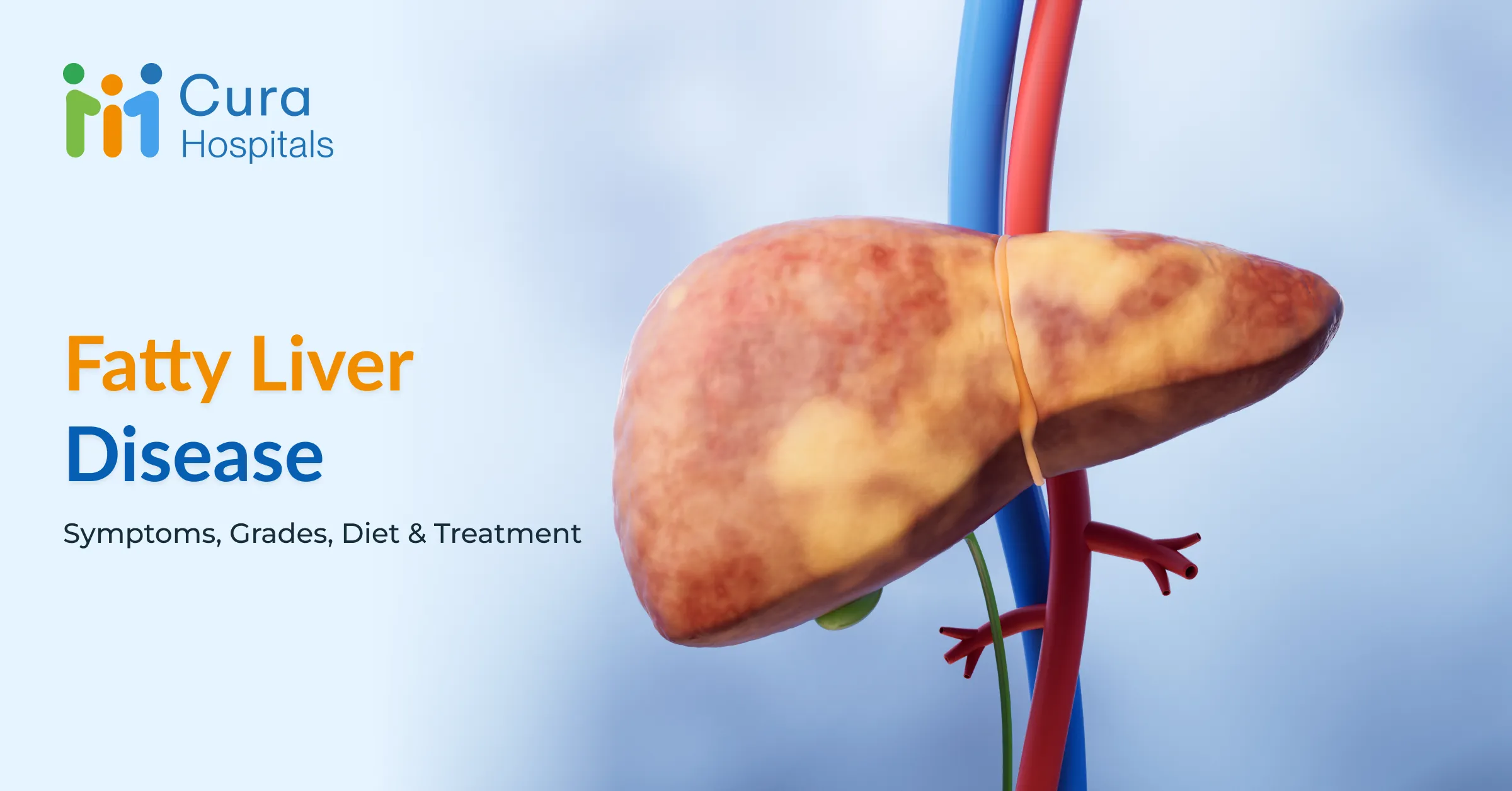
Fatty liver disease means too much fat has built up in the liver. Doctors now call the most common type MASLD (metabolic dysfunction-associated steatotic liver disease), which used to be called NAFLD.
Most people have no symptoms at first. It is often found by chance, on an ultrasound or on a blood test that shows raised liver enzymes.
Common fatty liver causes are extra weight, especially around the waist, type 2 diabetes or prediabetes, high triglycerides, high blood pressure and, in some people, alcohol. It can also affect people of normal weight.
Grades 1, 2 and 3 describe how much fat shows on an ultrasound. Stages describe scarring, which matters more for long-term risk.
Treatment starts with lifestyle: gradual weight loss of about 7 to 10% of body weight, a Mediterranean-style diet, regular activity and no alcohol, along with control of diabetes, cholesterol and blood pressure. Medicines or surgery are used in selected people.
Early fatty liver can improve. In some people it goes on to inflammation, scarring (cirrhosis) and, rarely, liver cancer, so follow-up matters.
Fatty liver disease occurs when excess fat builds up in the liver, often without causing noticeable symptoms in its early stages. It can affect people who drink little or no alcohol, including those with diabetes, excess weight or high cholesterol. Many people discover it during a routine ultrasound. The good news is that early fatty liver can often improve with timely medical care, dietary changes and regular physical activity. Understanding what your scan report means is the first step towards protecting your liver health.
Hearing “you have fatty liver” after a routine scan is more common than most people expect. A review of Indian studies estimated that roughly one in three adults has it (Shalimar et al., 2022), and worldwide the figure is about one in three as well (Riazi et al., 2022). Because it rarely causes symptoms, it can feel confusing. You feel fine, yet the report says something is not right.
This guide explains what fatty liver disease is, its symptoms and causes, how grades and stages differ, how it is diagnosed, how diet and fatty liver treatment work and when to see a doctor. It is meant to help you understand your report and ask better questions. It cannot replace an examination.
Have a question about fatty liver or a liver health appointment?
What Is Fatty Liver Disease?
In fatty liver disease, fat makes up a bigger share of the liver than it should. Doctors call this steatosis. For many people it does little harm for years. In some, the fat is joined by inflammation, and over time that can leave scar tissue.
MASLD
In 2023, international liver societies agreed on new names, because “fatty” and “non-alcoholic” were felt to be stigmatising and did not describe the cause well. The umbrella term is steatotic liver disease. The most common type, which goes with weight, blood sugar and cholesterol problems, is now called metabolic dysfunction-associated steatotic liver disease (MASLD). The form with inflammation, once called NASH, is now MASH (Rinella et al., 2023a). You will still hear “fatty liver” and “NAFLD” in everyday talk and in older reports, and they describe the same condition.
To count as MASLD, a person needs fat in the liver plus at least one of five risk factors: extra weight or a large waist, raised blood sugar or diabetes, raised blood pressure, high triglycerides, or low HDL cholesterol (Rinella et al., 2023a).
Fatty Liver Symptoms
Most people with fatty liver have no symptoms. When symptoms of fatty liver disease do appear, they are usually vague: tiredness, a dull ache or a feeling of fullness in the upper right side of the abdomen, and low energy. Yellow eyes or skin, itching, swelling of the legs or belly and easy bruising usually mean the liver has been scarred.
Fatty Liver Causes and Risk Factors
Causes of fatty liver disease are mostly linked to how the body handles energy and sugar. The most common are listed here.
- Extra weight, especially fat around the waist
- Type 2 diabetes or prediabetes, where the body does not respond well to insulin
- High triglycerides or low HDL (good) cholesterol
- High blood pressure
- Polycystic ovary syndrome (PCOS), an underactive thyroid and sleep apnoea
- Some medicines, such as long-term steroids, and very rapid weight loss
- Alcohol, which causes a related condition, alcohol-related liver disease, and can add to MASLD
- Family history and genes
Fatty liver can also occur in people of normal weight, so a normal weight on the scale does not rule it out. Children can develop it too, most often when they are overweight.
Fatty Liver Grades and Stages
Grades in fatty liver disease describe how much fat the ultrasound can see. Stages describe how much scarring (fibrosis) the liver has. Both matter, but scarring is the stronger predictor of liver-related risk, and the risk rises with each stage (Dulai et al., 2017).
| Grade on ultrasound | What the scan shows | Plain meaning |
| Grade 1 (mild) | The liver looks slightly brighter than the kidney, and blood vessel walls and the diaphragm are still clear | A small to moderate amount of fat |
| Grade 2 (moderate) | The liver is brighter, vessel walls are less clear and the diaphragm is only partly seen | More fat |
| Grade 3 (severe) | The liver is very bright, and vessel walls and the diaphragm cannot be seen | A large amount of fat |
Grade descriptions follow the commonly used ultrasound criteria (Ferraioli and Monteiro, 2019). A higher grade does not automatically mean scarring, and a grade 1 report does not mean there is nothing to look into.
How Fatty Liver Is Diagnosed
Doctors usually combine several steps.
- History and examination, including weight, waist size, blood pressure, alcohol use and medicines
- Blood tests for liver enzymes (ALT and AST), blood sugar, cholesterol and triglycerides, and tests to rule out hepatitis B and C. Liver enzymes can be normal even when the liver is scarred, so a normal result does not settle the question (Rinella et al., 2023b).
- An ultrasound of the abdomen, which shows fat
- A scarring risk score called FIB-4, worked out from age, AST, ALT and platelet count. Guidance recommends it as the first step for people with fatty liver or its risk factors (Rinella et al., 2023b).
- A FibroScan or similar test that measures liver stiffness, and sometimes an MRI or a liver biopsy, if the risk of scarring is not low
If your report shows raised liver enzymes or fatty liver, a general physician is a good first stop. A gastroenterologist or hepatologist may be needed if further evaluation reveals a risk of liver damage. Knowing which doctor to see after an abnormal health check report can help you understand the next steps.
Fatty Liver Diet
Food is the main tool for treating fatty liver. A fatty liver diet mainly focuses on the Mediterranean-style way of eating. Cut sugary drinks, sweets, fried and packaged foods, and avoid alcohol.
Fatty Liver Treatment
Treatment of fatty liver disease aims to deal with the causes, protect the liver and lower the risk to the heart. This last part matters, because heart disease is among the most common causes of death in people with fatty liver (Rinella et al., 2023b).
- Weight loss. Losing about 7 to 10% of body weight, gradually, improves liver fat and inflammation. In a study of 293 people with biopsy-proven liver inflammation who followed a year-long lifestyle programme, about a quarter saw the inflammation resolve and about one in five saw scarring regress, and the more weight they lost, the better the results (Vilar-Gomez et al., 2015).
- Food. A Mediterranean-style pattern, with less sugar and fewer ultra-processed foods (Tacke et al., 2024).
- Activity. Regular exercise helps the liver even when weight does not change much.
- Alcohol. Avoiding it is advised, or at least discussing it with your doctor.
- Other conditions. Diabetes, cholesterol and blood pressure should be treated well. Some diabetes and weight medicines may also help the liver (Tacke et al., 2024).
- Medicines for MASH with scarring. These are used in selected people and decided by a liver specialist.
- Surgery. Weight-loss surgery is an option for some people with obesity when lifestyle changes are not enough (Tacke et al., 2024).
- Cirrhosis. People with advanced scarring need regular monitoring, including checks for liver cancer, and a liver transplant is considered if the liver fails.
With early fatty liver, the liver can improve once the cause is addressed. Results vary from person to person, and no one can promise a particular outcome.
When Fatty Liver Becomes Serious
In some people, fat is followed by inflammation (MASH), then scarring (fibrosis) and, over many years, cirrhosis. Cirrhosis of the liver raises the risk of liver failure and liver cancer. These steps are slow, and most people with fatty liver do not reach the end of this path. The risk goes up with each stage of scarring (Dulai et al., 2017), which is why doctors look for scarring and not only for fat.
| Doctor’s Insight “Fatty liver is often called a lifestyle condition, and that is fair, but it should not be brushed aside. The liver can improve when the cause is addressed, and the earlier we check for scarring, the more options a patient has.” DR. ABRAR MOHAMMED M.B.B.S, M.S, Orthopaedics Registered Medical Practitioner | KMC Registration No: 116389 |
When to See a Doctor
See a doctor if you have a scan or blood test that shows fatty liver or raised liver enzymes. Also ask about a check if you have type 2 diabetes, obesity or a large waist, high triglycerides, high blood pressure, PCOS or a family history of liver disease, even with no symptoms. Book a visit if you have lasting tiredness or an ache in the upper right abdomen.
Go to an emergency department straight away if you vomit blood, pass black stools, become confused or very drowsy, or have yellow eyes or skin together with fever or severe abdominal pain.
Fatty Liver Care at Cura Hospitals
The gastroenterology department at Cura Hospitals provides liver disease management, including fatty liver disease, with regular monitoring and personalised care plans. The hospitals are in Kammanahalli and on Kanakapura Road, Bengaluru.
For appointments or general enquiries, reach out to the hospital.
Contact details
Cura Hospitals, Kammanahalli: #1, Bethel St, HRBR Layout 2nd Block, Kalyan Nagar, Kammanahalli, Bengaluru, Karnataka 560043
Cura Hospitals, Kanakapura Road: No.18, Kanakapura Rd, Venkatareddy Layout, Doddakallasandra, Uttarahalli Hobli, Bengaluru, Karnataka 560062
Phone: +91 87480 30303 | Email: info@curahospitals.com | 24/7 emergency: +91 84312 41403
This article is for general health education and is not a substitute for personal medical advice. Please speak to your treating doctor about your own diagnosis and treatment plan.
References
Dulai, P.S., Singh, S., Patel, J., Soni, M., Prokop, L.J., Younossi, Z., Sebastiani, G., Ekstedt, M., Hagstrom, H., Nasr, P., Stal, P., Wong, V.W.S., Kechagias, S., Hultcrantz, R. and Loomba, R. (2017) ‘Increased risk of mortality by fibrosis stage in nonalcoholic fatty liver disease: systematic review and meta-analysis’, Hepatology, 65(5), pp. 1557-1565.
Ferraioli, G. and Monteiro, L.B.S. (2019) ‘Ultrasound-based techniques for the diagnosis of liver steatosis’, World Journal of Gastroenterology, 25(40), pp. 6053-6062.
Riazi, K., Azhari, H., Charette, J.H., Underwood, F.E., King, J.A., Afshar, E.E., Swain, M.G., Congly, S.E., Kaplan, G.G. and Shaheen, A.A. (2022) ‘The prevalence and incidence of NAFLD worldwide: a systematic review and meta-analysis’, The Lancet Gastroenterology & Hepatology, 7(9), pp. 851-861.
Rinella, M.E., Lazarus, J.V., Ratziu, V. et al. (2023a) ‘A multisociety Delphi consensus statement on new fatty liver disease nomenclature’, Hepatology, 78(6), pp. 1966-1986.
Rinella, M.E., Neuschwander-Tetri, B.A., Siddiqui, M.S. et al. (2023b) ‘AASLD practice guidance on the clinical assessment and management of nonalcoholic fatty liver disease’, Hepatology, 77(5), pp. 1797-1835.
Shalimar et al. (2022) ‘Prevalence of non-alcoholic fatty liver disease in India: a systematic review and meta-analysis’, Journal of Clinical and Experimental Hepatology, 12(3), pp. 818-829.
Tacke, F., Horn, P., Wai-Sun Wong, V. et al. (2024) ‘EASL-EASD-EASO clinical practice guidelines on the management of metabolic dysfunction-associated steatotic liver disease (MASLD)’, Journal of Hepatology, 81(3), pp. 492-542. doi:10.1016/j.jhep.2024.04.031.
Vilar-Gomez, E., Martinez-Perez, Y., Calzadilla-Bertot, L. et al. (2015) ‘Weight loss through lifestyle modification significantly reduces features of nonalcoholic steatohepatitis’, Gastroenterology, 149(2), pp. 367-378.
Media Center Health Concerns?
Our specialists at Cura Hospitals are here to help with screening, diagnosis, risk assessment, and personalized treatment plans tailored to your health needs.
Schedule A ConsultationFrequently Asked Questions
Fatty liver disease is a condition in which too much fat builds up in the liver. The most common type is now called MASLD, and it is linked to weight, blood sugar, cholesterol and blood pressure. Many people have no symptoms.
The main causes are extra weight, type 2 diabetes or prediabetes, high triglycerides, high blood pressure and, in some people, alcohol. Some medicines, PCOS, an underactive thyroid, sleep apnoea and family history also play a part.
Most people have none. Some feel tired or have a dull ache in the upper right abdomen. Yellow eyes or skin, itching, swelling and easy bruising usually mean advanced liver disease.
Early fatty liver can improve or clear in many people who lose weight, change their diet, exercise and avoid alcohol. Scarring is harder to reverse, although it can sometimes improve and its progress can often be slowed. Results vary from person to person.
Often it is mild, but it should not be ignored. In some people it leads to inflammation and scarring, and it is linked with a higher risk of heart disease. Checking for scarring is what separates the milder cases from the ones that need closer follow-up.
MASLD is the new name for NAFLD, adopted in 2023. It describes fatty liver linked to metabolic problems such as extra weight, high blood sugar or high cholesterol. Most people who had a NAFLD diagnosis meet the MASLD definition.
Doctors use blood tests, an ultrasound and a scarring risk score called FIB-4, followed by a FibroScan or other tests when needed. Liver enzymes can be normal even when the liver is scarred.
A general physician is a good first step. A gastroenterologist or hepatologist treats fatty liver that is advanced, or when the scarring risk is raised.