Fracture Treatment: How Doctors Decide Between a Cast, Splint, Reduction or Surgery


Key Takeaways
Fracture treatment has one main aim which is to hold the bone in a good position, protected, until it heals, and then help you get back movement and strength.
Options range from a sling, splint or cast, to realigning the bone (reduction), to surgery with plates, screws, rods or pins.
Doctors decide using the type and location of the break, whether the pieces have moved, whether it is stable, whether the skin is open, whether it enters a joint, your age and bone quality, and what you need to do each day.
A cast gives firm, steady support. A splint is quicker to apply, leaves room for swelling and can sometimes be removed for washing. They are often used one after the other.
Surgery is usually considered for fractures that are open, unstable, badly displaced or inside a joint, and for those that do not heal with non-surgical care.
Treatment does not end when the cast goes on or the operation is done. Follow-up X-rays and rehabilitation are part of the plan.
If you have been told you have a fracture, your first questions are probably practical. Will I need a cast? Will I need an operation? How long will it take? The honest answer is that it depends on the bone, the break and the person. Two people with a broken wrist can be treated in very different ways.
This guide explains the common fracture treatment options, what each one involves and the factors your doctor uses to choose. If the injury has only just happened, fracture first aid is the more important part of the treatment.
Questions about a treatment plan or an orthopaedic appointment?
What Are the Goals of Fracture Treatment?
There are three goals. The first is alignment, which means putting the broken ends in a position that will heal well. The second is stability, which means keeping them still for long enough to heal. The third is function, which means getting you back to normal activity.
Bone has a natural ability to repair itself. Many fractures heal even when the bones are not held in a perfect position or fixed rigidly, which is why a good number of them do not need surgery (Marsell and Einhorn, 2011). Treatment mainly supports that natural process.
How Doctors Decide the Treatment Plan
The doctor looks at the X-ray, examines the limb, identifies the type of fracture and then weighs several things together.
| Factor | Why it matters |
| Type and location of the fracture | A simple break in a finger and a broken thigh bone need very different support |
| Displaced or not | Bones that have moved may need to be realigned |
| Stable or unstable | An unstable fracture can shift even inside a cast |
| Open or closed | Open fractures need wound cleaning and antibiotics, and usually surgery |
| Joint involvement | Joint surfaces must line up closely to protect the joint |
| Age and bone quality | Children heal quickly and can reshape the bone as they grow, while older bone is weaker and may hold screws less well |
| Daily demands | Work, sport and the need to walk or care for yourself affect the choice |
| Other health issues | Diabetes, smoking, poor circulation and some medicines can affect healing and surgical risk |
| Swelling and skin condition | Heavy swelling or damaged skin may delay a cast or an operation |
Your own wishes matter as well. A good plan explains the options, the likely recovery and the risks, so you can decide together with your doctor.
Bone Fracture Treatment Options
| Option | What it is | Often used when | What to expect |
| Sling, brace, boot or soft bandage | Support that limits movement but is not rigid | Minor, stable fractures, such as buckle fractures in children | Easy to wear, with advice on when to put weight on the limb |
| Splint | Rigid support along part of the limb, held with a bandage | The first days after injury, and some stable fractures | Quick to apply, leaves room for swelling, some can be removed for washing |
| Cast | A rigid shell of plaster or fibreglass around the limb | Stable fractures, and fractures that have been realigned | Must be kept dry, with check-ups and X-rays, and removed in the clinic |
| Closed reduction | The doctor moves the bone back into position by hand, without a cut | Displaced fractures that can be realigned | Pain relief or sedation first, X-ray after, then a splint or cast |
| Internal fixation (surgery) | Plates, screws, rods or wires hold the bone in place | Unstable, badly displaced, open or joint fractures, or fractures that fail non-surgical care | Anaesthesia, a hospital stay, early movement and rehabilitation |
| External fixator | Pins in the bone connected to a frame outside the skin | Severe open fractures or very swollen limbs, often as a first step | Regular care of the pin sites |
| Joint replacement | The damaged joint is replaced with an implant | Some hip fractures and complex joint fractures, especially in older adults | Rehabilitation, often starting within days |
Cast for Fracture
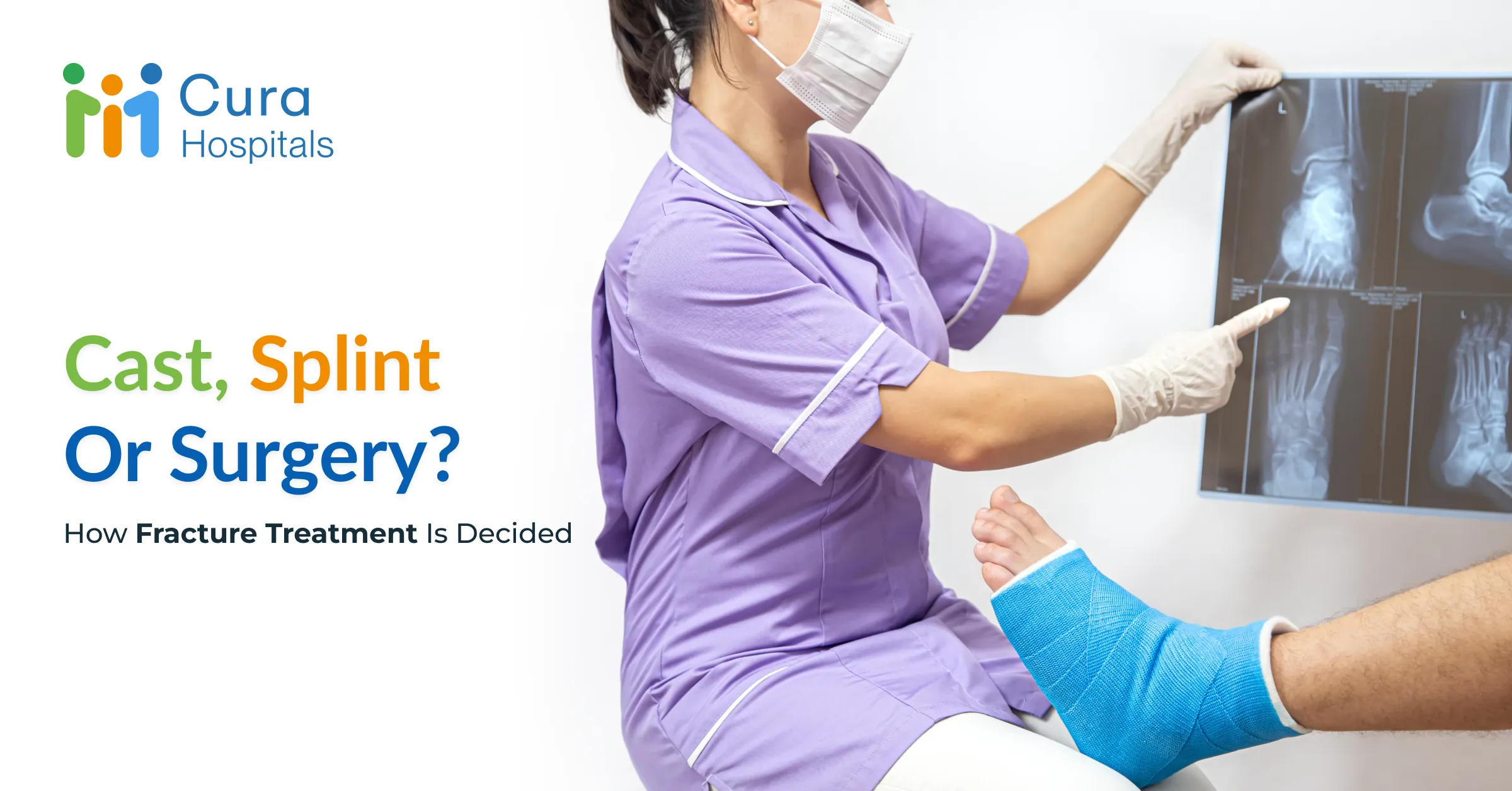
A cast is a firm shell, made of plaster or fibreglass, that wraps around the injured limb and holds the bone still while it heals. Plaster is easy to mould. Fibreglass is lighter and usually dries faster. A cast for a fracture is commonly used for stable breaks and for breaks that have been realigned.
Looking after a cast is simple, but it matters.
- Keep it dry unless you have been told it is waterproof.
- Move the fingers or toes often, and raise the limb to reduce swelling.
- Do not push objects inside the cast to scratch an itch.
- Do not trim or break the cast yourself.
Contact your doctor or the hospital promptly if you notice increasing pain, numbness or tingling, blue or pale fingers or toes, swelling that makes the cast feel tight, a bad smell or fluid coming from the cast, or fever.
Splint for Fracture
A splint supports the injured limb on one side or along part of it and is held with a bandage. It leaves room for swelling, so it is often used in the first days after an injury. The final cast can be fitted once the swelling settles.
For some low-risk fractures, a splint is all that is needed. In a trial of children with wrist buckle fractures, those treated with a removable splint had better physical function and less difficulty with daily activities than those treated with a short arm cast (Plint et al., 2006).
A later review of seven trials found that a soft bandage or a removable wrist splint appears to be a good first choice for buckle (torus) fractures of the forearm in children. Splints caused slightly more pain in the first week but allowed a faster return to activities, and these fractures healed clinically within 3 to 4 weeks (Pakarinen et al., 2024).
This applies to specific, low-risk types of fractures. It does not mean every break can be treated with a splint, so follow the advice for your own injury.
Reduction in Fracture Treatment
If the broken ends have moved, the doctor may need to move them back into position. This is called reduction. In a closed reduction, the doctor does this by hand, without a cut in the skin. Pain relief, a local anaesthetic or sedation is usually given first, and an X-ray is taken before and after. The bone is then held with a splint or cast.
If the bone slips again, or cannot be moved into a good position by hand, surgery may be recommended.
| Doctor’s Insight “Most patients assume a fracture means an operation. In practice, many fractures heal well with a splint or a cast. We recommend surgery when the break is unstable, or when the position of the bone or of a joint surface is unlikely to heal well without it.” DR. ABRAR MOHAMMED M.B.B.S, M.S, Orthopaedics Registered Medical Practitioner | KMC Registration No: 116389 |
When Is Surgery Needed for a Fracture?
Surgery is usually considered in these situations.
- The fracture is open, with the bone through the skin or a wound reaching the break.
- The fracture is unstable or badly displaced.
- The break runs into a joint surface.
- The bone is broken into many pieces.
- The bone slips out of position after reduction.
- A fracture has not healed with a cast or splint.
- The fracture is in a place where early movement matters, as with many hip fractures in older adults.
Surgery holds the bone in place with plates and screws, a rod placed inside the bone (an intramedullary nail), wires or pins, or an external frame with pins that pass through the skin. In some hip fractures and complex joint fractures, the damaged joint is replaced. The right choice depends on the bone, the break and your general health.
Like any operation, fracture surgery carries risks, such as infection, bleeding, blood clots and problems with healing or with the implant. Your team will explain these and how they are reduced. Starting movement early after surgery is a big part of recovery.
Open fractures need urgent care, with wound cleaning, antibiotics and stabilising of the bone. Doctors often grade them using the Gustilo and Anderson system, which helps plan treatment (Gustilo and Anderson, 1976).
Follow-Up and Recovery After Treatment of Fracture
A cast or an operation is the start of recovery. You will usually have follow-up visits and X-rays to check that the bone is staying in position and the healing of the fracture is in the correct direction. Stiffness and weakness are common after a limb has been protected for weeks, so exercises or physiotherapy are often part of the plan.
Questions You Can Ask Your Doctor
It can be hard to take everything in during a consultation. Many people find it helpful to write questions down beforehand. You might ask what type of fracture you have and whether the bones have moved. You could ask what treatment is recommended and why, and whether there are other options. It is also fair to ask how long you will need protection, when you can put weight on the limb, which warning signs to watch for, when the follow-up X-rays will be, and when you can return to work, driving or sport. If you are unsure about a recommendation, you can ask for a second opinion.
Fracture Care at Cura Hospitals
The orthopaedics department at Cura Hospitals provides surgical and non-surgical fracture management and trauma surgery. 24/7 emergency care is available at both hospitals, in Kammanahalli and on Kanakapura Road, Bengaluru.
For appointments or general enquiries, reach out to the hospital.
Contact details
Cura Hospitals, Kammanahalli: #1, Bethel St, HRBR Layout 2nd Block, Kalyan Nagar, Kammanahalli, Bengaluru, Karnataka 560043
Cura Hospitals, Kanakapura Road: No.18, Kanakapura Rd, Venkatareddy Layout, Doddakallasandra, Uttarahalli Hobli, Bengaluru, Karnataka 560062
Phone: +91 87480 30303 | Email: info@curahospitals.com | 24/7 emergency: +91 84312 41403
This article is for general health education and is not a substitute for personal medical advice. Please speak to your treating doctor about your own diagnosis and treatment plan.
References
Gustilo, R.B. and Anderson, J.T. (1976) ‘Prevention of infection in the treatment of one thousand and twenty-five open fractures of long bones: retrospective and prospective analyses’, Journal of Bone and Joint Surgery (American Volume), 58(4), pp. 453-458.
Marsell, R. and Einhorn, T.A. (2011) ‘The biology of fracture healing’, Injury, 42(6), pp. 551-555. doi:10.1016/j.injury.2011.03.031.
Pakarinen, O., Saarinen, A.J., Ponkilainen, V.T., Uimonen, M., Helenius, I. and Kuitunen, I. (2024) ‘Soft bandage, splint or cast as the treatment of distal forearm torus fracture in children: a systematic review and meta-analysis’, Scientific Reports, 14(1), pp. 1-12. doi:10.1038/s41598-024-71970-7.
Plint, A.C., Perry, J.J., Correll, R., Gaboury, I. and Lawton, L. (2006) ‘A randomized, controlled trial of removable splinting versus casting for wrist buckle fractures in children’, Pediatrics, 117(3), pp. 691-697.
Media Center Health Concerns?
Our specialists at Cura Hospitals are here to help with screening, diagnosis, risk assessment, and personalized treatment plans tailored to your health needs.
Schedule A ConsultationFrequently Asked Questions
A cast wraps all the way around the limb and is rigid, so it gives firm, steady support. A splint supports only part of the limb and is held with a bandage, so it leaves room for swelling and is quicker to apply. Some splints can be removed for washing. Many people have a splint first and a cast later.
No. Minor, stable fractures, such as buckle fractures in children, may need only a soft bandage, a removable splint or a brace. The choice depends on the type and location of the break.
Surgery is usually considered when a fracture is open, unstable, badly displaced or inside a joint, when the bone is in many pieces, or when it has not healed with a cast or splint. Your doctor will explain whether your fracture falls into one of these groups.
Reduction means moving the broken bone back into its proper position. In a closed reduction this is done by hand, without a cut, usually after pain relief or sedation. The bone is then held in place with a splint or cast.
It depends on the bone, the type of fracture and your age. A child’s buckle fracture of the wrist may need protection for about 3 to 4 weeks. Many other fractures need longer, and large weight-bearing bones can need months. Your doctor will set the timeline for your fracture.
Bone can start to heal by itself, but without the right alignment and support it may heal in a poor position or fail to heal. A suspected fracture should always be assessed by a doctor.
Only when your doctor says so. Some fractures allow early weight bearing, and others need weeks of protection. Follow the advice for your own fracture.