Sciatica: When Do You Need an MRI, Injection or Spine Surgery?
 Cura Hospitals

At a Glance: Sciatica is pain that travels from the lower back down one leg, caused by pressure on the sciatic nerve. Most people improve within six weeks without any of the three tools below.
MRI: used when symptoms last more than six weeks, or sooner if weakness or numbness is worsening and confirms the cause and plans next steps
Injection: an epidural steroid injection for pain that hasn’t settled with medication and physiotherapy that offers temporary relief, not a permanent fix
Spine surgery: considered when pain persists for weeks to months despite conservative treatment, or sooner with progressive weakness
Emergency signs: saddle numbness, new bladder or bowel control problems, or sudden weakness in both legs.
Sciatica is pain that travels from the lower back down one leg, caused by irritation or pressure on the sciatic nerve, most often due to nerve root compression. Most people improve within six weeks, but some may need an MRI, an injection, or spine surgery when there are severe symptoms like severe pain, muscle weakness and loss of bladder control.
If you or your loved one is suffering from sciatica and the symptoms are severe, this guide helps you understand the need for an MRI, injection or spine surgery and helps you choose the best approach.
What is Sciatica?
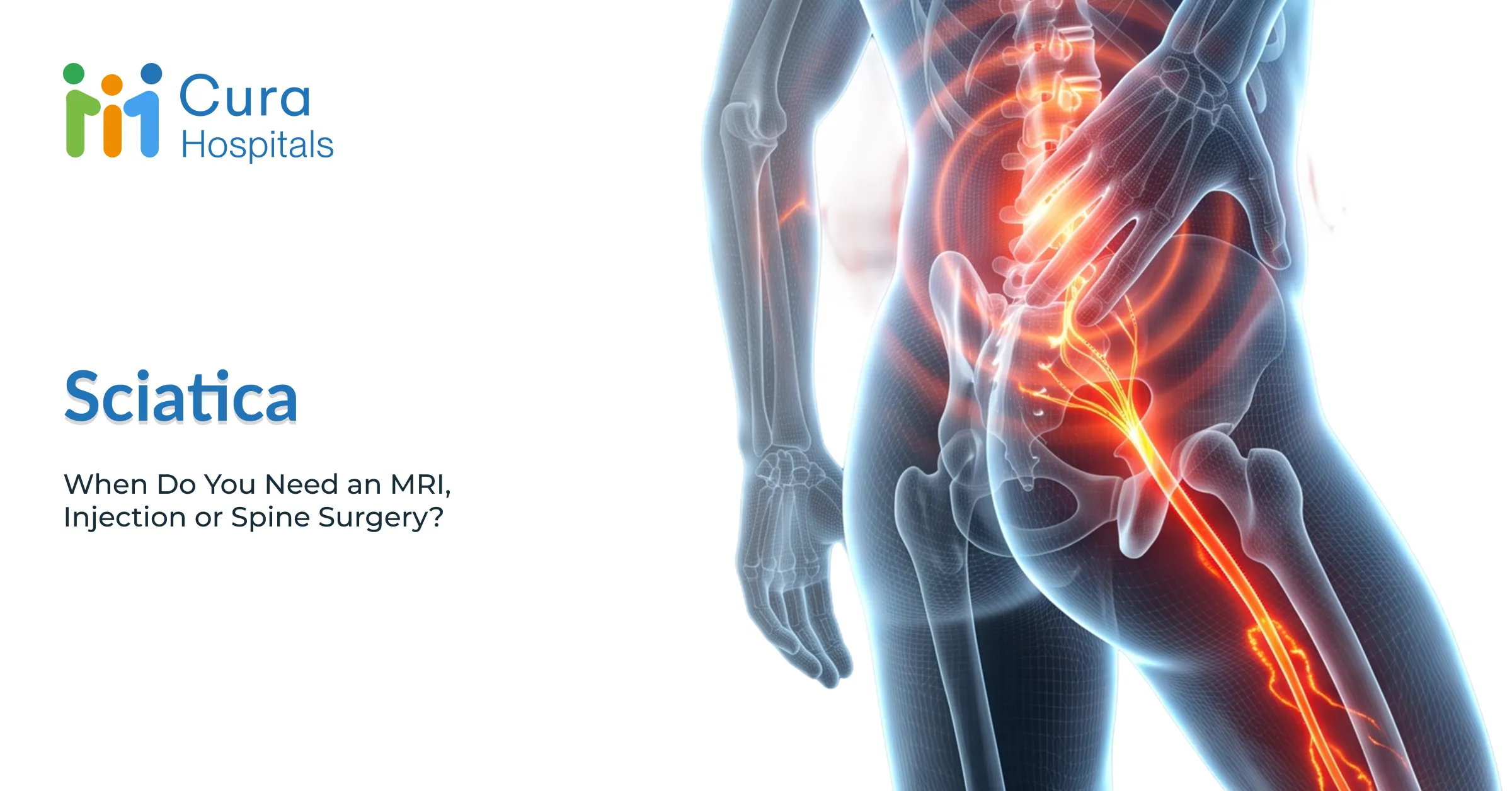
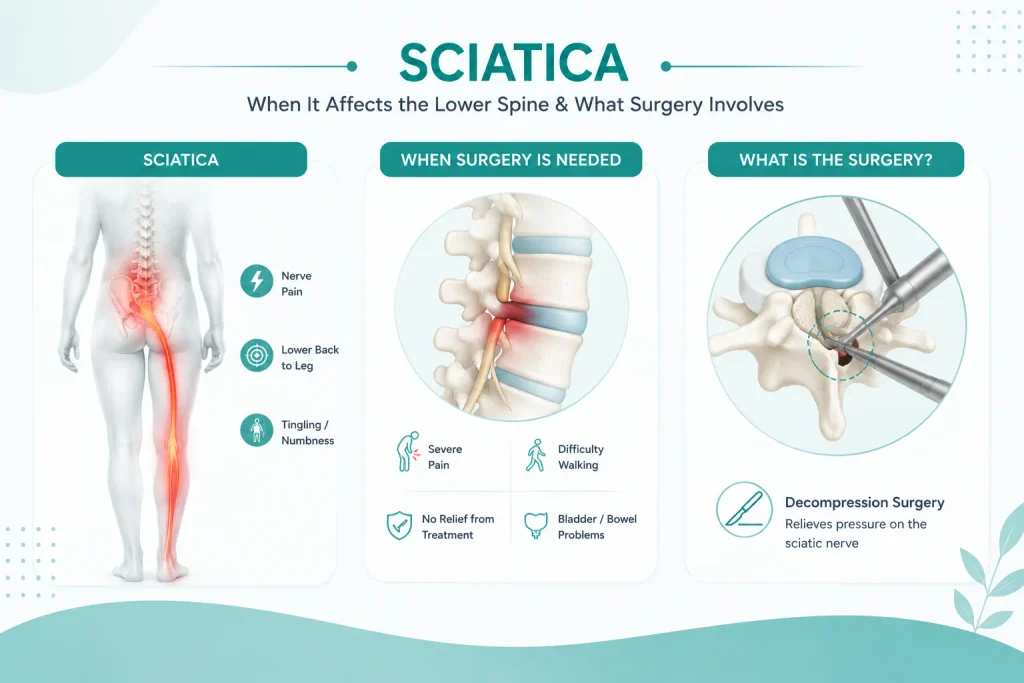
Sciatica is the pain that travels along the path of the sciatic nerve, the longest nerve in the body. The pain starts from the lower back and runs through the buttock and down the back of one leg, sometimes. reaching as far as the calf or foot. The pain may feel sharp, burning, or like an electric shock and is also associated with numbness, tingling, or muscle weakness.
The pain appears when a nerve root in the lower spine gets compressed or irritated, most often by a herniated disc. Our sciatica causes include conditions like spinal stenosis, a bone spur or another condition affecting the sciatic nerve. Identifying which of these is actually causing your symptoms is what allows a doctor to treat sciatica effectively.
Sciatica is not the only condition causing lower spine pain. Many other conditions like lumbar radiculopathy also lead to the pain in the lower spine. Before going for an MRI, injection or lower spine surgery, it is important to understand sciatica and lumbar radiculopathy in detail.
MRI for Lower Spine Pain
A lower spine MRI, or a lumbar MRI, is a scan that shows the discs, nerve roots, and surrounding bone and ligament in detail.
For sciatica, it is done when the symptoms last more than six weeks without improving. It’s also used sooner if there is an increase in weakness or numbness, or if a doctor is already planning an injection or surgery and needs to see exactly where the sciatic nerve is being compressed.
Here the MRI is useful not only to confirm the diagnosis but also to plan the next steps. It shows whether the lower spine pain is due to a disc herniation, spinal stenosis, or something else entirely, and exactly which level of the spine is involved.
That detail is what guides the next decision, whether that’s a targeted injection at the right level or a spine surgery. At Cura Hospitals, our diagnostics and imaging services include the lumbar MRI scan, and the entire team helps you plan the next steps.
If lower back pain or sciatica is not improving, or you are experiencing increasing numbness or weakness, a specialist can determine whether an MRI is needed and what it may reveal about the cause of your symptoms.
Injection for Lower Spine Pain
An epidural steroid injection for lower spine pain delivers anti-inflammatory medicine directly to an irritated nerve root. It is advised when sciatica pain is still significant even after a few weeks of medication and physiotherapy.
Lower spine pain injections are useful during a difficult flare-up or for delaying or avoiding surgery altogether, rather than as a one-time permanent fix. This is because the injections provide a good relief from the lower spine pain, but the relief is temporary, and the pain appears again. (Pinto et al., 2012).
When Is Lower Spine Surgery Needed
Lower spine surgery for sciatica is generally recommended when there is continuous pain for several weeks to a few months despite medicines, physiotherapy, and injections. It may also be advised sooner if there is severe and progressive weakness in the leg or foot. The most common procedure is the microdiscectomy that removes the part of the disc that presses the nerve.
Surgery tends to bring faster relief, but people improve without it as well when given enough time. (Weinstein et al., 2006), and so it is advised to opt for surgery only when the symptoms are very severe.
Our spine surgery team in Bangalore looks for the following before recommending an operation:
- Persistent significant leg pain
- A disc herniation as seen on MRI
- A reasonable time of conservative treatment taken but no relief in pain
Difference Between MRI, Injection and Spine Surgery
MRI, epidural injections and spine surgery are three different tools used at different points in treating sciatica. They are not competing options, but an MRI is required to look, injections are needed to calm things down, and lower spine surgery is needed to fix the problem directly.
“Patients often ask me why we need an MRI before an injection or an injection before considering surgery, as if we’re stalling. But each step actually answers a different question. The MRI tells us exactly where the problem is, the injection tells us how the nerve responds when we calm the inflammation, and surgery is what we turn to once we know conservative options genuinely won’t get you there. It’s not a delay, it’s how we make sure the treatment actually matches what’s happening in your spine.”
— Dr. Abhay Sikaria, Neurosurgery,
Cura Hospitals
Confusing them is common, since all three tend to come up in the same conversation once conservative care stops working.
| MRI | Epidural Injection | Lower Spine Surgery | |
| What it actually does | Produces detailed images of the disc, nerve root, bone and ligament | Delivers anti-inflammatory medicine directly to the irritated nerve root | Physically removes the tissue pressing on the nerve, typically via microdiscectomy |
| What it’s for | Confirming the cause and exact spinal level involved | Reducing pain and inflammation during a difficult flare-up | Relieving nerve compression that hasn’t resolved on its own |
| When it’s considered | After roughly six weeks without improvement, or sooner with worsening nerve symptoms | After a few weeks of medicines and physiotherapy that couldn’t control the pain | After weeks to months of conservative treatment, or sooner with progressive weakness |
| What it doesn’t do | Doesn’t treat anything on its own but informs the next decision | Doesn’t fix the underlying disc problem, and benefit tends to fade after three to six months. | Isn’t usually the first option and isn’t automatically better for everyone in the long run |
Most people move through an MRI, injection and lower spine surgery in order because each step naturally answers the question the previous one raised.
Book a Spine Consultation
The only reliable way to know whether your sciatica needs an MRI, an injection, or spine surgery is a clinical examination, since the right next step depends on how long the pain has lasted, whether there’s any nerve weakness, and what a scan shows if one is needed. Reading about the options is a useful starting point but not a substitute for a clinical examination.
At Cura, our spine team examines your symptoms, decides honestly whether imaging is needed yet, and walks you through medicines, physiotherapy, injections, or surgery, based on what is genuinely needed. If you’re searching for a spine surgery hospital in Bangalore for persistent lower spine pain, our spine surgery team is there to assess and treat. Book a spine surgery consultation for persistent radiating pain, numbness, weakness or recurrent sciatica.
Persistent back pain that radiates to your leg, or symptoms such as numbness, weakness or recurring sciatica, should be assessed by a spine specialist to understand the right treatment for you.
Frequently Asked Questions
When does sciatica need an MRI?
An MRI is usually recommended once sciatica has lasted more than about six weeks without improving, if there are red-flag symptoms like saddle numbness or bladder problems, or if a doctor is planning an injection or surgery and needs to see exactly where the nerve is compressed. In the first few weeks of ordinary sciatica without red flags, most guidelines recommend starting treatment before imaging, since an early scan rarely changes the plan.
Is sciatica the same as lumbar radiculopathy?
Not exactly. Sciatica describes the pain itself, running from the lower back down the leg, while lumbar radiculopathy is the medical term for the underlying cause, usually a nerve root in the lower spine being pinched by a herniated disc. The two terms are often used interchangeably, but ‘radiculopathy’ refers to the diagnosis, and ‘sciatica’ to the symptom.
What are the emergency warning signs of sciatica?
Numbness in the saddle area, new difficulty controlling your bladder or bowels, or sudden weakness in both legs together with back pain can signal cauda equina syndrome, a rare but genuine spinal emergency. These symptoms need same-day emergency assessment and urgent imaging, not a routine appointment.
Do epidural injections cure sciatica permanently?
Not usually. Epidural steroid injections tend to give meaningful pain relief in the short to medium term, generally within three to six months, and are most useful for getting through a bad flare-up or buying time for physiotherapy to work, rather than as a one-time permanent fix.
How do doctors decide between injections and surgery for sciatica?
Injections are generally tried first if pain persists despite medicines and physiotherapy, while surgery is usually discussed if significant leg pain continues for several weeks to a few months despite conservative treatment, or sooner if there’s progressive leg or foot weakness. The decision also depends on whether an MRI shows a clear disc herniation matching your symptoms.
References
Pinto, R.Z. et al. (2012) ‘Epidural corticosteroid injections in the management of sciatica: a systematic review and meta-analysis‘, Annals of Internal Medicine, 157(12), pp. 865–877.
Weinstein, J.N. et al. (2006) ‘Surgical vs nonoperative treatment for lumbar disk herniation: the Spine Patient Outcomes Research Trial (SPORT), a randomized trial‘, JAMA, 296(20), pp. 2441–2450.
Uncategorized Health Concerns?
Our specialists at Cura Hospitals are here to help with screening, diagnosis, risk assessment, and personalized treatment plans tailored to your health needs.
Schedule A ConsultationFrequently Asked Questions
An MRI is usually recommended once sciatica has lasted more than about six weeks without improving, if there are red-flag symptoms like saddle numbness or bladder problems, or if a doctor is planning an injection or surgery and needs to see exactly where the nerve is compressed. In the first few weeks of ordinary sciatica without red flags, most guidelines recommend starting treatment before imaging, since an early scan rarely changes the plan.
Not exactly. Sciatica describes the pain itself, running from the lower back down the leg, while lumbar radiculopathy is the medical term for the underlying cause, usually a nerve root in the lower spine being pinched by a herniated disc. The two terms are often used interchangeably, but ‘radiculopathy’ refers to the diagnosis, and ‘sciatica’ to the symptom.
Numbness in the saddle area, new difficulty controlling your bladder or bowels, or sudden weakness in both legs together with back pain can signal cauda equina syndrome, a rare but genuine spinal emergency. These symptoms need same-day emergency assessment and urgent imaging, not a routine appointment.
Not usually. Epidural steroid injections tend to give meaningful pain relief in the short to medium term, generally within three to six months, and are most useful for getting through a bad flare-up or buying time for physiotherapy to work, rather than as a one-time permanent fix.
Injections are generally tried first if pain persists despite medicines and physiotherapy, while surgery is usually discussed if significant leg pain continues for several weeks to a few months despite conservative treatment, or sooner if there’s progressive leg or foot weakness. The decision also depends on whether an MRI shows a clear disc herniation matching your symptoms.