When Is Knee Replacement Surgery Needed for Knee Pain?

 Cura Hospitals

At a Glance: Knee replacement is generally considered only after physiotherapy, medication, weight management, and injections have genuinely been tried and stopped working.
Cause: most often osteoarthritis, the gradual wearing down of knee cartilage
Criteria: pain lasting 3–6 months, X-ray evidence of significant joint damage, and no meaningful relief from conservative treatment
Types: partial (limited to one part of the knee), total (widespread damage), or robotic-assisted (added surgical precision)
Recovery: most people walk with support within a day, walk unaided within 4–6 weeks, and reach substantial recovery by 3 months
Knee replacement surgery is generally considered when persistent knee pain and stiffness continue despite medicines, physiotherapy, weight management and injections, and when X-rays confirm significant joint damage. It is not the first response to knee pain. It is what doctors turn to once conservative care has genuinely been given a fair chance and has stopped working.
Reaching a point where options like physiotherapy are no longer enough is not a failure on your part. It simply means your knee has reached a stage where surgery genuinely becomes the more effective option. This article explains what causes persistent knee pain, when knee replacement may be considered, the criteria doctors assess, and the different types of knee replacement surgery.
Causes of Persistent Knee Pain
Persistent knee pain is caused by osteoarthritis, the gradual wearing down of the cartilage that cushions the knee joint. However, other conditions like ligament injuries, meniscus tears and inflammatory arthritis may also be responsible. Osteoarthritis remains the single most common reason people eventually consider knee replacement.
As cartilage wears away, bone may begin to rub against the bony surface, causing pain, stiffness and swelling that tend to worsen with activity and improve with rest. These knee pain symptoms worsen with time, and so understanding knee pain is important before the knee replacement surgery. The risk factors for knee pain include age, previous knee injury, being overweight, and family history.
When is Knee Replacement Surgery Needed?
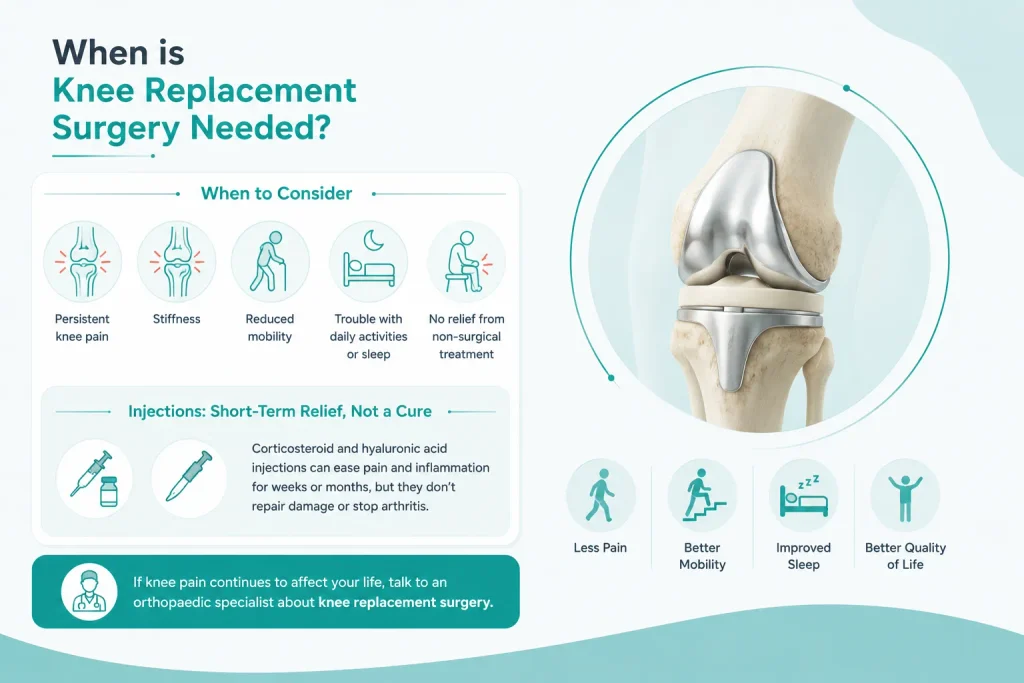
Knee replacement surgery may be considered when persistent knee pain, stiffness and reduced mobility continue to interfere with daily life despite appropriate non-surgical treatment. If physiotherapy, exercise, weight management, medicines or injections are no longer providing meaningful relief, your orthopaedic specialist can explain whether surgery is appropriate and the potential benefits of knee replacement surgery.
Corticosteroid and hyaluronic acid injections can reduce knee pain and inflammation for weeks or months, but they do not repair damaged cartilage or reverse the underlying joint changes causing the pain. They can be a useful tool for symptom control, but they are not a long-term solution for advanced arthritis. When the knee pain continues to affect walking, sleep or quality of life, discussing knee replacement surgery with an orthopaedic specialist can help you understand whether it is appropriate for your situation.
The decision to consider knee replacement is not based on an X-ray alone. Doctors also look at how severe and persistent your symptoms are, how much the knee affects walking, sleep and everyday activities, and whether non-surgical treatments have provided enough relief. When knee pain and stiffness continue to limit your quality of life despite appropriate conservative care, knee replacement may become a reasonable treatment option.
Criteria for Knee Replacement Surgery
Knee replacement surgery criteria include mainly three points. The ongoing knee pain is from at least three to six months, there is X-ray evidence of significant joint damage, and there is no significant relief from conservative treatment despite genuinely trying it.
Alongside these core criteria, doctors also examine how much the knee is affecting your quality of life and daily function, since two people with similar X-rays may have very different levels of actual disability.
It is important to note that the current clinical evidence does not support delaying surgery once these criteria are met in the hope that more physiotherapy, more medication or more injections will eventually work. Guidance from major rheumatology and orthopaedic bodies states that patients who meet the criteria for joint replacement and have already failed conservative treatment should generally proceed to surgery without further delay. (American College of Rheumatology and American Association of Hip and Knee Surgeons, 2023).
“I often see patients who have pushed through months, sometimes years, of pain because they feel like trying surgery too soon means they didn’t give physiotherapy or injections a fair chance. But once the criteria are genuinely met, waiting longer usually doesn’t change the outcome, it just means living with more pain than necessary. Reaching that point isn’t a failure but what the evidence tells us works best for that stage of arthritis.”
— Dr. Abrar Mohammed, Orthopaedics,
Cura Hospitals
If you have persistent knee pain, significant joint damage on X-ray and little relief from conservative treatment, speak with an orthopaedic specialist to understand whether knee replacement may be appropriate for you.
Types of Knee Replacement Surgery
The knee replacement surgery types mainly include total, partial and robotic-assisted. Total knee replacement replaces the entire joint surface, partial knee replacement replaces only the damaged section while preserving healthy bone and ligaments, and robotic-assisted surgery uses computer-guided precision to help position the implant more accurately. The right option depends on how much of the knee is actually affected.
| Knee Replacement Type | When It May Be Suitable | What Happens in the Surgery |
| Partial Knee Replacement | When arthritis is limited to one part of the knee joint | Less tissue is disturbed during surgery, which may allow a faster recovery in suitable patients. |
| Total Knee Replacement | When arthritis or joint damage is more widespread across the knee | Replaces the damaged surfaces across the affected joint |
| Robotic-Assisted Knee Replacement | When robotic assistance is considered appropriate by the surgical team | May improve surgical planning and precision, but technology alone does not guarantee better long-term outcomes. |
The choice between these types of knee replacement depends mainly on how much of the knee is affected by arthritis and where the damage is located.
Partial knee replacement may suit people whose arthritis is limited to one part of the joint, while total knee replacement is generally considered when the damage is more widespread. Robotic assistance can also support more precise surgical planning and implant positioning in selected knee replacement procedures.
At Cura Hospitals, robotic knee replacement combines advanced technology with individualised surgical planning. Your orthopaedic surgeon will recommend the most appropriate approach, including whether robotic assistance is likely to add value, based on the condition of your knee pain.
Knee replacement surgery recovery
Recovery from knee replacement surgery is a gradual process wherein most of the people begin walking with support within a day of surgery, transition to walking without support within four to six weeks, and reach substantial functional recovery by three months, with continued improvement for up to a year.
Physiotherapy typically starts the day after surgery and continues for several weeks, since strength and range of motion recover fastest with consistent, guided movement rather than rest alone. Pain and swelling are normal in the first few weeks and steadily improve. Most patients return to normal daily activities, including light exercise and driving, within six to eight weeks, though higher-impact activities may take longer. Your surgical team will give you a specific timeline based on which procedure you had and your general health going in.
Watch: Dr. Abrar Mohammed explains about the knee replacement surgery.
Book an Orthopaedic Assessment
The only reliable way to know whether your knee has reached the point where knee replacement should genuinely be discussed is a proper examination and X-ray review by an orthopaedic specialist, not a symptom checklist read online.
Cura’s orthopaedics team regularly helps patients work through exactly this decision, reviewing your history, examining your knee, and discussing whether continued conservative care, or knee replacement surgery, is the right next step.
For patients considering the robotic approach, our robotic knee replacement programme in Bangalore combines surgical experience with computer-guided precision. Book an orthopaedic consultation for examination, X-ray review and a personalised knee treatment plan.
If ongoing knee pain is affecting your mobility or daily activities, an orthopaedic assessment can help determine whether you should continue conservative treatment or discuss knee replacement options.
References
American College of Rheumatology and American Association of Hip and Knee Surgeons (2023) Guideline for the Optimal Timing of Elective Hip and Knee Arthroplasty.
Schmitt, J. et al. (2017) ‘Indication criteria for total knee arthroplasty in patients with osteoarthritis: a multi-perspective consensus study’, Zeitschrift für Orthopädie und Unfallchirurgie, 155(5), pp. 539–548.
Singh, J.A. et al. (2013) ‘Total joint replacement surgery versus conservative care for knee osteoarthritis and other non-traumatic diseases‘, Cochrane Database of Systematic Reviews.
Vermue, H. et al. (2025) ‘Standardized intraoperative robotic laxity assessment in TKA leads to no clinically important improvements at 2 years postoperatively: a randomized controlled trial‘, Clinical Orthopaedics and Related Research, 483(10), pp. 1866–1874.
Uncategorized Health Concerns?
Our specialists at Cura Hospitals are here to help with screening, diagnosis, risk assessment, and personalized treatment plans tailored to your health needs.
Schedule A ConsultationFrequently Asked Questions
Knee replacement is generally needed when pain has continued for several months despite medication, physiotherapy and injections, and X-rays confirm significant joint damage. The decision combines symptom severity, imaging findings and how much the knee is limiting your daily life.
If pain plateaus or worsens over several months of consistent physiotherapy, rather than showing gradual improvement, it is a sign the approach may need reassessment. A single difficult week does not mean physiotherapy has failed, but a stalled trend over months usually does.
No. Injections reduce pain and inflammation temporarily but do not repair the underlying joint damage. They are useful for managing symptoms or buying time, though their benefit often shortens with repeated use as arthritis progresses.
Total knee replacement replaces the entire joint surface, while partial knee replacement replaces only the damaged section, preserving healthy bone and ligaments. Partial replacement generally allows faster recovery but only suits arthritis limited to one part of the knee.
Not automatically. Robotic assistance improves surgical precision, but recent research shows it does not always produce a clinically significant difference in outcomes compared with well-performed conventional surgery. Surgeon experience remains just as important as the technology used.