Gallstones Without Severe Pain: When Is Gallbladder Surgery Recommended?
 Cura Hospitals

At a Glance: Gallstones found incidentally on a scan don’t automatically mean you need surgery. Whether they need treatment depends on symptoms, size, and complication risk.
No symptoms: many silent gallstones can be safely observed for years with periodic review
Recurring pain: a clear signal that observation may no longer be enough
Emergency signs: fever with abdominal pain, jaundice, back pain with vomiting, or severe tenderness.
Treatment: laparoscopic cholecystectomy (keyhole gallbladder removal) is the standard approach when surgery is needed
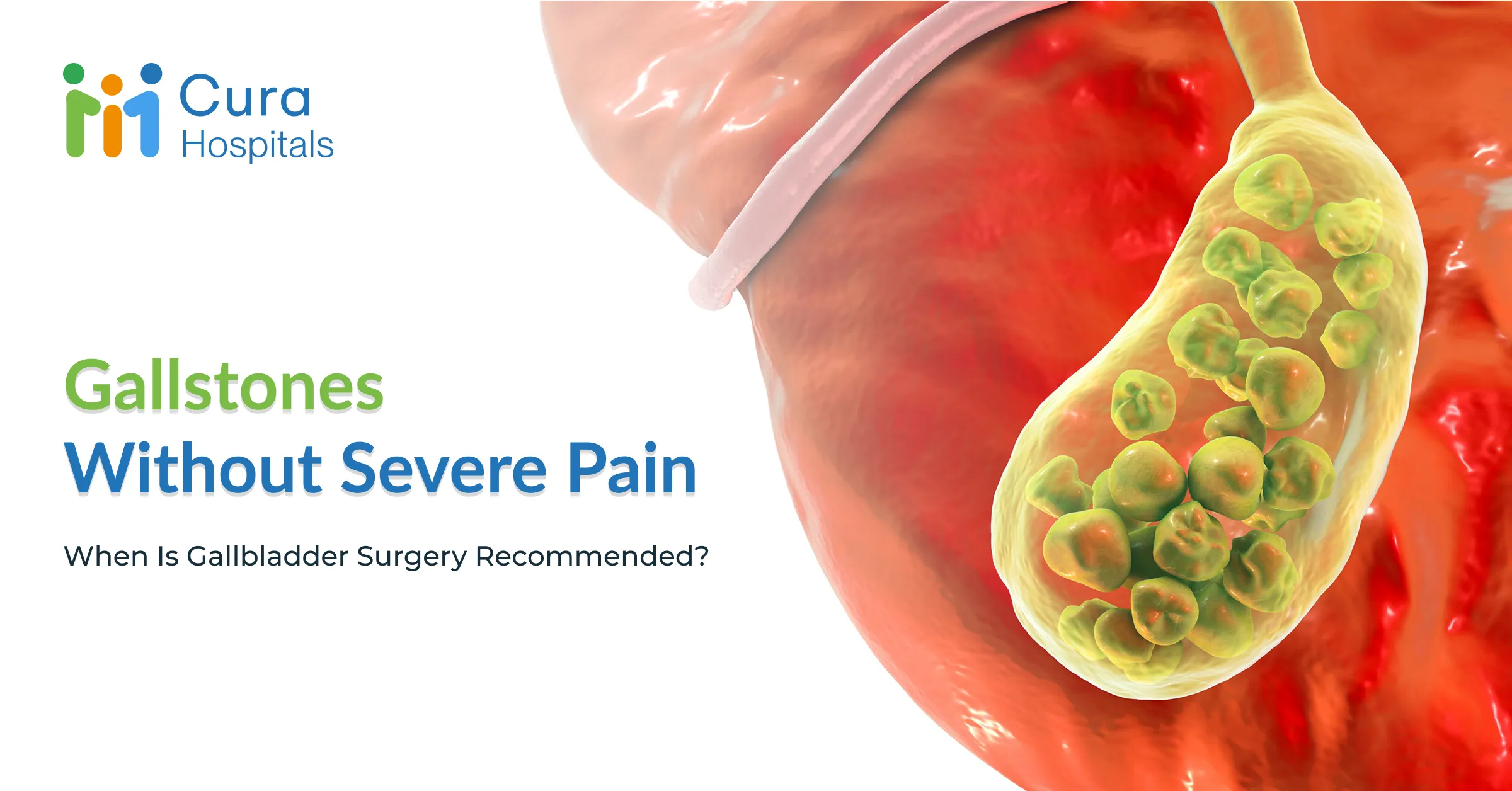
Gallstones are small, hardened deposits that form inside the gallbladder, and many people only discover them during a routine ultrasound scan. Whether that finding needs gallbladder surgery depends less on the stones and more on the symptoms, size, and risks that come with them.
If your ultrasound report just came back showing gallstones and you’re not in any real pain, you’re probably left wondering what you’re actually supposed to do about it. That confusion is fair. A lot of patients assume a stone automatically means an operation, and just as many assume that no pain means no problem, and neither of those assumptions is quite right. This blog looks at what an incidental gallstone finding actually means, when your doctor might simply keep an eye on it, and when it’s genuinely time to talk about gallbladder surgery.
What Do Gallstones Without Symptoms Mean?
Incidental gallstones are stones found on a scan done for another health concern, even when you have no typical gallbladder pain or symptoms. These gallstones do not necessarily mean you need treatment, as many people have gallstones without symptoms that remain harmless for years.
Studies have found that most people with silent gallstones do not develop symptoms or require gallbladder surgery (Gracie and Ransohoff, 1982; McSherry et al., 1985).
Typical and Atypical Symptoms
Gallstone symptoms can vary from classic biliary pain to less specific digestive symptoms. Typical symptoms are more suggestive of gallbladder disease, while atypical symptoms such as bloating or indigestion can overlap with other digestive conditions.
| Typical Symptoms | Atypical Symptoms |
| Steady or cramping pain in the upper right or centre of the abdomen | Bloating, particularly after meals |
| Pain may occur after eating a fatty or heavy meal. | Mild indigestion |
| Pain may spread towards the right shoulder blade. | Occasional dull abdominal ache that comes and goes |
| Abdominal pain may be significant and persistent. | Nausea without an obvious cause |
| Symptoms may be associated with gallbladder contraction after a meal. | Symptoms may occur without a clear pattern or may resemble other digestive problems. |
Because these atypical symptoms are common in many digestive conditions, symptoms alone cannot confirm that gallstones are the cause. An ultrasound along with a proper clinical assessment can help determine whether the gallstones are actually responsible for the symptoms.
If you experience persistent abdominal pain, bloating, nausea, or discomfort after meals, consult a specialist to determine whether gallstones are causing your symptoms.
When Can Gallstones Be Monitored Without Surgery? w
Observation, rather than surgery, tends to be reasonable when gallstones are genuinely asymptomatic, of modest size, and there’s no evidence of complications on imaging or blood test.
“Observation” isn’t a one-time decision you make and forget. It usually means periodic review, watching for new symptoms, and being clear with your doctor about anything that changes, rather than quietly assuming the stones will never cause trouble.
“A lot of patients come in worried the moment they hear the word ‘gallstones’, assuming it means surgery is inevitable. In reality, if there are no symptoms and nothing concerning on the scan, we simply keep track of it together. What matters is that you come back if something changes, not that we operate just because a stone showed up.”
— Dr. Devaprashanth M, General Surgeon,
Cura Hospitals
One question we hear constantly is whether a specific stone size, an 11mm stone in the gallbladder, say, changes the calculation. Size alone isn’t the whole story, but it is one factor your surgeon will consider alongside your symptoms, your gallbladder wall thickness on ultrasound, and your overall health, since larger stones can behave differently than smaller ones over time.
Recurrent Pain and Complications
Recurrent biliary pain, pain that keeps coming back rather than a single isolated episode, is one of the clearer signals that observation may no longer be the right approach. Once symptoms become a pattern, the chances of surgery increase.
If you’ve had more than one episode of pain that fits the gallstone pattern, especially if each episode has been getting more intense or lasting longer than the one before, you need medical attention.
Warning Signs of Cholecystitis, Jaundice or Pancreatitis
Certain gallstone symptoms indicate the need for prompt medical attention. Acute cholecystitis, gallstone pancreatitis, and bile duct blockage are the three common complications that doctors check closely for. (Yokoe et al., 2018).
Get assessed quickly, the same day if possible, if you notice:
- Fever along with abdominal pain, particularly pain that’s sharp and persistent in the upper right abdomen
- Yellowing of the skin or eyes (jaundice), or unusually dark urine and pale stools
- Pain that spreads to the back and is accompanied by vomiting, which can point toward pancreatitis
- Abdominal tenderness severe enough that pressing on the area, or even breathing deeply, makes it noticeably worse
These aren’t symptoms to push through or manage with painkillers at home. A blocked bile duct or an inflamed, infected gallbladder may cause unwanted complications quickly, and getting to a hospital with round-the-clock surgical capability, an accredited surgical facility, is the safer call every time.
Tests Before Surgery
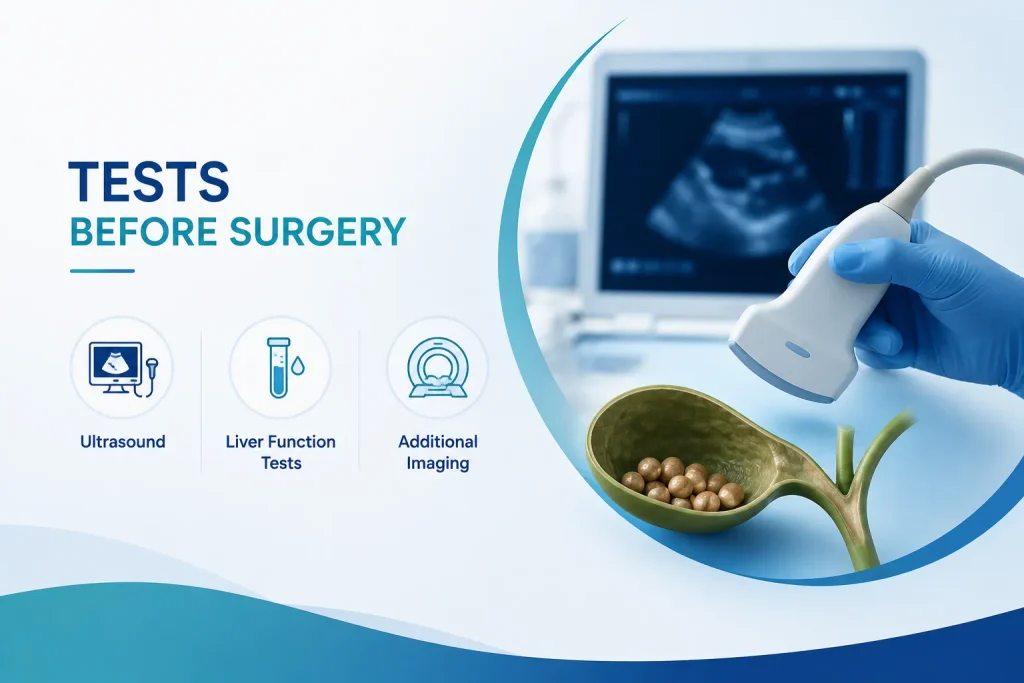
Before recommending gallbladder surgery, your surgical team will usually want a recent abdominal ultrasound, liver function blood tests, and sometimes additional imaging if there’s any suspicion the stones have moved into the bile duct itself.
An ultrasound confirms stone number, size, and gallbladder wall condition. Liver function tests can flag whether a stone has already caused some obstruction, even before jaundice becomes visible.
If your reports suggest a stone may have entered the bile duct, your team may recommend an additional scan or procedure to clear it before or during surgery. Cura’s diagnostics and imaging team typically works alongside general surgery on exactly this kind of pre-surgical workup, so nothing gets missed before you’re in the operating room.
Laparoscopic Cholecystectomy and Recovery
Laparoscopic cholecystectomy, keyhole removal of the gallbladder through a few small incisions, is the standard approach for the vast majority of gallstone cases today, and it’s generally what people mean when they search for gallstone treatment. Open surgery is still used, but usually only when laparoscopic access isn’t safe or feasible for a particular patient.
Most people go home within a day or two of a straightforward laparoscopic procedure, resume light activity within about a week, and are back to their normal routine within two to four weeks depending on the individual and the type of work they do.
Most patients adjust to eating normally within a few weeks, sometimes with minor, temporary changes. Recovery specifics vary by technique and by whether the surgery was planned in advance or performed urgently for a complication, which is one more reason an early conversation with a surgeon tends to be better than a rushed one during an emergency.
Talk to a General Surgeon Before Deciding
There’s no substitute for having an actual surgeon look at your specific ultrasound and blood work before deciding whether to watch, wait, or operate. Gallstone size, gallbladder wall changes, symptom pattern, and liver function all factor into that call differently for every patient.
Cura’s general surgery team works closely with gastroenterology whenever a case needs that second angle and with our own diagnostics and imaging unit so your reports don’t get lost between departments.
If you’re looking for an experienced general surgeon in Bangalore to review an incidental gallstone finding, that’s exactly the kind of consultation we handle regularly, not just the urgent cases. Book a general surgery consultation and bring your ultrasound and liver function reports along, so your surgeon can review your actual case rather than guessing from symptoms alone.
Found gallstones on an ultrasound? Get your reports reviewed by a specialist to understand whether monitoring or treatment is right for you.
References
Gracie, W.A. and Ransohoff, D.F. (1982) ‘The natural history of silent gallstones: the innocent gallstone is not a myth‘, New England Journal of Medicine, 307(13), pp. 798–800.
McSherry, C.K., Ferstenberg, H., Calhoun, W.F., Lahman, E. and Virshup, M. (1985) ‘The natural history of diagnosed gallstone disease in symptomatic and asymptomatic patients‘, Annals of Surgery, 202(1), pp. 59–63.
Yokoe, M., Hata, J., Takada, T., Strasberg, S.M., Asbun, H.J., Wakabayashi, G., Kozaka, K., Endo, I., Deziel, D.J., Miura, F., Okamoto, K., Hwang, T.L., Huang, W.S.W., Ker, C.G., Chen, M.F., Han, H.S., Yoon, Y.S., Choi, I.S., Yoon, D.S. and Yamamoto, M. (2018) ‘Tokyo Guidelines 2018: diagnostic criteria and severity grading of acute cholecystitis‘, Journal of Hepato-Biliary-Pancreatic Sciences, 25(1), pp. 41–54.
Uncategorized Health Concerns?
Our specialists at Cura Hospitals are here to help with screening, diagnosis, risk assessment, and personalized treatment plans tailored to your health needs.
Schedule A ConsultationFrequently Asked Questions
No. Many gallstones, particularly ones found incidentally with no symptoms, can be safely observed for years. Surgery becomes the recommended path once pain becomes recurrent, complications appear, or warning signs like fever, jaundice, or pancreatitis show up.
For a large number of people, yes, at least for a long time. Long-term studies of symptom-free gallstones show low complication rates that tend to drop further the longer someone stays symptom-free, though periodic review with a doctor is still worthwhile.
Not automatically. Size is one factor your surgeon considers alongside symptoms, gallbladder wall thickness, and overall health. An 11 mm stone with no symptoms is managed differently from one causing recurrent pain or showing signs of complication.
For most patients, gallstone treatment means laparoscopic cholecystectomy, keyhole removal of the gallbladder. Open surgery is reserved for cases where keyhole access isn’t safe, and observation remains appropriate for genuinely asymptomatic stones without complications.
Fever with abdominal pain, yellowing of the skin or eyes, pain spreading to the back with vomiting, or abdominal tenderness severe enough to worsen with pressure or deep breathing all need urgent evaluation, not a wait-and-see approach.