Hernia: When Is Watchful Waiting Safe and When Is Surgery Needed?

 Cura Hospitals

At a Glance: A hernia is a bulge that forms when tissue pushes through a weak spot in the abdominal wall. Small, painless hernias may be safely monitored under a doctor’s regular review, but surgery is generally needed when a hernia grows, becomes painful, or stops going back in on its own.
Watchful waiting: an option for small, minimally symptomatic hernias in adults, under regular medical review
Surgery needed: if the hernia is growing, painful, firm, or interfering with daily activity
Emergency signs: sudden severe pain, discolouration, a hernia that won’t push back in, fever, or vomiting
Options: open or laparoscopic repair, chosen based on the hernia’s size, location, and your health
A hernia is a bulge that forms when part of an internal organ or tissue pushes through a weak spot in the surrounding muscle wall, most often in the groin, the belly button, or elsewhere on the abdomen. Some hernias can be safely watched for a while under a doctor’s guidance, but others need timely hernia surgery to avoid serious complications.
If you or someone you care for has just been told, “You have a hernia,” it is completely normal to feel unsure about what happens next. You are not overreacting by wanting clear answers, and you are not wrong to want to understand your options before deciding anything.
This guide walks through what a hernia actually is, when doctors may suggest simply monitoring it, which symptoms mean it is time to seriously consider hernia treatment, and which signs mean you should get to a hospital right away.
What Is Hernia?
A hernia happens when an organ, usually part of the intestine, pushes through a weak or torn area in the muscle or tissue that is meant to hold it in place. It often looks and feels like a soft lump under the skin that may grow larger when you stand, cough, or strain and shrink or disappear when you lie down and relax.
The abdominal wall is built to hold everything inside, but certain areas are naturally weaker than others, especially where blood vessels, the spermatic cord, or the umbilical cord once passed through during development. Age, heavy lifting, chronic coughing, obesity, pregnancy, and prior surgery can all put extra strain on these weak points over the years, which is why hernias become more common as people get older.
Symptoms and Common Types
The most common hernia symptom is a visible or feelable bulge that appears near the groin, the belly button, or an old surgical scar, sometimes with mild aching or a dragging sensation, especially after standing for long periods or lifting something heavy.
The type of hernia is usually named after where it occurs.
| Type of Hernia | Description |
| Inguinal hernia | Develops in the groin and is the most common type by far and appears more often in men, though women can develop it too. |
| Umbilical hernia | Develops near the belly button and is common in babies but also appears in adults, particularly after pregnancy or significant weight gain. |
| Incisional hernia | At the site of a previous abdominal surgery, where the muscle never fully regained its original strength. |
| Hiatal hernia | Where part of the stomach pushes up into the chest through the diaphragm, causing symptoms more like heartburn than a visible lump. |
Not every hernia causes pain in the early stages. Some are found only during a routine check-up or while investigating an unrelated concern, which is one reason a proper clinical examination matters even if symptoms feel mild.
When Watchful Waiting May Be Discussed
Watchful waiting means monitoring a hernia over time instead of operating on it immediately, and it is generally only considered safe for small, minimally symptomatic hernias in adults, under a doctor’s regular review. It is not a do-it-yourself decision but a specific, monitored plan a general surgeon agrees to with you.
“Patients are often relieved to hear that not every hernia needs immediate surgery, but I always make clear that watchful waiting isn’t the same as ignoring it. We agree on what changes to watch for, and if the hernia starts causing more pain or stops reducing on its own, that’s when we revisit the plan together.”
— Dr. Devaprashanth M, General Surgeon,
Cura Hospitals
One of the most well-known studies found that watchful waiting was an acceptable option, since serious complications during observation were genuinely rare (Fitzgibbons et al., 2006).
More recent trial evidence has continued to support watchful waiting specifically for hernias causing little to no pain, as a genuinely safe starting point rather than a compromise (Meuzelaar et al., 2025).
In practice, this option tends to be discussed when the hernia is small, easily pushed back in, causing minimal or no pain, and the patient does not have other health conditions that would make a future emergency operation particularly risky.
When Does a Hernia Need Surgery?
A worsening hernia usually shows up as increasing pain, a bulge that keeps growing or no longer goes away when you lie down, or discomfort that starts interfering with daily activities like walking, working, or sleeping. These changes are your body’s way of telling you that watchful waiting may no longer be the right plan.
Other signs worth paying attention to include a dragging or heavy sensation that lasts longer through the day, pain that spreads toward the thigh or lower abdomen, or the bulge becoming firmer and more tender to touch than before. None of these on their own are an emergency, but they are a clear sign to book a proper reassessment with a general surgeon rather than waiting for the next routine check-up. Learn more about the hernia pain from the team of Cura Hospitals.
Freedom from hernia pain starts here!
Emergency Signs of Obstruction or Strangulation
A strangulated hernia is a genuine medical emergency that happens when the blood supply to the trapped tissue gets cut off, and it needs immediate hospital care. This is the one part of hernia care where waiting even a few hours can matter.
Go to the nearest emergency department immediately if the hernia becomes the following:
- Suddenly very painful, especially if the pain is severe and does not ease up
- Red, discoloured, or dark, rather than the normal skin tone around it
- Hard and impossible to push back in, when it was previously reducible
- Accompanied by fever, vomiting, or an inability to pass gas or stool, which can point to a bowel obstruction
If you notice any of these signs, do not wait to see if they improve on their own, and do not try to push the hernia back in yourself. Head to an emergency room right away, ideally one with round-the-clock surgical capability, such as an accredited surgical facility equipped to operate immediately if needed.
If you notice signs of hernia obstruction or strangulation, seek urgent surgical evaluation to assess your condition and determine the right treatment.
Open vs Laparoscopic Hernia Surgery
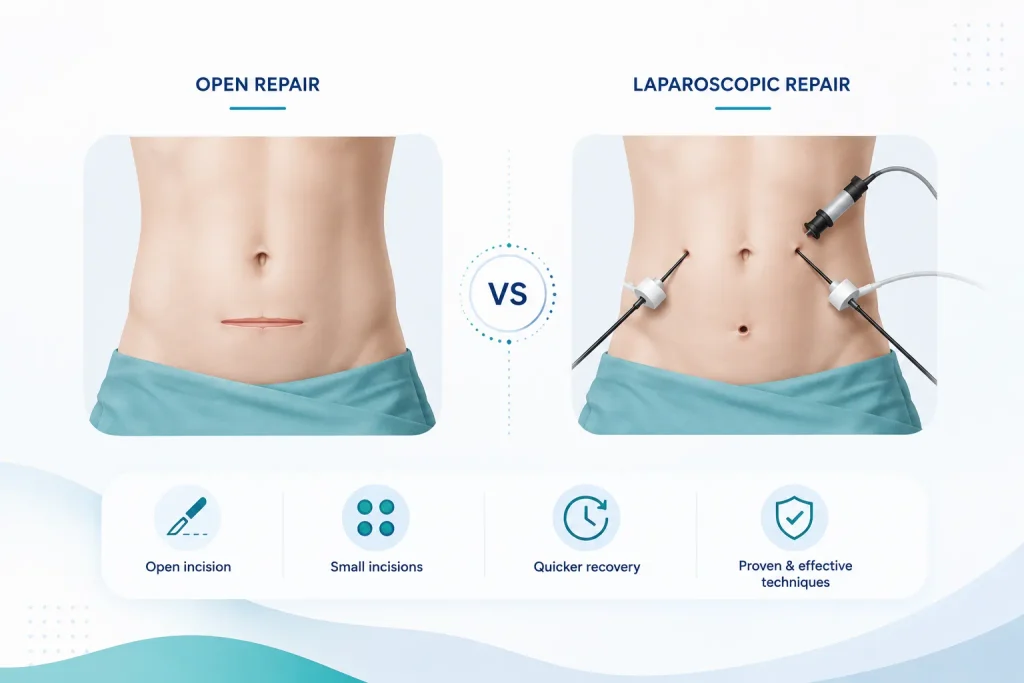
Open repair involves a single incision directly over the hernia, while laparoscopic hernia surgery uses a few small cuts and a camera to repair the defect from behind the muscle wall, and the right choice depends on the hernia’s size, location, history, and your overall health. Both are well-established, effective techniques.
A large overview of systematic reviews comparing the two approaches found that laparoscopic repair is associated with a meaningfully lower risk of long-term chronic groin pain, while recurrence rates between the two techniques were broadly similar (Haladu et al., 2022).
Laparoscopic surgery also tends to involve smaller scars, sometimes less postoperative discomfort, and a quicker return to normal activity, though it typically takes a little longer on the operating table and is not always suitable for every hernia type. Very large or complicated hernias, or certain recurrent ones, may still be better suited to an open approach. This decision is best made together with your surgeon after a proper examination, not from a generic comparison chart, since it depends on details specific to your hernia and your health history.
Recovery and Recurrence Factors
Recovery from hernia surgery typically takes a few weeks for most daily activities and around four to six weeks before returning to heavy lifting or strenuous exercise, though this varies by technique, hernia size, and individual healing. Recurrence, the hernia coming back after repair, is uncommon with modern mesh-based techniques but is not impossible.
A few factors genuinely influence how well recovery goes and how likely a hernia is to return. Follow your surgeon’s activity restrictions in the first few weeks, maintaining a healthy body weight, managing any chronic cough or constipation that repeatedly strains the abdominal wall, and avoiding heavy lifting before your surgeon has cleared you to resume it.
None of these guarantee a perfect outcome on their own, but together they meaningfully reduce the odds of complications or recurrence, and your care team will usually walk you through a specific plan based on your surgery type.
Talk to a General Surgeon Before Deciding
The only way to know for certain whether your hernia is safe to monitor or needs timely repair is a proper clinical examination by a general surgeon, since hernia type, size, and symptoms vary enormously from person to person.
At Cura, our general surgery team, including Dr. Devaprashanth M, regularly helps patients work through exactly this decision, confirming the hernia type, discussing whether observation is genuinely appropriate for your case, and explaining what open or laparoscopic repair would involve if surgery is the right next step. If you are searching for dependable hernia surgery in Bangalore, our team also works with most major insurance and TPA partners, so cost concerns do not have to stand between you and the right decision for your health. If you are unsure about your next step, contact our team to discuss your symptoms, diagnosis, and available hernia treatment options with an experienced surgical team.
Book a General Surgery consultation today to confirm your hernia type and discuss observation and hernia surgery in Bangalore today.
References
Fitzgibbons, R.J., Giobbie-Hurder, A., Gibbs, J.O., Dunlop, D.D., Reda, D.J., McCarthy, M., Neumayer, L.A., Barkun, J.S., Hoehn, J.L., Murphy, J.T., Sarosi, G.A., Syme, W.C., Thompson, J.S., Wang, J. and Jonasson, O. (2006) ‘Watchful waiting vs repair of inguinal hernia in minimally symptomatic men: a randomized clinical trial‘, JAMA, 295(3), pp. 285–292.
Haladu, N., Alabi, A., Brazzelli, M., Imamura, M., Ahmed, I., Ramsay, G. and Scott, N.W. (2022) ‘Open versus laparoscopic repair of inguinal hernia: an overview of systematic reviews of randomised controlled trials‘, Surgical Endoscopy, 36(7), pp. 4685–4700.
Meuzelaar, R.R., Verleisdonk, E.J.M.M., Schiphorst, A.H.W., den Hartog, F.P.J., Tanis, P.J. and Burgmans, J.P.J. (2025) ‘Watchful waiting versus totally extraperitoneal (TEP) hernia repair for occult inguinal hernia and pain (EFFECT trial), a multicenter, non-inferiority, randomized controlled trial‘, Surgical Endoscopy.
Uncategorized Health Concerns?
Our specialists at Cura Hospitals are here to help with screening, diagnosis, risk assessment, and personalized treatment plans tailored to your health needs.
Schedule A ConsultationFrequently Asked Questions
A hernia generally needs surgery when it causes ongoing pain, keeps growing, no longer reduces on its own, or starts limiting daily activity. Any hernia that becomes suddenly painful, hard, discoloured, or associated with vomiting or fever needs emergency surgical assessment right away.
No. Watchful waiting is generally only considered for small, minimally symptomatic hernias in adults, and only under a doctor’s regular review. It is not considered safe for hernias that are painful, enlarging, or difficult to push back in, and it is not appropriate for suspected strangulation, which needs emergency care.
Open hernia treatment repairs the defect through a single incision directly over the hernia, while laparoscopic hernia surgery uses a few small incisions and a camera to repair it from behind the muscle. Laparoscopic repair is generally linked to less chronic pain afterward, while both approaches show similar recurrence rates overall.
Extremely urgent. A strangulated hernia cuts off blood supply to trapped tissue and can become life-threatening within hours if untreated. Sudden severe pain, a hard bulge that cannot be pushed back in, discolouration, fever, or vomiting all call for an emergency room visit immediately.
Most people resume light daily activities within one to two weeks, while heavy lifting and strenuous exercise are usually avoided for four to six weeks, depending on the technique used and the individual’s healing. Your surgeon will give you a specific timeline based on your particular surgery.