
Dermatographic Urticaria / Skin Writing: Why Scratching Causes Raised Lines and When to Treat
 Cura Hospitals

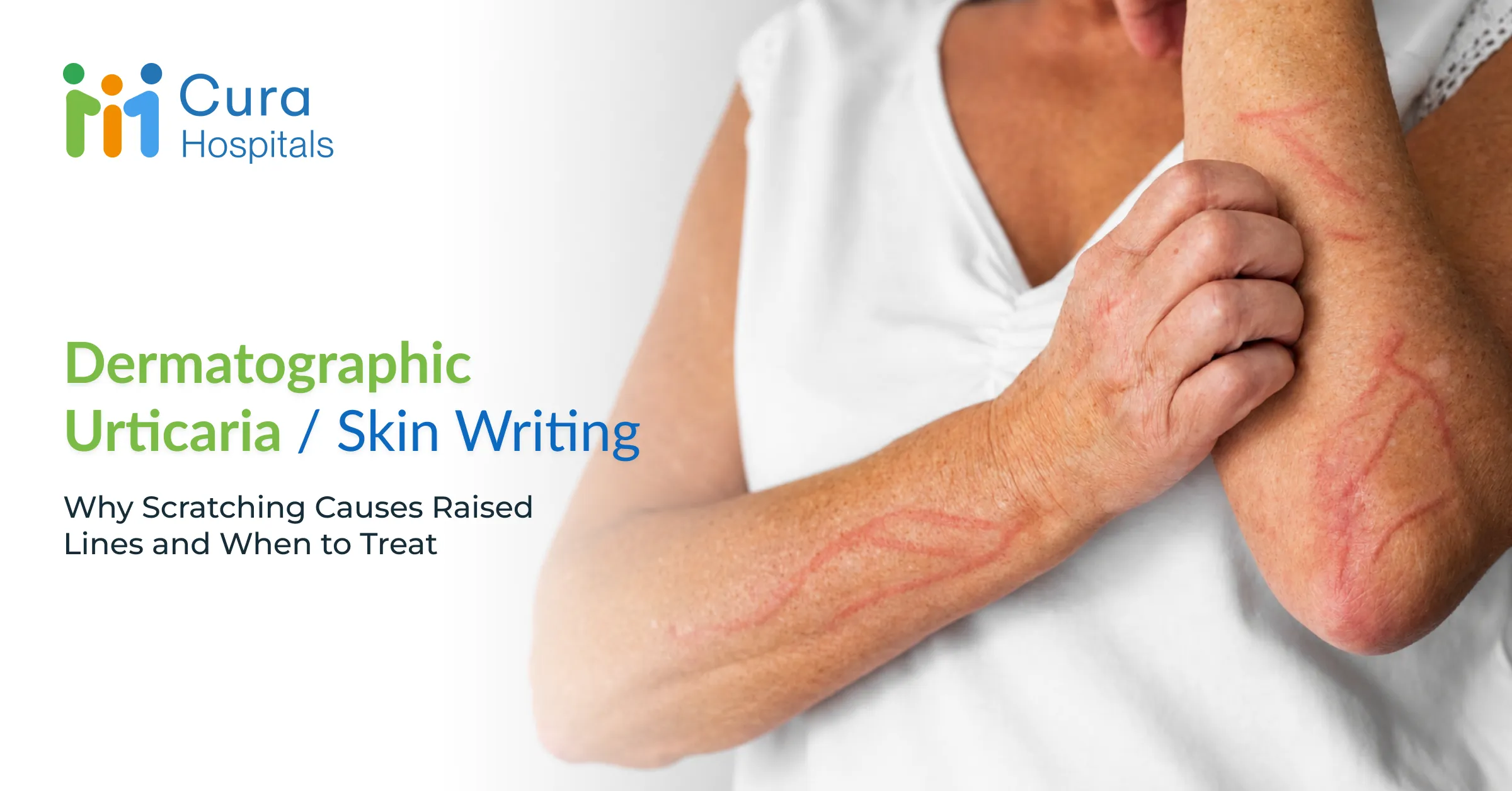
Some people notice it accidentally. They scratch an itch, and a few minutes later, the scratch mark has turned into a raised, red welt that looks almost like a line drawn on the skin. Others discover it when a tight waistband or a bag strap leaves behind a temporary but very visible mark. If this sounds familiar, you may have dermatographic urticaria, one of the more common but least talked about skin conditions out there.
What is Dermatographic Urticaria?
Dermatographic urticaria, also called ‘dermographism urticaria’ or ‘skin writing disease’, is a condition where the skin reacts to minor physical pressure or friction by producing raised, itchy lines or welts. The name itself comes from the Greek and Latin words for skin writing, which describes exactly what it looks like. If you were to drag a blunt object gently across the skin of someone with this condition, the skin would respond by writing the path back in raised red lines.
It is estimated to affect around 2 to 5 per cent of the population, making it one of the most common forms of urticaria, or hives. Most people with the condition are between 20 and 30 years old when it first appears, though it can develop at any age. In many cases, it resolves on its own over months to years, though some people live with it for much longer.
Why Scratching Creates Raised Lines
To understand why this happens, it helps to know a little about what is going on under the surface of the skin. When someone with dermatographic urticaria experiences friction or pressure, the mast cells in the skin release a chemical called histamine. This histamine causes the small blood vessels in the area to dilate and leak fluid into the surrounding tissue, which is what produces that characteristic raised, reddened line.
This response is essentially the same mechanism behind a regular allergic skin reaction, but the trigger here is not an allergen. It is simply physical contact. The skin’s immune cells are reacting to touch the way they would normally only react to something they identify as a threat. Why some people’s skin does this and others’ does not is still not fully understood, but it is believed to involve a heightened sensitivity of the mast cells in the skin rather than a true allergy.
The raised lines after scratching skin typically appear within a few minutes of friction and fade on their own within 15 to 30 minutes, leaving no lasting marks.
Is Skin Writing Dangerous?
For the vast majority of people, dermatographic urticaria is not dangerous. It is uncomfortable and can be visually striking, but it does not damage the skin, spread to internal organs, or indicate a serious underlying disease in most cases.
That said, it is worth paying attention to. When the condition is severe, even the friction of clothing, a towel, or bedsheets can trigger visible welts across large areas of the body. For some people, this significantly disrupts sleep, exercise, and daily comfort. A small number of people also experience a form called symptomatic dermographism, where the welts are intensely itchy rather than just mildly uncomfortable, and this can affect quality of life in a very real way.
Common Triggers
The physical trigger for dermatographic urticaria is friction or pressure, but several factors can make the condition more reactive or harder to manage:
- Heat and sweating, which tend to amplify skin sensitivity
- Cold temperatures in some individuals, particularly when moving from a cold environment to a warm one
- Emotional stress, which is known to lower the threshold for skin reactivity in many urticaria conditions
- Tight clothing, watches, bra straps, waistbands, or anything that creates sustained pressure on the skin
- Exercise, particularly activities that involve repeated friction or contact
- Hot showers or baths
- Dry skin, which tends to be more reactive than well-moisturised skin
- Infections or illnesses, which can temporarily worsen the condition
Managing triggers is often just as important as any medical treatment, since reducing friction and heat exposure can significantly lower how often and how severely the skin reacts.
Dermatographic Urticaria vs Regular Hives
People sometimes use the word ‘hives’ as a general term for any raised, itchy skin reaction, and while dermatographic urticaria is technically a form of hives, there are meaningful differences worth understanding.
Regular hives, or urticaria in the general sense, typically arise from an internal trigger, most commonly an allergic reaction to a food, drug, insect sting, or infection. The welts can appear anywhere on the body regardless of physical contact and are driven by systemic immune activity. Hives treatment in these cases is often focused on identifying and avoiding the allergen.
Dermatographic urticaria, by contrast, is always linked to a physical stimulus. The welts appear specifically where friction or pressure has occurred and nowhere else. There is no allergen to avoid, and the condition is not caused by food, medication, or an environmental substance in the way classic allergic hives are. This distinction matters because the management approach is different.
When Hives Need Medical Review
Most mild cases of dermatographic urticaria can be managed with simple measures, but certain situations call for a proper medical review:
- When the welts are intensely itchy and interfering with sleep or daily life
- When large areas of the body are affected regularly
- When the condition has appeared suddenly alongside other symptoms like fever, joint pain, or weight changes
- When standard antihistamines are not providing enough relief
- When the condition is worsening despite avoiding known triggers
- When you are unsure whether what you are experiencing is dermatographic urticaria or another form of urticaria that needs different management
Diagnosis by a Dermatologist
Diagnosing dermatographic urticaria is usually straightforward. A dermatologist will take a detailed history of when the condition started, what triggers it, and whether any other symptoms are present. The clinical test is simple: a blunt instrument is drawn across the skin, and the response is observed over the following few minutes. A positive result, meaning a raised, red weal forms along the line of contact, confirms the diagnosis.
In cases where the presentation is atypical or where an underlying cause is suspected, additional blood tests may be ordered to check for thyroid disorders, infections, or inflammatory conditions, since some of these can provoke or worsen urticaria.
Treatment and Trigger Control
The good news is that dermatographic urticaria responds well to treatment in most people. The first line of management is non-sedating antihistamines, which work by blocking the histamine response that causes the welts. These are taken regularly rather than just when a reaction occurs, since consistent histamine suppression keeps the skin’s reactivity at a lower baseline.
Trigger control runs alongside medication. Wearing loose, soft fabrics, keeping skin well moisturised, avoiding very hot showers, managing stress, and keeping the bedroom cool can all make a meaningful difference to how often and how badly the skin reacts. In more resistant cases, higher doses of antihistamines or alternative medications may be considered by a specialist.
It is also worth knowing that dermatographic urticaria often improves on its own over time, and treatment is about managing symptoms rather than curing the condition outright.
When to Consult Cura’s Dermatology Department
You do not need to be dealing with a severe reaction before seeking advice. Consider reaching out to Cura’s dermatology and allergy team if:
- You notice raised lines or welts forming regularly after scratching, pressure, or friction
- The itching is disrupting your sleep or daily comfort
- You are unsure whether your symptoms point to dermatographic urticaria or another skin condition
- You want a proper skin assessment and a personalised treatment plan
At Cura Multispeciality Hospitals, our dermatology and allergy specialists approach skin conditions with thorough clinical evaluation and practical, patient-centred care. Whether you are dealing with mild symptoms or a condition that has been affecting your quality of life for some time, our team can help you identify the right path forward.
Book your consultation with our dermatology team at Cura today.
Media Center Health Concerns?
Our specialists at Cura Hospitals are here to help with screening, diagnosis, risk assessment, and personalized treatment plans tailored to your health needs.
Schedule A ConsultationFrequently Asked Questions
The most direct trigger is physical friction or pressure on the skin, such as scratching, rubbing, tight clothing, or straps. Beyond that, heat, stress, exercise, hot showers, dry skin, and even certain illnesses can make the skin more reactive and lower the threshold for a response.
There is no instant cure, but the condition is very manageable. Regular non-sedating antihistamines are the most effective treatment for reducing reactions. Alongside that, avoiding friction, keeping skin moisturised, wearing loose clothing, and managing stress all help. Many people also find the condition improves on its own over time.
It is not classified as a classic autoimmune disorder, but there is evidence that the immune system plays a role, specifically an overreaction of mast cells in the skin to physical stimulation. In some cases, an underlying thyroid condition or other immune-related issue may be contributing, which is why a proper evaluation is worthwhile.
For most people, no. It is uncomfortable and visually noticeable but not dangerous. In more severe cases where large areas of the body react regularly or the itching disrupts sleep and daily life, it can significantly affect quality of life and is worth treating properly rather than ignoring.
It most commonly appears in young adults between the ages of 20 and 30, but it can develop at any age, including in children and older adults. There is no fixed age of onset, and in some people it appears suddenly with no obvious reason.
Related Blogs

Kidney Stone Size Guide: Can It Pass Naturally, or Does It Need RIRS, URS, or PCNL?

Leg Pain, Swelling or a Non-Healing Wound: Vascular Surgeon, Orthopaedic Doctor or Diabetologist?