Pneumonia in Children – Symptoms Parents Should Watch For and When to Go to Hospital


Key Takeaways
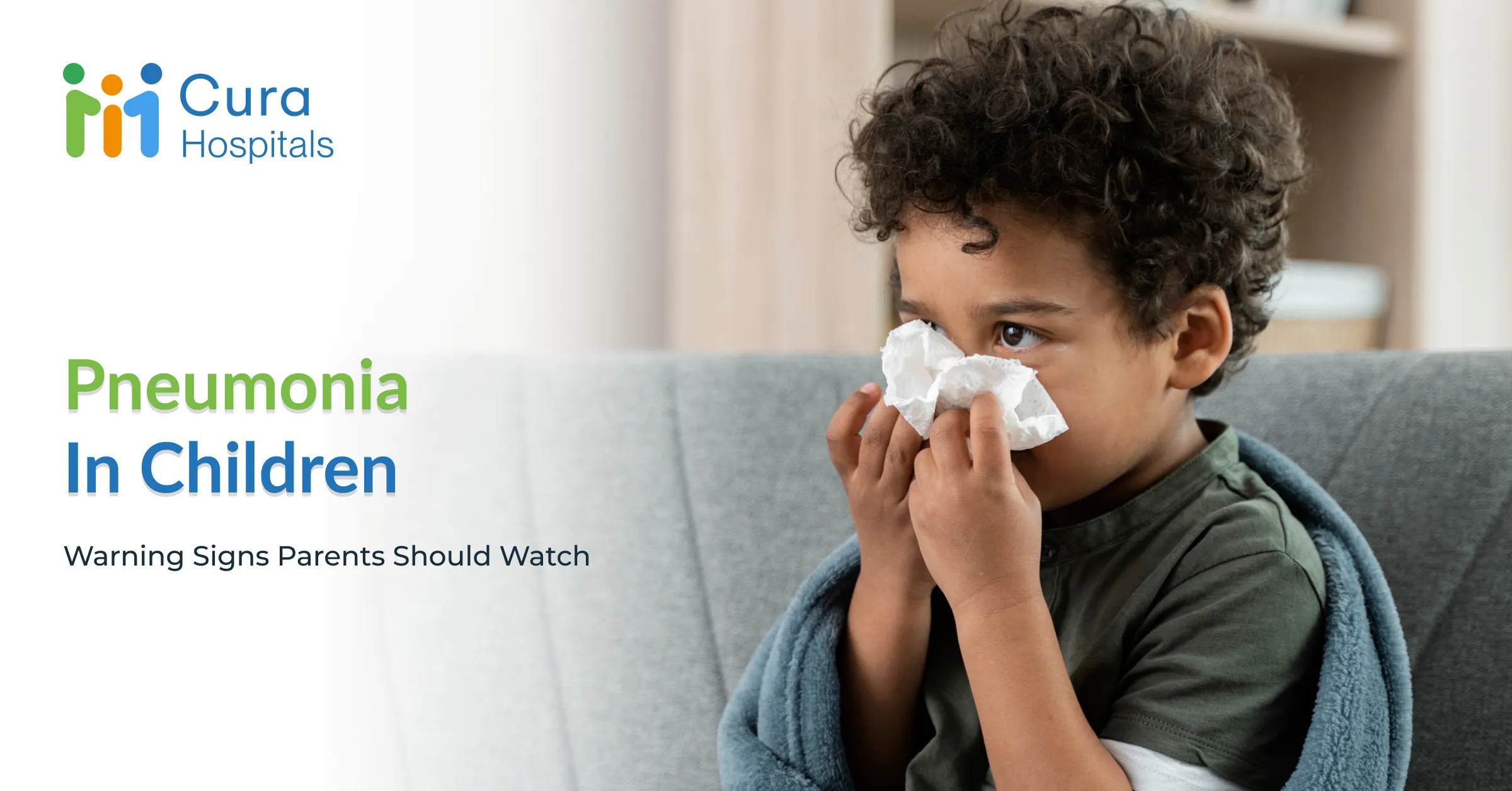
In children, pneumonia is a lung infection which causes the tiny air sacs to fill with fluid or pus that makes it hard to breathe.
The most common pneumonia symptoms in a child are a cough and difficult breathing.
Both bacteria and viruses cause pneumonia in children.
Go to hospital straight away if your child cannot drink or eat properly and has bluish lips. And also when your child is having difficulty in breathing (lower chest pulls in with each breath).
Many children with milder pneumonia recover at home with medicines prescribed by a doctor. Vaccines, breastfeeding and cleaner air lower the risk.
In children, pneumonia is something that parents often hear about. It starts with a cough, fever and blocked nose similar to a cold that every child gets several times a year.
This guide explains the symptoms of pneumonia in a child, how it differs from a cold, what pneumonia in babies looks like, when to go to hospital, how it is treated and how to prevent it. It is meant to help you act early and ask better questions. It cannot replace an examination.
Worried about your child’s breathing or cough?
What Is Pneumonia in Children?
In children, pneumonia is an infection that affects the lungs and the air sacs fill with fluid. This condition makes it harder for oxygen to pass into the blood. Doctors describe that in most cases a healthy child has a community acquired pneumonia, meaning the child caught it outside a hospital.(Singh et al.)
Pneumonia in some children especially in babies it can become serious within a day or two so the way your child is breathing matters more than how high the fever is.
Pneumonia Symptoms in a Child
The symptoms of pneumonia in children vary from child to child and also it depends on the severity of the infection and age. Some signs of pneumonia in children to look for includes –
- A cough that is getting worse day by day along with fever and chills.
- Difficulty in breathing.
- Wheezing or a noisy sound while breathing.
- Tiredness with low energy and poor appetite.
- Vomiting after coughing or a stomachache.
- Chest pain after coughing is commonly seen in older children.
Difficulty in breathing along with a cough or fever is a good enough reason to see a doctor.
Cold or Pneumonia?
Cold and pneumonia may have similar symptoms but they are not the same.
| Feature | More likely a cough or cold | More likely pneumonia |
| Breathing | Normal rate, even with a blocked nose | Fast or looks like hard work |
| Chest | Moves normally | Lower chest pulls in with each breath |
| Feeding and play | Eats and plays fairly well | Feeds poorly, tires quickly or is unusually quiet |
| Fever | Mild and short | May be high or absent in some children |
| Over the next few days | Slowly improves | Stays the same or gets worse |
Doctors classify a child with only a cough and cold and without fast breathing or chest indrawing as not having pneumonia.
Pneumonia in Babies
Pneumonia in babies is harder to detect because a very young baby barely coughs. What signs do you see instead
- Not eating well, being unable to suckle and refuse to eat
- Fever or an unusually cold body
- Fast breathing, their nostrils flaring up, and a grunting sound coming in every breath..
- Lips and tongue turning blue.
A baby under 2 months with any of these signs should see a doctor immediately. Infants under 3 months who have pneumonia are usually admitted to hospital for treatment and monitoring.
Causes and Risk Factors of Pneumonia in Children
Pneumonia in children is caused by viruses such as respiratory syncytial virus (RSV) and influenza and by bacteria such as Streptococcus pneumoniae (pneumococcus), Haemophilus influenzae and Staphylococcus aureus. Indian studies that tested blood and nasal samples from children with pneumonia have looked for both viruses and bacteria, since both play a part (Mathew et al.). In one study from Chandigarh, pneumococcus and RSV were commonly found in the nose and throat of children with severe pneumonia, finding a germ there does not always prove that it caused the illness (Singh et al.).
Children are more likely to get pneumonia or to become more sick with it when they have these risk factors.
- Young babies under the age of two years.
- Vaccination is not received on time including pneumococcal vaccines
- Not being exclusively breastfed in the first 6 months
- In a child with poor care and nutrition
- Smoke from cooking fuels such as wood or cow dung and tobacco smoke inside the house or burning of waste near the home
- Poor ventilation indoors and crowded living conditions
- Long term conditions such as heart or lung disease or weak immunity
Under nutrition, incomplete immunisation and low oxygen levels at presentation are associated with a poorer response to treatment (Singhi, 2008).
How Pneumonia in Children Is Diagnosed
In children, pneumonia is diagnosis based on the medical history and examination. The doctor checks the breathing rate and checks the oxygen level. A chest X-ray and blood tests are usually done for children who are admitted and those who are very ill or not showing signs of improvement.
Treatment of Pneumonia in Children
Treatment depends on the cause and on how serious the infection is.
Antibiotics- Antibiotics are the mainstay for treating bacterial infections that cause pneumonia. Your child can get these in an IV line or in pill or liquid form. This can also include medications for other symptoms like fever, pain and inflammation. Children with fast breathing alone and no danger signs can usually be treated at home with oral antibiotics (WHO 2022). Give the full course as prescribed by the doctor even after your child looks better. Antibiotics do not work against viruses, so they are used only when the doctor feels they are needed.
Hospital care- Children with chest indrawing, danger signs, low oxygen levels or who are very young may need oxygen, fluids and injectable antibiotics in hospital.
Fever and comfort- Paracetamol may be advised for fever. The dose depends on your child’s weight and the product, so check the label or ask your doctor or pharmacist.
Cough syrups – These are generally not needed for young children. Do not give them without asking the doctor.
| Doctor’s Insight “Parents often tell us the fever was not very high, so they waited. With pneumonia, the breathing matters more than the temperature. If your child is facing difficulty while breathing do not wait for the fever to increase.” Dr Bopanna CU, MBBS, DCH, DNB in Paediatrics 25 years of clinical experience, Reg. No- NMC/ 64008 |
When to See a Doctor
Call a doctor the same day if your child has a cough or fever with difficulty in breathing and a cough that is getting worse after 3 to 4 days or is eating and drinking much less than usual. Take your child to the emergency department immediately if their lips and face are turning blue. Take your child to the emergency department straight away if the lower chest pulls in with each breath, your child is very drowsy or hard to wake, cannot drink or breastfeed, vomits everything or has a fit (seizure).
Child and Baby Care at Cura Hospitals
The paediatrics department at Cura Hospitals checks children with cough, fever and breathing problems and provides assessment and treatment for children with chest infections including children with pneumonia, with 24/7 emergency care. The hospitals are in Kammanahalli and on Kanakapura Road, Bengaluru.
Contact details
Cura Hospitals, Kammanahalli: #1, Bethel St, HRBR Layout 2nd Block, Kalyan Nagar, Kammanahalli, Bengaluru, Karnataka 560043
Cura Hospitals, Kanakapura Road: No.18, Kanakapura Rd, Venkatareddy Layout, Doddakallasandra, Uttarahalli Hobli, Bengaluru, Karnataka 560062
Phone: +91 87480 30303 | Email: info@curahospitals.com | 24/7 emergency: +91 84312 41403
This article is for general health education and is not a substitute for personal medical advice. Please speak to a doctor about your child’s health.
For appointments or general enquiries, reach out to the hospital.
References
Mathew, J.L., Singhi, S., Ray, P., Hagel, E., Saghafian-Hedengren, S., Bansal, A., Ygberg, S., Sodhi, K.S., Kumar, B.V. and Nilsson, A. (2015) ‘Etiology of community acquired pneumonia among children in India: prospective, cohort study’, Journal of Global Health, 5(2), 050418.
Singh, M., Agarwal, A., Das, R.R., Jaiswal, N. and Ray, P. (2016) ‘Nasopharyngeal carriage of organisms in children aged 3-59 months diagnosed with severe community-acquired pneumonia’, Indian Pediatrics, 53(2), pp. 125-128.
Singhi, S. (2008) ‘Community acquired pneumonia in children – contemporary issues and current concerns’, Annals of the National Academy of Medical Sciences (India), 44(4). [page range to be added]
Sukumaran, T.U., Das, R.R. and Warankar, S. (2022) ‘Community-acquired pneumonia’, in IAP Standard Treatment Guidelines 2022. Indian Academy of Pediatrics.
World Health Organization (2022) Pneumonia in children [Fact sheet]. Geneva: World Health Organization.
Media Center Health Concerns?
Our specialists at Cura Hospitals are here to help with screening, diagnosis, risk assessment, and personalized treatment plans tailored to your health needs.
Schedule A ConsultationFrequently Asked Questions
In children pneumonia is an infection of the lungs caused by viruses or bacteria. The air sacs filled with fluid cause coughs and difficulty in breathing.
Usually a cough and fever that do not subside like a normal cold with fast breathing, tiredness and reduced appetite.
In babies the symptoms are fever or an unusual cold body, rapid breathing, grunting, poor feeding and unusual sleepiness. New borns may have a low temperature instead of fever.
Go straight away if the chest pulls in with each breath, your child cannot drink or feed, the lips look blue, your child is very drowsy or has a fit. Any baby under 2 months with suspected pneumonia should be seen at once.
Some children with fast breathing and no danger signs can be treated at home with antibiotics prescribed by a doctor, plus fluids, feeding and careful watching. Children with danger signs or low oxygen need hospital care.
The germs that cause pneumonia can spread through coughs and sneezes but not every child who catches them gets pneumonia.
Giving the pneumococcal vaccine on time, breastfeeding exclusively for 6 months, proper nutrition and keeping smoke away from children all lower the risk.