Fracture Healing Stages – Timeline, Signs of Healing & When Recovery Is Delayed
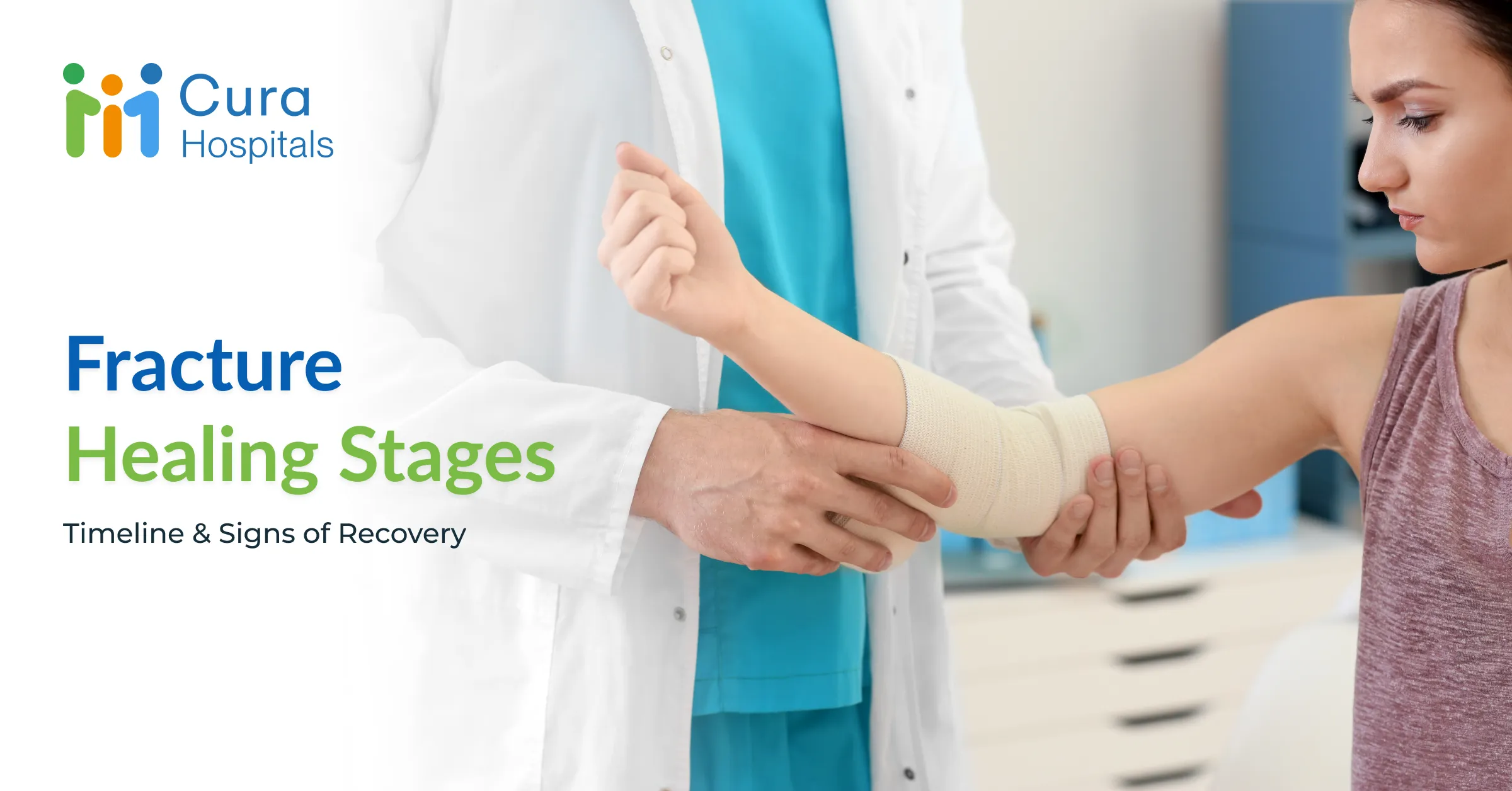


Bone heals in overlapping stages which are inflammation, soft callus, hard callus and remodelling. These are the fracture healing stages doctors describe, and they blend into one another.
Fracture healing time depends on the bone, the type of break, your age, your health and how well the bone is protected. There is no single number.
Signs of healing include less pain, less swelling and better movement. X-rays show new bone, called callus, forming around the break.
About one in ten fractures does not heal normally (Einhorn and Gerstenfeld, 2015). Pain that is not improving, or a limb that still moves at the break, should be reviewed.
Physiotherapy after a fracture helps restore movement, strength and balance. It should start when your doctor says it is safe.
Not smoking, good nutrition and following weight-bearing advice all support healing. Returning to sport too early can set recovery back.
Waiting for a broken bone to heal can feel slow. Most people want to know how long it will take and how they can tell it is going well. The answer depends on the bone, the fracture treatment and the person, but the body follows a recognisable pattern.
This guide explains the stages of fracture healing, what affects healing time, how doctors judge progress, what delayed healing looks like and how physiotherapy fits in.
Questions about follow-up or recovery?
The Stages of Fracture Healing
Bone is living tissue. When it breaks, it repairs itself in stages that overlap. Researchers describe four main bone healing stages (Marsell and Einhorn, 2011; Einhorn and Gerstenfeld, 2015). The timings below are general ranges.
| Stage | What happens | Roughly when | What you may notice |
| 1. Inflammation | Bleeding forms a clot at the break, and the body sends in repair cells | The first few days, up to about a week | Pain, swelling, bruising and warmth |
| 2. Soft callus | Soft, cartilage-like tissue begins to bridge the gap | From about the end of the first week to about week 3 | Pain and swelling settle, but the break is still weak |
| 3. Hard callus | The soft callus turns into bone, and the break becomes stronger | From about week 3 to week 12, sometimes longer | Less pain, the bone starts to carry more load, and the X-ray shows callus |
| 4. Remodelling | Bone reshapes and strengthens until it resembles the original | From about 3 months, for months to a couple of years | Little pain, and strength and function keep improving |
Pain usually falls well before the bone is fully strong. This is why a break can feel better while it is still healing, and why you should follow your doctor’s advice on weight bearing and activity until the examination and X-ray show the bone is ready.
Fracture Healing Time
Several things shape fracture healing time.
| Factor | How it affects fracture healing |
| The bone | Small bones in the fingers and toes usually heal sooner than large weight-bearing bones such as the thigh bone or shin bone. |
| The type of break | A simple, stable break heals more readily than a bone broken into many pieces, an open fracture or one with a lot of soft tissue damage. |
| Age | Children heal faster than adults, and healing is often slower in older adults. |
| Blood supply | Some areas, such as the scaphoid bone in the wrist, have a limited blood supply and can take longer. |
| Health and habits | Smoking, diabetes, poor nutrition and low vitamin D can slow healing. Some medicines can too, so tell your doctor what you take. |
| Stability | A bone that is held steady heals better than one that keeps moving at the break. |
| Infection | An infected fracture or wound can delay healing. |
Because of this, your doctor’s estimate for your own fracture is more reliable than any chart. For example, a child’s buckle fracture of the wrist may need protection for about 3 to 4 weeks (Pakarinen et al., 2024), while a break in a large weight-bearing bone can take months to become strong. The type of fracture as well as the treatment also matter.
Signs That Your Fracture Is Healing
- Pain is easing, and the spot over the break is less tender.
- Swelling is going down.
- You can move the nearby joints more freely.
- You can use the limb for light tasks as your doctor advises.
- The X-ray shows callus forming and later bone bridging the break.
- The doctor finds the bone steady when examining it.
Doctors judge healing by putting together how you feel, what they find on examination and what the X-rays show. Callus often becomes visible some weeks after the injury, while a firm bridge across the break can take a few months to show clearly. Being free of pain is a good sign, but it does not always mean the bone is fully healed.
When Is Fracture Recovery Delayed?
About one in ten fractures does not heal normally (Einhorn and Gerstenfeld, 2015). Doctors use the term delayed union when healing is slower than expected, and nonunion when healing has stopped making progress. Definitions vary, and no single time limit suits every bone.
Talk to your doctor if you notice any of the following.
- Pain at the fracture site that is not improving, or is getting worse over time
- Trouble putting weight on the limb after the time your doctor expected
- Swelling that does not settle
- Movement, clicking or a feeling of looseness at the break
- A limb that looks more bent than before
- Redness, warmth, fever or discharge near a wound or surgical scar, which can be signs of infection
Common reasons for slow healing include movement at the fracture site, poor blood supply, infection, smoking, diabetes, poor nutrition and severe damage to the surrounding tissue. The doctor may order more X-rays or a CT scan, treat the cause, add protection, or recommend surgery in some cases where swelling or wound is not healing.
Physiotherapy After Fracture
After weeks in a cast or sling, joints become stiff and muscles weaker. Physiotherapy after a fracture helps you regain movement, strength, balance and the ability to walk or use the limb in daily life.
When Fracture Healing Physiptherapy Starts?
Your doctor will tell you when it is safe. Sometimes it begins while the limb is still in a cast, with movement of the joints that are free, such as the fingers, shoulder or toes. After surgery, it often starts within days.
| Doctor’s Insight “Pain settling does not always mean the bone is strong enough. We combine how the limb feels, what we find on examination and what the X-ray shows before we allow more weight or activity.” DR. ABRAR MOHAMMED M.B.B.S, M.S, Orthopaedics Registered Medical Practitioner | KMC Registration No: 116389 |
What Physiotherapy for Fracture Healing Includes
- Gentle range of motion exercises
- Strengthening exercises
- Balance and walking practice
- Ways to control swelling
- Scar care after surgery
- Guidance on weight bearing and on returning to activity
Research on wrist fractures suggests that a clear, structured home exercise programme taught by a therapist can work well, although the quality of the evidence is limited (Handoll and Elliott, 2015). Whatever plan you are given, doing the exercises regularly matters more than doing them hard. A little discomfort is expected. Sharp or worsening pain is a sign to pause and ask your doctor or therapist.
Supporting Healing at Home
- Follow the advice on weight bearing and keep every follow-up appointment.
- Do not smoke, since smoking is linked with slower bone healing.
- Eat a balanced diet with enough protein, calcium and vitamin D, and ask your doctor before starting supplements.
- Look after your cast, splint or wound as you were taught.
- Move the joints you are allowed to move, and raise the limb to control swelling.
- Get enough sleep and keep other conditions, such as diabetes, under control.
Returning to Normal Activities
Go back to work, driving and sport in steps, and only when your doctor agrees. A bone that looks healed on an X-ray may still need weeks of strengthening before it can handle sport or heavy work. Returning too early risks a new injury and a setback. For children, ask the doctor when the child can return to play and school sports.
Fracture Follow-Up at Cura Hospitals
The orthopaedics department at Cura Hospitals provides surgical and non-surgical fracture management, and X-ray and imaging services are available for follow-up. The hospitals are in Kammanahalli and on Kanakapura Road, Bengaluru.
For appointments or general enquiries, reach out to the hospital.
Contact details
Cura Hospitals, Kammanahalli: #1, Bethel St, HRBR Layout 2nd Block, Kalyan Nagar, Kammanahalli, Bengaluru, Karnataka 560043
Cura Hospitals, Kanakapura Road: No.18, Kanakapura Rd, Venkatareddy Layout, Doddakallasandra, Uttarahalli Hobli, Bengaluru, Karnataka 560062
Phone: +91 87480 30303 | Email: info@curahospitals.com | 24/7 emergency: +91 84312 41403
This article is for general health education and is not a substitute for personal medical advice. Please speak to your treating doctor about your own recovery plan.
References
Einhorn, T.A. and Gerstenfeld, L.C. (2015) ‘Fracture healing: mechanisms and interventions’, Nature Reviews Rheumatology, 11(1), pp. 45-54.
Handoll, H.H.G. and Elliott, J. (2015) ‘Rehabilitation for distal radial fractures in adults’, Cochrane Database of Systematic Reviews, Issue 9, CD003324. doi:10.1002/14651858.CD003324.pub3.
Marsell, R. and Einhorn, T.A. (2011) ‘The biology of fracture healing’, Injury, 42(6), pp. 551-555. doi:10.1016/j.injury.2011.03.031.
Pakarinen, O., Saarinen, A.J., Ponkilainen, V.T., Uimonen, M., Helenius, I. and Kuitunen, I. (2024) ‘Soft bandage, splint or cast as the treatment of distal forearm torus fracture in children: a systematic review and meta-analysis’, Scientific Reports, 14(1), pp. 1-12. doi:10.1038/s41598-024-71970-7.
Media Center Health Concerns?
Our specialists at Cura Hospitals are here to help with screening, diagnosis, risk assessment, and personalized treatment plans tailored to your health needs.
Schedule A ConsultationFrequently Asked Questions
There are four main stages include inflammation, soft callus, hard callus and remodelling. They overlap, and the whole process can take from a few weeks for small bones to many months, with remodelling continuing for longer.
First, a blood clot forms and the body clears the damage. Next, soft tissue bridges the gap. Then that tissue turns into bone, and finally the bone reshapes itself and becomes stronger.
It depends on the bone, the type of break, your age and your health. A child’s buckle fracture of the wrist may be protected for about 3 to 4 weeks. Large weight-bearing bones can take months. Your doctor can give an estimate for your own fracture.
Less pain, less swelling and better movement are good signs, and follow-up X-rays show callus and then bridging bone. Your doctor judges healing by combining symptoms, examination and imaging.
Common reasons include movement at the break, poor blood supply, infection, smoking, diabetes and poor nutrition. If your pain is not improving, see your doctor, who may order more imaging and look for the cause.
Your doctor will advise. Sometimes gentle movement of free joints starts while the limb is still in a cast, and after surgery it often begins within days. Do not start strengthening exercises on your own before you have been told it is safe.
Only when your doctor says so. Some fractures allow early weight bearing, while others need weeks of protection. Putting weight on the limb too soon can move the bone and slow healing.