Aspiration Pneumonia Symptoms: Early Signs to Watch For


Key Takeaways
Aspiration pneumonia is a lung infection that occurs when foreign objects such as food, fluids, saliva or vomit are breathed into the lungs.
Common early symptoms include coughing, a low grade temperature, tiredness. In older adults confusion may be the first symptom.
Sometimes there may be no noticeable symptoms such as choking or coughing.
Those most at risk are older adults, stroke sufferers, those with dementia and those who have difficulties swallowing.
If someone is struggling to breathe, has blue lips or has a sudden change in confusion they need to go to hospital.
Common early symptoms of aspiration pneumonia include coughing, a low-grade temperature, tiredness, and breathlessness. In older adults, the initial symptoms can be very subtle. Sometimes the only symptom is confusion and a reduced appetite. This can occur days or even weeks after aspirating.
What is Aspiration Pneumonia?
Aspiration pneumonia is a type of lung infection that occurs when foreign objects such as food, fluid, saliva or gastric contents are breathed into the lungs. These objects carry bacteria which will then grow.
The human body has natural defences. A cough reflex and a small flap that covers the trachea every time we swallow will usually stop anything other than air getting into your lungs (NCBI StatPearls). However, if these defenses aren’t working as well as they should small amounts of foreign objects get into the lungs.
This often doesn’t cause any issues and is referred to as silent aspiration. As the infection can take days or even weeks to develop it can be difficult to link to eating. It is also different to aspiration pneumonitis which causes irritation within the lungs but isn’t an infection.
For appointments or general enquiries, reach out to the hospital.
What are the Early Symptoms of Aspiration Pneumonia?
The most common early symptoms are coughing, temperature, tiredness and breathlessness. Often these symptoms are associated with eating and drinking. In adults symptoms are usually more subtle. They may appear confused, sleepy or lose interest in food. They may not even have a temperature.( Acc to
Other early aspiration pneumonia symptoms include-
- Coughing or clearing the throat during or after meals
- A wet or gurgly voice after drinking
- Phlegm that is yellow, green or bad smelling
- Chest discomfort when breathing deeply
- Low energy or loss of appetite
Symptom checklist for Indian families
Use this at home if you are caring for a parent or relative. The signs are grouped by how quickly to act.
Tell your doctor within a few days
Coughing during or after meals they cough or clear their throat almost every time they eat or drink chai or water. A wet or gurgly voice- it sounds watery after drinking.
See a doctor within 24 hours
Low fever or unusual tiredness, starting to feel more sleepy and eating less. A cough with coloured phlegm (yellow, green or bad smelling).
Go to the hospital now
Visit hospital immediately if you see a person having difficulty in breathing, along with breathlessness while talking or even at rest along with high fever and chest pain while normal breathing. Also if the lips and tongue are turning blue in colour.
What Causes Aspiration Pneumonia in Adults?
Aspiration pneumonia occurs when the body’s swallowing and cough defences fail allowing bacteria carrying material to reach the lungs. Some people are at higher risk. The most common risk factors are –
- Swallowing difficulties (dysphagia), often after a stroke or with dementia or Parkinson’s disease
- Reduced alertness from sedatives, alcohol, anaesthesia or serious illness
- Acid reflux or repeated vomiting
- Poor oral hygiene, which increases bacteria in saliva
- Feeding tubes
- Head and neck cancer and its treatment
A recent flu or chest infection can add to the risk. Here’s why. When you are weak and drowsy, your cough loses its strength, and anything that goes down the wrong way is more likely to stay there.( Acc to Stat Pearls)
How is Aspiration Pneumonia Diagnosed?
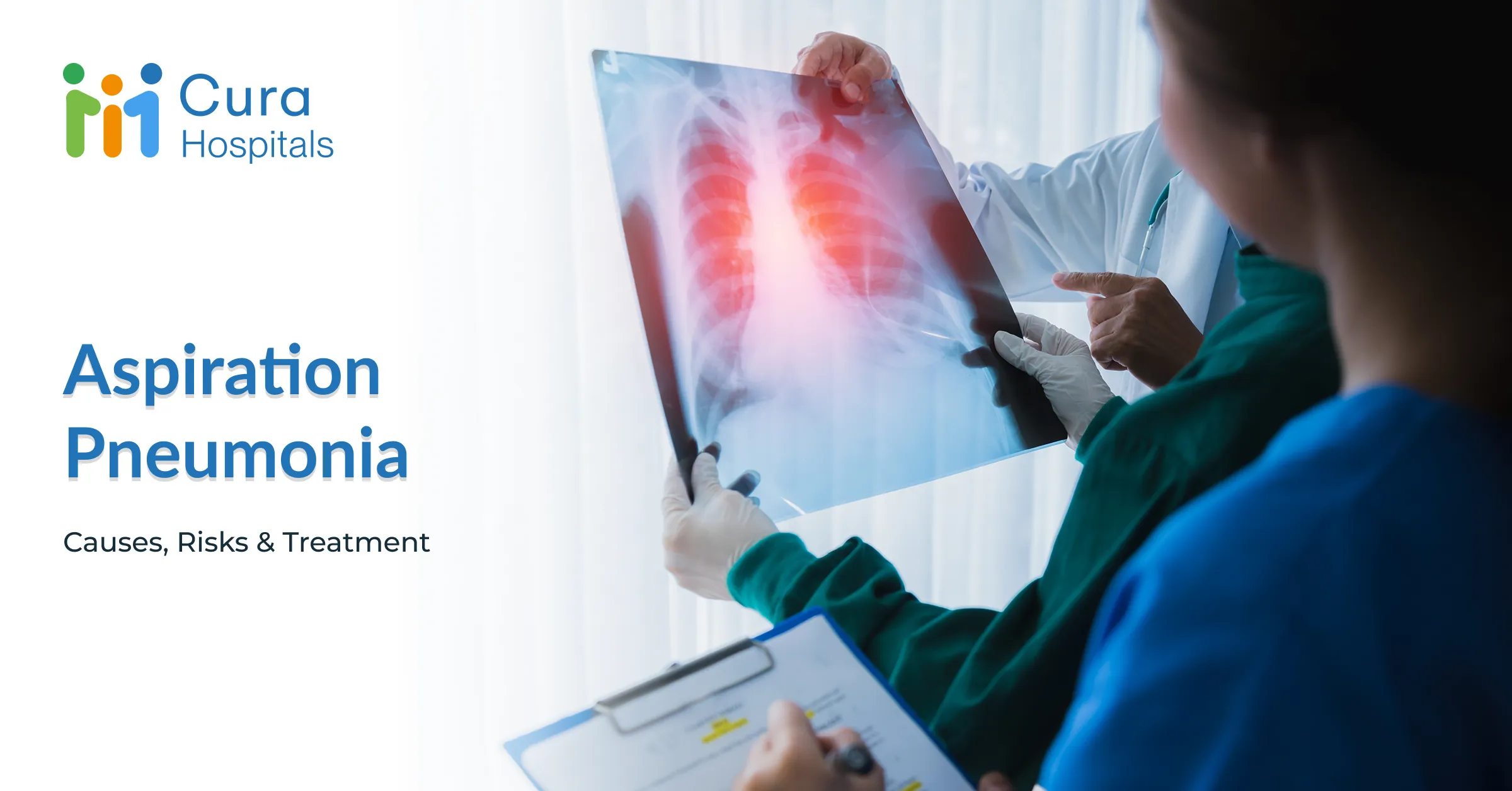
Doctors diagnose aspiration pneumonia by combining your symptoms and history with a chest X-ray. Expect questions. They will want to know about swallowing problems, recent choking, vomiting or illness, and they will listen to your lungs for crackling sounds.
Tests may include a chest X ray and sometimes a CT scan. Sometimes blood tests are taken to check the infection. Pulse oximeter is used to check oxygen level along with phlegm test to identify the causing bacteria.
How is Aspiration Pneumonia Treated?
Aspiration pneumonia is treated with antibiotics prescribed by a doctor along with breathing support if needed. Many people need hospital care at first. This is especially true for older adults, who often need closer monitoring in the early days.
Treatment may include-
- Antibiotics, chosen by the doctor based on the likely bacteria and where the infection was picked up
- Oxygen, if blood oxygen levels are low
- A breathing machine (ventilator) in the ICU for severe cases
- Treating the cause, such as swallowing therapy after a stroke
Please don’t use leftover antibiotics or buy them from a chemist without a prescription. It’s tempting. But the wrong medicine, or stopping the course too early, can let the infection worsen and make the bacteria harder to treat next time.
Aspiration Pneumonia Life Threatening in Elderly Patients?
It can be. Aspiration pneumonia mainly affects older adults , and age raises the stakes. According to NCBI after an aspiration event, people over 80 develop pneumonia about twice as often as those under 80, roughly 10% compared with 5%.(Acc to Manabe T Teramoto)
Adults also live with diabetes, heart disease or a past stroke, and their symptoms are easier to miss. Timing matters. The outlook depends on age and overall health but also on how quickly treatment starts.
Prevention of Aspiration Pneumonia Reoccuring
The most effective step is to treat the underlying cause which is usually a swallowing problem and then make every mealtime a little safer. Small habits help which include sitting upright while eating and drinking water. Taking small bites and sips and eating slowly also helps. Avoid eating while lying drown and brush your teeth and dentures every day before sleeping. If anyone is having difficulty in swallowing follow the swallowing therapist’s advice on food textures or thickened liquids.
What Our Doctors at Cura Hospitals See
| Doctor’s Insight “After a recent flu, a weak cough and reduced alertness can make it easier to inhale food or saliva, which is how aspirrts.ation pneumonia often starts.” Dr Praveen Biradar MBBS, MD Pulmonary Medicine 18 years of clinical experience, KMC (Reg. No. 79951, 2008) |
We also hear a few beliefs that can delay care
- Khana galat jagah chala gaya – A cough while eating can mean food is reaching the airway. If it happens often, get it checked.
- No high fever means no pneumonia – Older adults may show confusion, weakness or loss of appetite instead.
- Thanda khana or the weather caused it – Aspiration pneumonia comes from inhaling food, liquid or saliva, not from cold food itself.
- Only very old people get it – Anyone with swallowing problems, heavy drinking, sedation or repeated vomiting is at risk.
- No cough while eating means it’s safe – Aspiration can be silent.
- A feeding tube removes the risk – Saliva and stomach contents can still enter the lungs.
- Leftover antibiotics will do- Only a doctor can choose the right antibiotic and the right duration of the course.
When to See a Doctor
Go to the nearest emergency department, or call an ambulance (108 or 112) if you or a family member has:
- Difficult or noisy breathing
- Blue or grey lips, face or fingertips
- Sudden confusion, heavy drowsiness or difficulty waking
- High fever with shaking chills
- Chest pain when breathing in
- Coughing up blood
Don’t ignore the milder signs either. Book a doctor’s visit within 24 hours for a cough after meals with fever, coloured phlegm or unusual tiredness, especially in someone over 65 or with a history of stroke.
Don’t wait for it to pass automatically.
In such situations it is important to act quickly. If you or someone close to you has any of the signs mentioned above you should make sure to act early. That is what makes the real difference.
Contact details
Cura Hospitals, Kammanahalli: #1, Bethel St, HRBR Layout 2nd Block, Kalyan Nagar, Kammanahalli, Bengaluru, Karnataka 560043
Cura Hospitals, Kanakapura Road: No.18, Kanakapura Rd, Venkatareddy Layout, Doddakallasandra, Uttarahalli Hobli, Bengaluru, Karnataka 560062
Phone: +91 87480 30303 | Email: info@curahospitals.com | 24/7 emergency: +91 84312 41403
This article is for general health education and is not a substitute for personal medical advice. Please speak to a doctor about your own injury.
For appointments or general enquiries, reach out to the hospital.
References
StatPearls Publishing. Aspiration Pneumonia. StatPearls [Internet]. NCBI Bookshelf.
Manabe T, Teramoto S, Tamiya N, Okochi J, Hizawa N. Risk factors for aspiration pneumonia in older adults. PLoS One. 2015;10(10):e0140060.
Marik PE. Aspiration pneumonitis and aspiration pneumonia. N Engl J Med. 2001;344(9):665-671.
Aspiration pneumonia in older adults. Journal of Hospital Medicine. 2019;14(7):429-435. doi:10.12788/jhm.3154
Media Center Health Concerns?
Our specialists at Cura Hospitals are here to help with screening, diagnosis, risk assessment, and personalized treatment plans tailored to your health needs.
Schedule A ConsultationFrequently Asked Questions
Many people start to feel better within a few days of starting antibiotics. Full recovery takes longer, often several weeks, and older adults or people with other illnesses usually need more time still.
Sometimes. Mild cases in otherwise healthy adults can be managed at home, but only after a doctor has examined the person and prescribed treatment; older adults, and anyone with breathing difficulty or confusion, usually need hospital care.
You can’t confirm it at home. If a cough, fever or breathlessness follows a choking episode, or appears in someone with known swallowing problems, see a doctor, who will diagnose it with an examination and a chest X-ray.
Yes. Many people recover fully with timely treatment, although recovery is slower, and the infection can return, if the underlying cause, such as a swallowing problem, is left unaddressed.
It depends on age, overall health, how severe the infection is and how quickly treatment starts. Early treatment helps. The risk is higher in older adults and in people with conditions like stroke or dementia.