
Dengue Fever: Symptoms, Treatment, and Prevention – A Complete Guide
 Cura Hospitals

Dengue fever is one of the most underestimated illnesses in the world, and that is exactly what makes it dangerous.
Around 400 million infections happen globally every year. Most people recover. But the ones who deteriorate fast are almost always those who did not recognise the warning signs early enough or who stopped monitoring too soon.
A high fever, severe headaches, unbearable body pain, nausea, vomiting, this guide will help you understand which category you are in and what to watch for.
What Is Dengue Fever?
Dengue is a viral infection that spreads through mosquito bites, specifically from the Aedes aegypti mosquito, which bites during the day and not at night.
It breeds in small amounts of standing water. Thus, it can be a flowerpot, a bucket left outside, or even a bottle cap with rainwater in it. You don’t need to be near a swamp; your own home can be enough.
There are four strains of the virus. Getting infected with one doesn’t protect you from the others. And a second dengue infection is often worse than the first, where your immune system’s memory of the first strain can actually make the new one hit harder.
What Are The Symptoms Of Dengue Fever?
Dengue fever hits fast. There is no gradual build-up, where one day you are fine, and the next you are at 102-104°F, with a throbbing headache that feels like pressure building behind your eyes.
That retro-orbital pain, behind the eyeballs, is one of dengue’s more distinctive features.
Most fevers don’t cause it. Combined with severe muscle and joint pain intense enough to earn dengue the old nickname “breakbone fever”, it feels different from a standard flu.
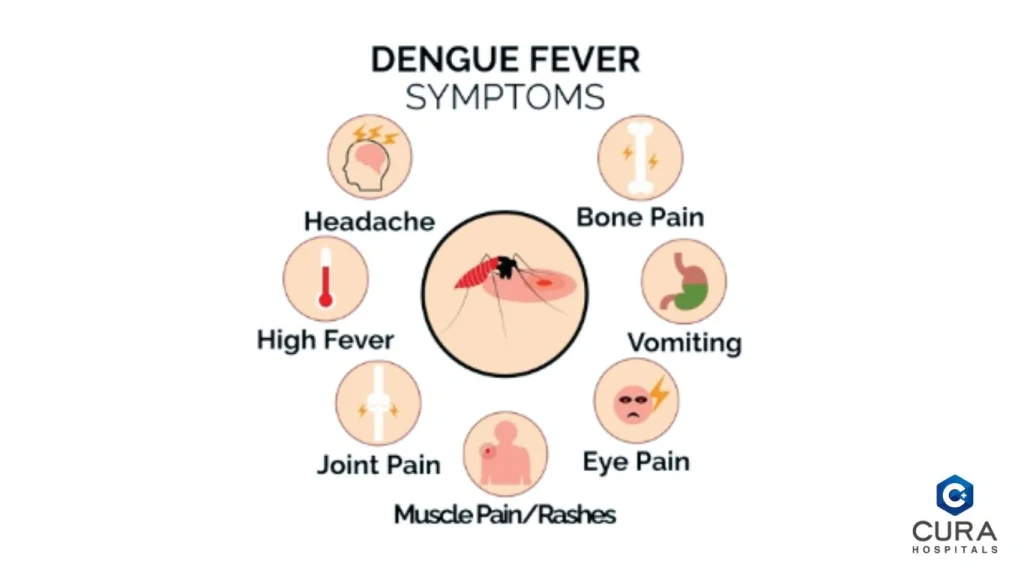
Early dengue fever symptoms include:
- Sudden high fever
- Severe headache with pain behind the eyes
- Deep muscle and joint aches
- Nausea and vomiting
- Flushing of the face and neck in the first 24-48 hours
- Loss of appetite
What dengue typically doesn’t cause is a runny nose, significant cough, or sore throat. The absence of respiratory symptoms is one of the clearest ways to distinguish it from influenza early on.
Recognising dengue early can save your life
Dengue can turn severe within 24-48 hours, Don’t wait it out
If you or someone at home has had these symptoms for more than 3 days, it’s time to get a proper diagnosis, not a guess.
Book a Dengue Consultation at Cura Hospitals
Dengue Fever Symptoms in Adults vs Children
Dengue fever symptoms in adults are generally more pronounced, where the joint pain hits harder, the fatigue is more severe, and the clinical picture is clearer. Children often present with milder, less specific symptoms that are easier to dismiss. In children, err on the side of early medical review rather than waiting for symptoms to worsen.
| Phase | Days | Key Symptoms | Action |
| Febrile | 1-3 | High fever, headache, joint pain | Rest, fluids, paracetamol |
| Critical | 4-6 | Fever drops – complication risk peaks | Monitor for warning signs |
| Recovery | 7-10 | Improving energy, possible second rash | Continue fluids, ease back gradually |
They are at higher risk of fluid-related complications if the illness progresses. The symptoms are just quieter, which makes them easier to miss.
What Is the Treatment for Dengue Fever?
There is no specific antiviral for dengue. Current dengue fever treatment guidelines from the WHO are built entirely on supportive care managing symptoms, maintaining hydration, and watching closely for the signs that tell you the illness is escalating.
Managing Dengue at Home
For most patients, dengue can be managed at home with the right care and careful monitoring.
Staying Hydrated: This is non-negotiable. Fever causes rapid fluid loss. Drink water, oral rehydration salts (ORS), coconut water, or clear soups consistently throughout the day. Avoid tea, coffee, and caffeinated drinks, they work against you by promoting further fluid loss.
Use Paracetamol for Fever and Pain: No more than 4 grams per day in adults, and always weight-adjusted for children. Do not take ibuprofen, aspirin, or any NSAID. These medications impair platelet function and increase bleeding risk and in a disease that already compromises platelets and vascular integrity, that combination can turn a manageable case into a medical emergency.
Rest Without Compromise: Physical activity during the febrile phase puts additional strain on a body that is already under significant stress. Rest is not optional — it is part of the treatment.
Monitor daily: Especially between days 4 and 6. This is the window when the fever may drop but the real danger begins. Do not mistake a falling temperature for recovery. Watch for warning signs and act on them immediately.
When Dengue Requires Hospital Care
Home management has limits. Hospitalisation becomes necessary when warning signs appear, when a patient cannot maintain adequate hydration orally, or when blood tests reveal a significant drop in platelets or a rising haematocrit both indicators that the illness is progressing beyond what can be safely managed at home.
Once admitted, treatment is closely monitored and adjusted in real time:
- IV fluid therapy administered carefully based on clinical parameters, because both under-hydration and over-hydration carry serious risks in dengue
- Regular blood count monitoring platelet levels and haematocrit are tracked to detect deterioration early
- Platelet transfusion reserved for active severe bleeding only, not administered routinely for low counts alone
- Intensive management required if the illness progresses to dengue haemorrhagic fever or dengue shock syndrome
How Do You Prevent Dengue Fever?
Dengue fever prevention is less about big interventions and more about small habits done consistently.
Eliminate Breeding Sites
These mosquitoesbreed in clean, stagnant water, not in drains or ponds. Common culprits inside homes include flower pot trays, overhead tanks, air cooler water trays, and any uncovered container left outdoors.
Empty and scrub any container that holds water at least once a week.
Tipping the water out isn’t always enough; mosquito eggs cling to the sides of containers and can survive drying. Scrubbing removes them.
Personal Protection
- Use mosquito repellents on exposed skin during the day
- Wear long sleeves and trousers during early morning and late afternoon, as these are peak biting hours.
- Use mosquito nets when sleeping in high-risk areas
- Keep windows and doors screened during daylight hours.
Air conditioning helps too, not because it repels mosquitoes, but because thesemosquitoes are less active in cool environments.
Dengue Fever Prevention and Control at the Community Level
Individual measures have limits. Dengue fever prevention and control at scale involves vector surveillance, indoor spraying during outbreaks, community-level source reduction drives, and early warning systems that let health authorities respond before outbreaks take hold. Certain vaccinations that can be taken for prevention as well.
Dengvaxia: Recommended only for those with confirmed prior dengue infection. Risk of severe dengue in previously uninfected individuals.
Qdenga (TAK-003): Different profile, broader evaluation underway. Worth discussing with a doctor if you live in or are travelling to an endemic area.
When to See a Doctor?
Seek emergency care immediately if:
- Warning signs appear during days 4-6
- Any visible bleeding
- Sudden extreme weakness, dizziness, or difficulty breathing
Prompt evaluation required if:
- You have been in a dengue-endemic area and develop a sudden high fever with eye pain and body aches
- You are pregnant, elderly, diabetic, or have cardiovascular disease, as these groups face higher complication risk
- Symptoms worsen beyond Day 5 rather than following the expected course.
Blood tests like CBC for platelet count and haematocrit and NS1 antigen in the first five days are the key diagnostic tools. Other febrile illnesses, including malaria in some regions, can mimic dengue and require completely different treatment.
Conclusion
Dengue fever symptoms progress fast and are easy to underestimate early on. The critical phase between days 4 and 6 is when the real danger develops, and a dropping fever during that window is a reason to watch more carefully, not to relax.
No antiviral exists, so supportive care and early recognition of warning signs are everything.
Dengue fever prevention comes down to two things done consistently: eliminating standing water around your home and protecting yourself from daytime mosquito bites. Neither is complicated. Both are genuinely effective.
Concerned About Dengue Symptoms? Cura Hospitals Can Help.
From same-day diagnosis to round-the-clock monitoring, Cura Hospitals provides comprehensive dengue care at every stage of the illness. Do not wait for symptoms to worsen, early evaluation saves lives.
Book your consultation at Cura Hospitals today.
References:
- Eva Pilot, Vasileios Nittas, Gudlavelleti Venkatta S Murthy, 2020, The Organization, Implementation, and Functioning of Dengue Surveillance in India-A Systematic Scoping Review, available at, https://pubmed.ncbi.nlm.nih.gov/30813470/
- Suraj Jagtap, Chitra Pattabiraman, Arun Sankaradoss, Sudhir Krishna, Rahul Roy, 2023, Evolutionary dynamics of dengue virus in India, available at, https://pubmed.ncbi.nlm.nih.gov/37011104/
Media Center Health Concerns?
Our specialists at Cura Hospitals are here to help with screening, diagnosis, risk assessment, and personalized treatment plans tailored to your health needs.
Schedule A ConsultationFrequently Asked Questions
Sudden high fever, pain behind the eyes, and intense muscle and joint pain are the hallmark early symptoms. They appear 4-10 days after an infected mosquito bite.
Rest, consistent oral hydration with water or ORS, and paracetamol for fever. NSAIDs must be avoided. Monitor daily for warning signs, especially days 4-6.
Adults typically experience more pronounced joint pain, deeper fatigue, and clearer warning signs than children. The critical phase warning signs, like abdominal pain, vomiting, bleeding, and restlessness, are the ones that require immediate action.
Immediately if warning signs appear during days 4-6, like severe abdominal pain, persistent vomiting, bleeding, extreme fatigue with restlessness, or rapid breathing.
Related Blogs
Kidney Stone Size Guide: Can It Pass Naturally, or Does It Need RIRS, URS, or PCNL?

Leg Pain, Swelling or a Non-Healing Wound: Vascular Surgeon, Orthopaedic Doctor or Diabetologist?