Thyroid Nodule – Symptoms, Tests (Ultrasound, FNAC) and Treatment Options


Key Takeaways
A thyroid nodule is a lump that grows inside the thyroid gland in the front of your neck and most thyroid nodules are not cancer.
Most people with a thyroid nodule do not have any symptoms and it is often found by chance on a scan done for some other reason.
The first tests are usually a TSH blood test and a thyroid ultrasound, which shows the size and shape of the nodule.
FNAC is a needle test that takes a few cells from the nodule and it is done only when the ultrasound shows features that need checking.
Thyroid nodule treatment depends on the size, the FNAC result and whether the nodule is making extra hormone, and many nodules only need regular follow up.
Never start thyroid tablets to shrink a nodule on your own without your doctor’s supervision.
Go to the hospital emergency at once if you have trouble breathing or cannot swallow your saliva because of neck swelling.
A thyroid nodule is something that most people come to know about when they feel a small lump while touching their neck or when it shows up on a neck scan done for some other reason.
Studies show that thyroid nodules can be seen on ultrasound in up to 68 out of every 100 adults (Haugen et al., 2016) there are many people who are told they have a lump in their thyroid without really knowing what it means.
Usually the first fear that comes to mind is cancer. Some people start worrying as soon as they hear the word nodule while some others ignore it because it does not hurt, but most thyroid nodules are harmless and only a small number of them turn out to be cancer (Durante et al., 2018).
In this blog we explain what a thyroid nodule is, the common thyroid nodule symptoms, how it is tested with ultrasound and FNAC, the thyroid nodule treatment options and how Cura Hospitals can help you.
Found a lump in your neck or on your scan? Get it checked by our doctors.
What Is a Thyroid Nodule?
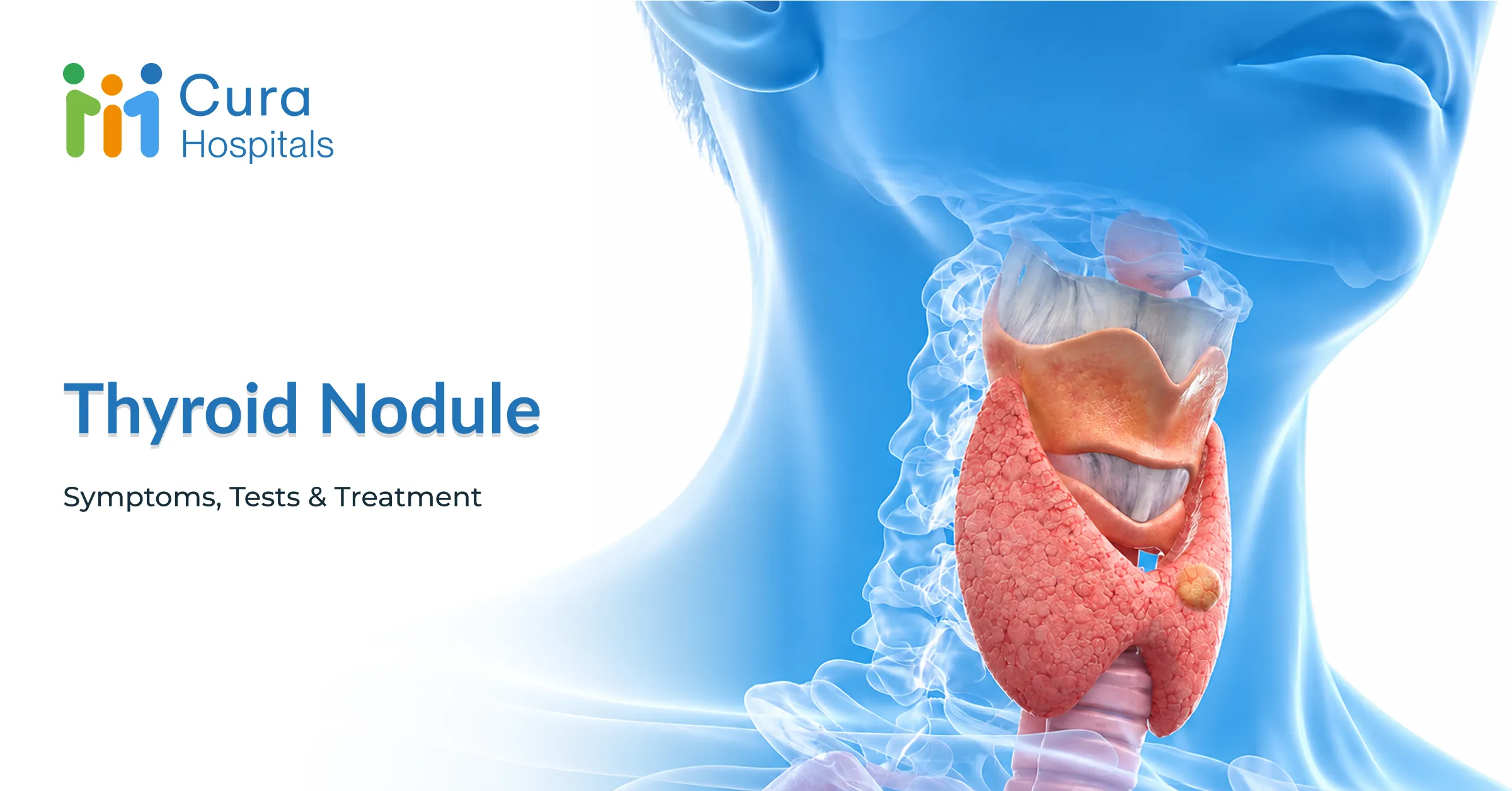
A thyroid nodule is a solid or fluid filled lump which forms inside the thyroid gland, which is the small butterfly shaped gland in the front of your neck.
To understand it in easy terms, you should firstly know that some cells in the thyroid can grow a little more than the others and form a small lump. Sometimes this lump is filled with fluid and is called a cyst, and sometimes many small lumps form together which is called a multinodular goitre.
For example a nodule of 8 mm may never be felt from outside and is often found only on a scan, while a nodule of 3 cm may be seen as a swelling when you swallow. Size alone does not tell whether a nodule is harmless or not and this is something that many people get confused about.
Thyroid Nodule Symptoms
Most thyroid nodules do not cause any symptoms. When symptoms are there, they usually depend on how big the nodule is and whether it is making extra thyroid hormone. Following is the table that explains the common thyroid nodule symptoms and what they may mean.
| Symptom | What it may mean for you |
| A lump in the front of your neck | The nodule is big enough to be seen or felt and should be checked with an ultrasound. |
| Pressure or a tight feeling in the throat | A larger nodule may be pressing on nearby structures. |
| Difficulty in swallowing | The nodule may be pushing on the food pipe. |
| Change in voice or hoarseness | This needs to be checked soon as the nodule may be affecting the nerve of the voice box. |
| Fast heartbeat, weight loss or sweating | The nodule may be making extra thyroid hormone. |
| Pain in the neck | This is not common and may happen if there is bleeding inside a cyst. |
A nodule which is growing fast, is hard and fixed, or comes with a hoarse voice or swollen glands in the neck needs to be seen by a doctor without delay.
What Causes Thyroid Nodules?
The exact reason why nodules form is not always known. They are more common in women, become more common as you grow older and are seen more often in people who have low iodine in their diet or a family history of thyroid problems.
Some nodules form because of Hashimoto’s thyroiditis, which is a long-term inflammation of the thyroid and is also a common reason for a mildly high TSH, and some are simple cysts filled with fluid. A small number of nodules turn out to be thyroid cancer, which is more likely if you had radiation to your head or neck as a child or if someone in your family has had thyroid cancer.
| Endocrinologist’s Insight “When I look at a nodule report I do not go by the size alone. A 1 cm nodule with irregular edges or tiny calcium spots worries me more than a bigger smooth one filled with fluid, and that is what decides whether we do FNAC. Most of my patients end up with a benign report and only need a scan again after a year or two.” Dr. Manasa, Endocrinology, KMC Reg. No. 110274 |
How Is a Thyroid Nodule Tested?
After understanding what a thyroid nodule is, you should know how your doctor finds out whether it needs treatment. This is usually done in a step by step way.
TSH Blood Test
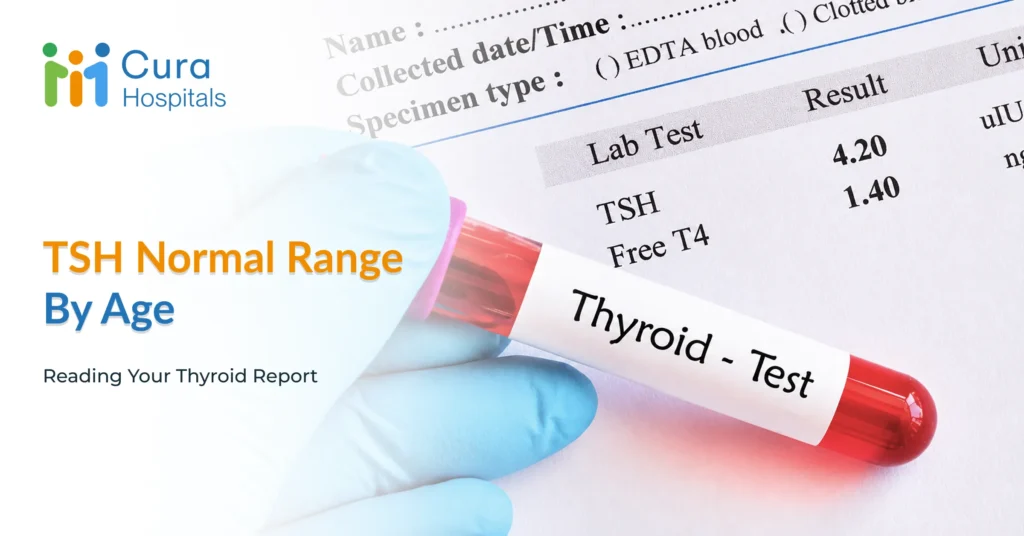
The first test is usually a TSH blood test which tells whether your thyroid is working normally. If your TSH is low, the nodule may be making extra hormone and your doctor may advise a thyroid scan, as these hot nodules are almost always not cancer (Haugen et al., 2016). Your doctor will read this result along with the TSH normal range for your age and your free T4.
Thyroid Ultrasound
After this your doctor will ask for a thyroid ultrasound, which is the same kind of painless scan that is done in pregnancy with some gel on your neck. It tells your doctor how big the nodule is, whether it is solid or has fluid, how its edges look and whether there are tiny calcium spots inside. Many reports also give it a TI-RADS score, where a higher number means the nodule needs a closer look (Tessler et al., 2017).
What Is FNAC for a Thyroid Nodule?
FNAC or fine needle aspiration cytology is a test in which a very thin needle is put into the nodule to take out a few cells which are then seen under a microscope. It is usually done while watching the ultrasound screen so the needle goes exactly into the nodule.
Most people are surprised how quick it is. You feel a small prick and some pressure for a few minutes and then you can go home and even go back to work the same day.
Not every nodule needs FNAC. If your nodule is a simple cyst filled with fluid your doctor may not do it at all. For other nodules, the need for FNAC depends on ultrasound features, nodule size and your medical history.
Understanding Your FNAC Report
Your FNAC report will have a number from I to VI which comes from the Bethesda system (Ali et al., 2023). Following is the table that explains what each number usually means for you.
| Bethesda category | What it usually means for you |
| I Non-diagnostic | Not enough cells came out so the test will be done again |
| II Benign | Good news, the nodule is not cancer and you mostly need only follow up scans |
| III Atypia of undetermined significance | The cells are not clear so your doctor may repeat the test or send it for more tests |
| IV Follicular neoplasm | Your doctor may recommend further tests or surgery to clarify the diagnosis |
| V Suspicious for malignancy | There is a high chance of cancer and surgery is usually advised |
| VI Malignant | Cancer cells are seen and your specialist will discuss the appropriate treatment plan |
Thyroid Nodule Treatment Options
The honest answer to which thyroid nodule treatment you need depends on your FNAC report, the size of the nodule, your symptoms and whether it is making extra hormone. Many people do not need any treatment at all and only need a repeat ultrasound after some time. Following is the table that explains the common treatment options.
| Treatment | When it is usually used |
| Watch and wait | For selected benign nodules causing no problems, ultrasound follow-up depends on the risk features and previous results |
| Surgery | If the nodule is cancer or suspicious, or if it is big enough to press on your throat and make swallowing difficult |
| Radioactive iodine | If the nodule is making too much thyroid hormone |
| Radiofrequency ablation | For selected, confirmed benign nodules causing pressure or cosmetic concerns, without removing the thyroid |
| Fluid drainage | For simple cysts, though the fluid may fill up again |
If surgery is needed, your surgeon may remove only one side of the thyroid which is called lobectomy or the whole thyroid which is called total thyroidectomy. After the whole thyroid is removed you will need thyroid tablets every day for life and your doctor will keep checking your TSH to get the dose right.
| Interesting Research – Why Tablets Are No Longer Used to Shrink Nodules In the past many doctors gave thyroid hormone tablets to shrink benign nodules. Current guidelines do not advise this for most people, because the benefit is small and taking extra thyroid hormone for a long time can affect your heart and bones (Haugen et al., 2016). |
When Should You See a Doctor for a Thyroid Nodule?
You should see a doctor if you feel or see a lump in the front of your neck, if a scan done for some other reason shows a nodule, or if you have symptoms like difficulty in swallowing, a feeling of pressure in your throat or a change in your voice.
See a doctor sooner if the lump is growing quickly, feels hard, is stuck in one place or comes with swollen glands in your neck, and go to the emergency at once if you have trouble breathing.
Thyroid Nodule Care at Cura Hospitals
At Cura Hospitals your thyroid nodule can be checked with blood tests, thyroid ultrasound and FNAC under one roof. Our Radiology team does the ultrasound and guided FNAC, our Pathology team reports the cells, and if surgery is needed it is done by our ENT and General Surgery surgeons.
We have hospitals in Kammanahalli and Kanakapura Road, Bengaluru.
Have a thyroid nodule that needs checking? Speak to our doctors.
References
Ali, S.Z. et al. (2023) ‘The 2023 Bethesda System for Reporting Thyroid Cytopathology’, Thyroid, 33(9), pp. 1039–1044.
Durante, C. et al. (2018) ‘The Diagnosis and Management of Thyroid Nodules: A Review’, JAMA, 319(9), pp. 914–924.
Haugen, B.R. et al. (2016) ‘2015 American Thyroid Association Management Guidelines for Adult Patients with Thyroid Nodules and Differentiated Thyroid Cancer’, Thyroid, 26(1), pp. 1–133.
Tessler, F.N. et al. (2017) ‘ACR Thyroid Imaging, Reporting and Data System (TI-RADS): White Paper of the ACR TI-RADS Committee’, Journal of the American College of Radiology, 14(5), pp. 587–595.
Media Center Health Concerns?
Our specialists at Cura Hospitals are here to help with screening, diagnosis, risk assessment, and personalized treatment plans tailored to your health needs.
Schedule A ConsultationFrequently Asked Questions
Usually no. Most thyroid nodules are not cancer and many never cause any problem, but every nodule should be checked once with an ultrasound and sometimes FNAC.
Some fluid filled nodules can shrink on their own, but most solid nodules stay the same size or grow very slowly over the years.
It is usually not very painful. Most people feel a small prick and some pressure for a few minutes and can go back to their routine the same day.
Most nodules do not change your hormone levels. Some nodules make extra hormone and cause a low TSH, which is why a TSH test is done first.
Not always. Surgery is usually needed only if the nodule is cancer or suspicious on FNAC, or if it is large and causing pressure or trouble in swallowing.
For benign nodules, the interval between scans depends on ultrasound findings and earlier results. Your doctor may check sooner if the nodule looks different or you notice any change.